Nuremberg is a 2025 historical drama written and directed by James Vanderbilt, adapted from Jack El-Hai's nonfiction book The Nazi and the Psychiatrist. Released by Sony Pictures Classics, it dramatizes the months surrounding the first Nuremberg trial, when the surviving leaders of the Third Reich were brought before an international tribunal, and centers on the unsettling relationship that formed between a captive Nazi and the American doctor assigned to gauge his sanity.
Rami Malek plays Douglas Kelley, the U.S. Army psychiatrist tasked with evaluating the imprisoned Nazi high command, while Russell Crowe delivers a commanding turn as Hermann Göring, the charismatic and manipulative Reichsmarschall who becomes both his subject and his adversary. Michael Shannon plays Supreme Court Justice Robert H. Jackson, the chief American prosecutor determined to build a lasting framework of international law, with Richard E. Grant, Leo Woodall, John Slattery, and Colin Hanks filling out the ensemble.
Premiering at the Toronto International Film Festival to one of its longest standing ovations, the film earned praise for Crowe's magnetic, chilling performance and for its sober reckoning with how ordinary-seeming men rationalized atrocity. A courtroom drama and a psychological duel in equal measure, it grossed more than $70 million worldwide. Nuremberg is streaming on Netflix.

I'm Still Here is a devastating and deeply personal film from legendary Brazilian director Walter Salles, based on the memoir by Marcelo Rubens Paiva about his own family's trauma during Brazil's military dictatorship. Set in Rio de Janeiro in 1971, the film centers on Eunice Paiva, a mother of five whose husband Rubens is disappeared by the regime, leaving her to fight for the truth while raising her children alone in a climate of fear and repression. Fernanda Torres delivers a towering performance that anchors every moment of the film's emotional journey.
Salles brings an intimacy and restraint to the material that makes the horror of authoritarian violence all the more palpable. The early sequences depicting the family's warm, chaotic life together make the rupture of Rubens' arrest feel catastrophic in the most personal terms. As Eunice navigates bureaucratic indifference and deliberate obstruction in her search for her husband, the film builds to a quiet fury that speaks to the experiences of countless families across Latin America's era of military rule.
I'm Still Here won the Best Screenplay award at the 2024 Venice Film Festival and became Brazil's submission to the Academy Awards, where Fernanda Torres earned the distinction of being the first Brazilian actress nominated for Best Actress. The film sparked a major national reckoning in Brazil about the dictatorship era, breaking box office records domestically and igniting conversations about memory, truth, and accountability that remain urgently relevant today.

All We Imagine as Light is a luminous debut from Indian director Payal Kapadia, a poetic portrait of two nurses navigating love, longing, and displacement in the teeming city of Mumbai. The film follows Prabha, whose estranged husband has left for Germany, and her younger roommate Anu, who pursues a forbidden romance in a city where such relationships carry social risk. Kapadia weaves their parallel stories with a documentary naturalism and lyrical beauty that evokes the city's vibrant chaos and quiet corners alike.
The film's visual language draws on the imagery of urban Indian life—crowded trains, fluorescent hospital corridors, street food vendors at night—to build a deeply immersive world. Kapadia shoots much of the film in a vérité style that recalls classic French cinema, allowing conversations and silences to carry equal weight. When the two women travel to the coastal village of Ratnagiri in the film's final act, the shift in landscape brings a new emotional clarity and freedom that feels hard-won and deeply earned.
Winner of the Grand Prix at Cannes 2024 and India's selection for the International Feature Film Academy Award, the film marks a significant moment in contemporary world cinema. It captures the inner lives of women who rarely take center stage in mainstream Indian filmmaking, honoring their desires, friendships, and quiet rebellions with the care and attention they deserve.
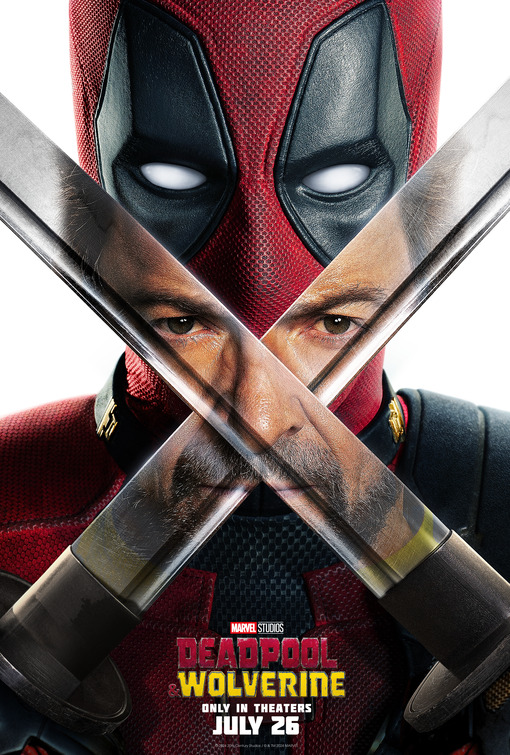
Deadpool & Wolverine brings together Marvel's most irreverent antiheroes in a film that shatters the boundaries between the MCU and Fox's X-Men universe. Ryan Reynolds returns as the wise-cracking mercenary Wade Wilson, while Hugh Jackman dons the iconic claws once more in what seemed like an impossible reunion. Directed by Shawn Levy, the film balances raucous comedy with genuine emotional weight, exploring themes of redemption and unlikely brotherhood in a multiverse-spanning adventure unlike anything Marvel has attempted before.
The plot centers on the TVA recruiting Deadpool for a reality-altering mission, thrusting him and a reluctant Wolverine into a dangerous void filled with discarded Marvel variants. Their begrudging partnership becomes a wildly entertaining spectacle, as the two must overcome their considerable differences to face a threat with consequences for all of existence. The film's R-rated freedom allows it to indulge in sharp satire and self-referential humor that playfully dismantles superhero movie conventions while still delivering the spectacular action audiences expect.
Beyond the laughs and action, Deadpool & Wolverine serves as a heartfelt tribute to the Fox Marvel era and its fans. References to beloved characters and storylines land with emotional resonance alongside the gags, making the film both a crowd-pleasing blockbuster and a genuine love letter to the genre. It became the highest-grossing R-rated film of all time, proving that superhero movies can still find new ways to surprise and delight.

Companion opens on what appears to be a perfectly ordinary romantic getaway — Iris and Josh have arrived at a lakeside retreat with two other couples, the kind of weekend that movies use as shorthand for comfortable modern life. Within minutes, something is wrong in ways the film refuses to name directly, and by the time it does name them, everything you thought you understood about the power dynamics in the opening scene has inverted completely. Drew Hancock's debut feature is the kind of thriller that requires total viewer participation from the first frame.
Sophie Thatcher plays Iris with calibrated uncertainty — she conveys something between contentment and suppressed something else that the film slowly reveals to be the most precisely accurate emotion available to her. Jack Quaid is unsettling as Josh in ways that only register gradually, and the supporting cast (Harvey Guillén, Lukas Gage, Megan Suri) each carries their own secrets that amplify the story's central revelation rather than distract from it. Hancock's screenplay is meticulous about planting information the audience will retroactively recognize as obvious once the film declares its hand.
Companion was released by Warner Bros. in January 2025 and became one of the year's most discussed genre films — a word-of-mouth phenomenon driven by audiences who insisted on telling people to see it without revealing what they were about to experience. The film earned praise for its wit, its central performance, and its willingness to use a genre premise as the vehicle for something more interesting than genre alone provides. It streams on Max, and is best experienced knowing as little as possible before pressing play.
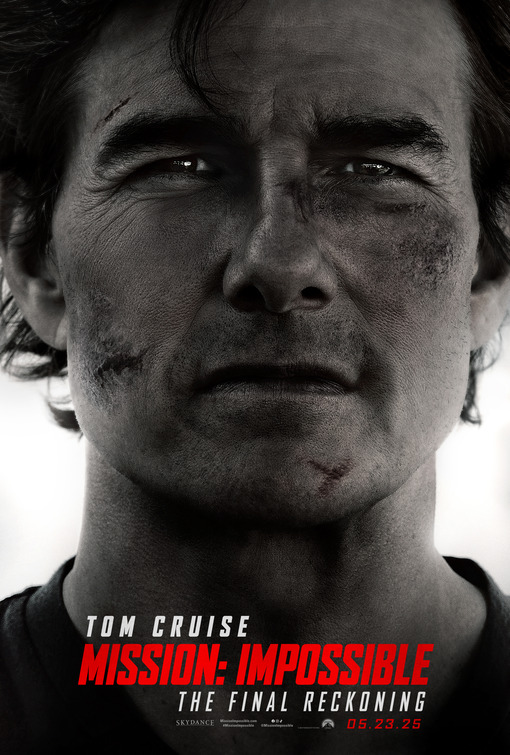
Ethan Hunt's most consequential mission arrives with the weight of franchise history behind it — a two-and-a-half-hour action operetta that functions simultaneously as a standalone thriller and as the culmination of nearly three decades of increasingly elaborate physical filmmaking. Tom Cruise returns as the IMF's indestructible operative for what director Christopher McQuarrie has described as the conclusion of a story arc spanning multiple films, pursuing an artificial intelligence called the Entity across every continent and every environment that can be made to yield spectacular action. The film opens mid-chase and rarely pauses for breath.
The cast includes returning players Ving Rhames, Simon Pegg, and Rebecca Ferguson alongside new additions who complicate Ethan's already complicated moral landscape. McQuarrie's screenplay finds genuine philosophical territory in the question of whether a man defined by his ability to solve impossible problems can solve one whose solution requires him to become something he isn't. The action sequences are extraordinary in the technical sense — Cruise performing stunts at altitudes and speeds that remain genuinely dangerous despite every precaution — but the film's surprising emotional core is what distinguishes it from the franchise's earlier installments.
Mission: Impossible – The Final Reckoning opened in May 2025 to both critical and commercial success, earning over $700 million globally and widespread acknowledgment that it achieved what franchise conclusions rarely manage — genuine resolution without sacrifice of excitement. Critics praised McQuarrie's control of a narrative whose moving parts could easily become incoherent, and the film's practical stunt work was recognized with multiple technical awards. It streams on Paramount+.

Twenty-two years after Jurassic World burned, the world's dinosaur population has contracted to isolated pockets in equatorial regions, where the animals have retreated to environments most hospitable to their biology. Zora Bennett, a mercenary played by Scarlett Johansson, is hired by a pharmaceutical company to extract genetic material from three of the largest surviving dinosaurs — DNA that may hold the key to a revolutionary medical breakthrough. The mission requires navigating territory no sane person would enter, alongside a team of specialists who are each motivated by something more complicated than money.
Director Gareth Edwards, whose previous films include Rogue One and Monsters, brings his signature patience and awe for large-scale spectacle to the Jurassic franchise with results that feel genuinely revitalized. The film treats its dinosaurs not as monsters to be defeated but as ecological wonders whose existence creates terrible pressures on everyone who encounters them. Johansson is at her most capable here — practical, funny, and occasionally frightened in ways that ground even the most outlandish sequences. The supporting cast includes Jonathan Bailey and Manuel Garcia-Rulfo as her reluctant mission partners.
Jurassic World Rebirth debuted in summer 2025 to the franchise's strongest critical reception in decades, with many reviewers noting that Edwards' restraint and his gift for building dread before releasing it made it the most effective entry since Spielberg's original. The film crossed $1 billion at the global box office and is considered a successful creative reset for a franchise that had been coasting on nostalgia. It is available for streaming on Peacock.
%2520poster.jpeg)
Babygirl is a bold, unflinching erotic thriller from Dutch director Halina Reijn that places desire, power, and professional identity in direct and provocative conflict. Nicole Kidman stars as Romy, a high-powered Manhattan CEO whose outwardly perfect life conceals a profound disconnection from her own desires. When a young intern named Samuel, played with electric control by Harris Dickinson, correctly intuits what Romy truly wants and offers it to her in the most unexpected terms, she enters an affair that puts everything she has built at risk. Antonio Banderas co-stars as Romy's husband, a theater director whose trust she is simultaneously deceiving and protecting.
Kidman gives one of the rawest, most committed performances of her career — physically and emotionally exposed in ways that make Babygirl feel genuinely transgressive rather than merely provocative. Reijn approaches the material with the moral seriousness of a European art film while maintaining the propulsive tension of a classical thriller. The film asks serious questions about how desire and agency intersect for women in positions of power, and refuses to answer them in ways that are either condemnatory or triumphant.
Babygirl premiered at the Venice Film Festival, where Kidman won the Volpi Cup for Best Actress — adding another prestigious honor to a career already defined by risk-taking. The film generated significant cultural conversation about its subject matter, with critics praising its refusal to sentimentalize its protagonist while celebrating it as a rare studio film willing to take genuine adult risks. It streams on Max.
%2520poster.jpeg)
The Room Next Door is Pedro Almodóvar's landmark first English-language feature film — a profound meditation on friendship, mortality, and the courage it takes to face death on one's own terms. Tilda Swinton plays Martha, a war correspondent diagnosed with terminal cancer who reaches out to her estranged former friend Ingrid, a celebrated novelist played by Julianne Moore, asking her to be present during the final chapter of her life. Almodóvar, working from Sigrid Nunez's novel What Are You Going Through, infuses the material with his signature visual opulence and emotional directness, creating a film that is simultaneously heartbreaking and life-affirming in equal measure.
The chemistry between Swinton and Moore is extraordinary — two actors of comparable stature finding in each other a genuine artistic equal, navigating the film's shifting emotional registers with complete trust. The film grapples with questions of euthanasia and the ethics of assisted dying, but never allows its philosophical concerns to overwhelm its essential humanity. Almodóvar directs with the patient, confident touch of an artist fully in command of his powers at the most mature stage of his career.
The Room Next Door won the Golden Bear at the Berlin International Film Festival and was selected as Spain's entry for the Academy Award for Best International Feature Film, ultimately earning Almodóvar his first Oscar in that category. Critics celebrated it as one of his greatest achievements — a film about death that vibrates with the full intensity of lived experience. It streams globally on Netflix.
%2520poster.jpeg)
Queer is Luca Guadagnino's deeply intimate adaptation of William S. Burroughs' semi-autobiographical novella, set in 1950s Mexico City among a colony of American expatriates. Daniel Craig delivers what many consider the finest performance of his career as William Lee, a lonely middle-aged expat who becomes obsessively infatuated with a younger man named Allison, played with cool magnetic ambiguity by Drew Starkey. Guadagnino transforms Burroughs' raw prose into a film of extraordinary visual beauty and psychological depth, capturing the ache of unrequited longing with the same precision he brought to Call Me by Your Name and Bones and All.
The film explores desire, addiction, and the terror of genuine connection through Guadagnino's signature blend of sensuality and melancholy. Craig disappears completely into the role, stripping away all traces of his most famous character to inhabit a man whose vulnerability feels utterly unguarded. The screenplay by Justin Kuritzkes captures the hallucinatory quality of Burroughs' writing while grounding it in the mundane loneliness of exile — bars, cheap hotels, and endless afternoons with nothing but longing to fill them.
Queer premiered at the Venice Film Festival to rapturous critical acclaim, earning Craig widespread awards consideration and cementing Guadagnino's reputation as one of cinema's most essential voices. The film represents a major artistic risk — Burroughs' source material was long considered unfilmable — and its success is a testament to both director and lead's willingness to pursue emotional truth without compromise. It streams on Amazon Prime Video as one of the most daring prestige films of the decade's first half.

Captain America: Brave New World thrusts Sam Wilson into the full weight of the shield as he navigates a world where trust is the rarest commodity. After a surprise encounter with the President of the United States leads to an international incident, Sam finds himself at the center of a conspiracy that pulls him into conflict with a surprising enemy. Anthony Mackie owns the role of Captain America with commanding presence, backed by Harrison Ford in his Marvel Cinematic Universe debut as Thaddeus 'Thunderbolt' Ross, now elevated to President. Director Julius Onah crafts a tense political thriller wrapped in superhero spectacle, exploring what it means to carry the symbol of an entire nation on your back.