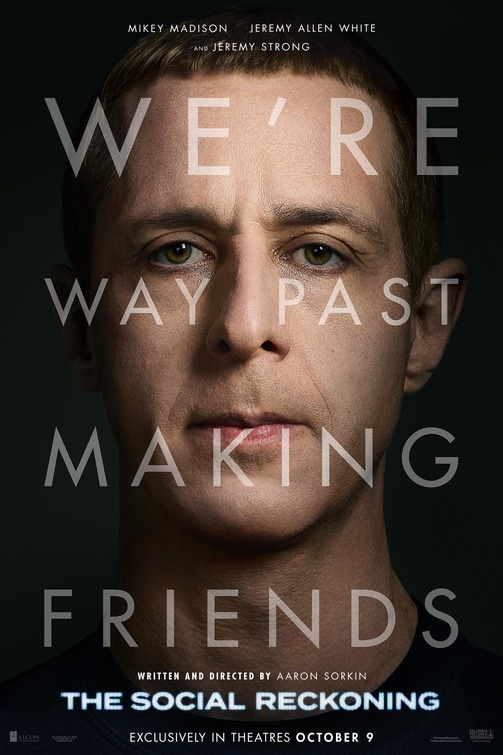
The Social Reckoning is currently exclusive to theaters in the United States. Sony Pictures opened the film on October 9, 2026, and no authorized U.S. subscription, rental or purchase stream was identified in the October 11 check.
Aaron Sorkin's original screenplay is a companion piece to The Social Network rather than a direct sequel. Inspired by true events, it follows Facebook engineer Frances Haugen, played by Mikey Madison, as she enlists Wall Street Journal reporter Jeff Horwitz, played by Jeremy Allen White, to expose the platform's most closely guarded secrets. Sorkin writes and directs, with Wunmi Mosaku, Betty Gilpin, Billy Magnussen, Bill Burr and Jeremy Strong in the ensemble.

1992 is a 2024 crime thriller directed and co-written by Ariel Vromen, set against the real-life backdrop of the Los Angeles uprising that erupted after the acquittal of the officers who beat Rodney King. The film uses that chaotic, smoke-filled flashpoint in American history as the pressure cooker for a tense, intimate story about fathers, sons, and survival amid civic collapse.
Tyrese Gibson stars as Mercer, a father struggling to rebuild his life and repair his fractured relationship with his teenage son as the city ignites around them. Their story collides with a separate crew of thieves, led by a father-and-son pair played by the late Ray Liotta and Scott Eastwood, who choose the cover of the riots to execute a heist at the factory where Mercer works. As the two families' fates intertwine inside the building, the unrest outside becomes both camouflage and catastrophe.
The film carries added weight as one of Ray Liotta's final screen performances, and it was produced with Snoop Dogg among its backers. Released theatrically by Lionsgate in August 2024, 1992 blends a grounded heist thriller with a meditation on a defining moment of American rage and grief. It is available to rent or buy through authorized digital retailers in the United States.

Last Breath is a 2025 survival thriller directed by Alex Parkinson, who adapts his own acclaimed 2019 documentary of the same name into a tense, fact-based feature. It dramatizes a real 2012 incident in the North Sea, where a team of commercial saturation divers faced catastrophe nearly a hundred meters below the surface while repairing an oil pipeline in freezing, pitch-black water.
Woody Harrelson, Simu Liu, and Finn Cole star as the three-man dive team whose routine operation turns into a race against death when their ship loses position in a storm and a young diver, Chris Lemons, is left stranded on the seabed. His umbilical line, which supplies heat, breathing gas, and communication, snaps, leaving him alone in the dark with only a few minutes of emergency oxygen while his colleagues and the crew above mount a desperate rescue against impossible odds.
Parkinson stages the ordeal with procedural precision and almost unbearable tension, emphasizing the claustrophobic reality of saturation diving and the professionalism that kept hope alive. Released theatrically in early 2025 by Focus Features, the film earned praise for its restraint and its respect for the real people involved, turning a little-known true story of survival into a gripping big-screen thriller. It is now streaming on Peacock.

Wolf Man is a 2025 horror film from writer-director Leigh Whannell, the filmmaker behind the acclaimed 2020 reinvention of The Invisible Man, once again reimagining a classic Universal Monster for modern audiences through the Blumhouse horror machine. Rather than a sprawling creature feature, Whannell narrows the legend to an intimate, almost chamber-piece scale, trapping a single family inside a nightmare of transformation.
Christopher Abbott stars as Blake, a father who inherits his estranged dad's remote farmhouse in rural Oregon and travels there with his wife Charlotte, played by Julia Garner, and their young daughter. After a violent encounter with an unseen creature on the dark road in, Blake is wounded, and over the course of a single harrowing night he begins a grotesque physical and psychological metamorphosis, forcing his terrified family to confront the question of whether the man they love is still inside the thing he is becoming.
Whannell leans into body horror and sensory dread, using sound design and shifting points of view to put the audience inside Blake's deteriorating perception as his senses warp and his humanity slips away. Released in January 2025 by Universal, the film opened the horror calendar for the year and continued Blumhouse and Whannell's project of grounding monster mythology in raw human fear. It is now streaming on Peacock.
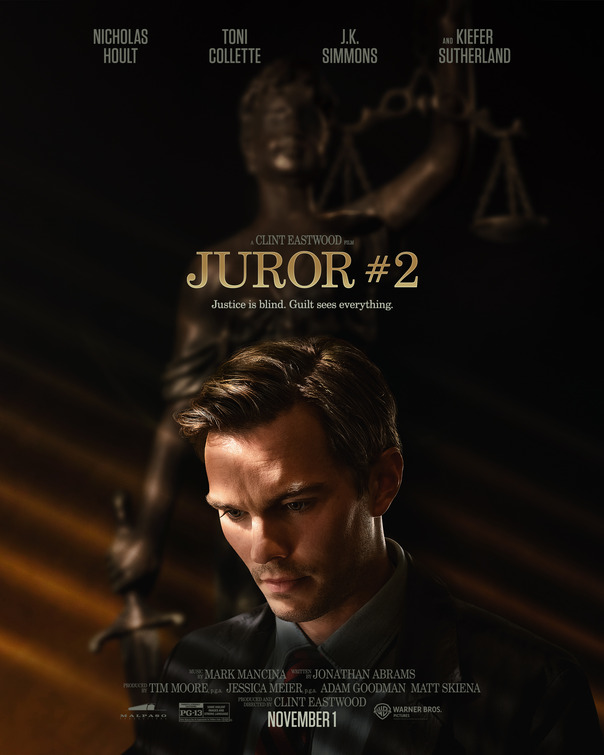
Juror #2 is a courtroom thriller directed by Clint Eastwood from Jonathan Abrams’s screenplay. Nicholas Hoult plays Justin Kemp, a family man seated on a high-profile murder jury who realizes that his own actions may be connected to the victim’s death, creating a moral dilemma that could determine whether the accused is convicted or freed.
The complete feature film is available with an HBO Max subscription in the United States as of October 11, 2026. Warner Bros. Discovery launched it as an exclusive streaming debut on December 20, 2024, following its limited theatrical release.
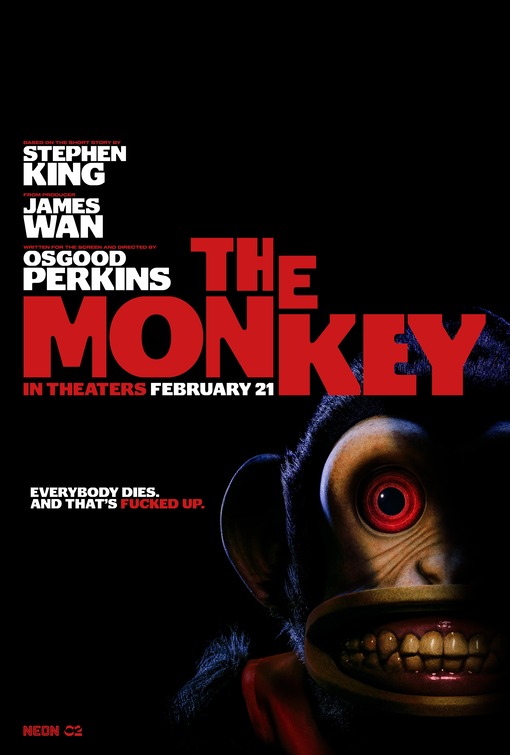
The Monkey is a 2025 horror-comedy written and directed by Osgood Perkins and adapted from a 1980 short story by Stephen King. Produced by James Wan's Atomic Monster alongside distributor NEON, the film arrived hot on the heels of Perkins's sleeper hit Longlegs and trades that film's dread-soaked restraint for gleeful, splatter-filled black comedy.
Theo James stars in a dual role as estranged adult twin brothers Hal and Bill, who as children discovered a wind-up toy monkey that triggers a gruesome, seemingly random death each time its key is turned. Decades after they tried to bury the cursed object, the killings begin again, forcing the brothers to confront the toy and each other. Tatiana Maslany, Elijah Wood and Perkins himself appear in supporting roles amid a cascade of elaborate, cartoonishly violent set pieces.
The Monkey opened in February 2025 to a strong box-office result for an original horror title, becoming one of NEON's biggest launches and quickly turning a profit against its low budget. Critics embraced its demented sense of humor and inventive kills, reading the film as a meditation on grief and the randomness of death dressed up as a crowd-pleasing gorefest. It streams on Hulu.

Karate Kid: Legends follows Li Fong, a kung fu prodigy who moves from Beijing to New York and enters a karate tournament after drawing the attention of a local champion. Jackie Chan returns as Mr. Han and Ralph Macchio as Daniel LaRusso, combining their different martial-arts traditions to train Li for the showdown.
The complete 2025 feature film is available on Netflix in the United States as of October 11, 2026. Netflix catalogs vary by country: the same official title URL may show an unavailable message to a visitor outside the U.S., which is why this answer is explicitly scoped to the U.S. market.

Bill Condon's 2025 Kiss of the Spider Woman is a movie musical starring Diego Luna, Tonatiuh and Jennifer Lopez. Set in 1983 Argentina, it follows political prisoner Valentín and his cellmate Molina, who escapes confinement by retelling a lavish Hollywood musical starring screen diva Ingrid Luna; their imagined world gradually creates an unexpected bond.
Hulu carries the complete 2025 feature film in the United States as of October 11, 2026. This page refers to the new musical adaptation released theatrically on October 10, 2025, not the separate 1985 film that also has a Hulu listing.

Regretting You is Josh Boone's adaptation of Colleen Hoover's novel, starring Allison Williams as Morgan Grant and Mckenna Grace as her teenage daughter Clara. After a fatal accident exposes a betrayal, the pair struggle through grief, family secrets and separate paths toward love while trying to rediscover each other.
Paramount+ carries the complete feature film in the United States as of October 11, 2026. The film opened in U.S. theaters on October 24, 2025, and Paramount+ officially announced its subscription-streaming debut for March 13, 2026.

The Thursday Murder Club is director Chris Columbus's star-studded adaptation of Richard Osman's record-breaking 2020 cozy-crime novel, the first in a wildly popular book series. Scripted by Katy Brand and Suzanne Heathcote and produced by Steven Spielberg's Amblin Entertainment for Netflix, the film gathers an almost absurdly distinguished cast to tell a warm, witty whodunit about four retirees who refuse to let old age slow them down.
Set in the genteel surroundings of Coopers Chase, an upscale English retirement village, the story follows a quartet of friends who meet every Thursday to pick over unsolved murders for fun. Helen Mirren plays Elizabeth, a steely former intelligence officer; Pierce Brosnan is Ron, a firebrand ex-union man; Ben Kingsley is Ibrahim, a precise retired psychiatrist; and Celia Imrie is Joyce, a sharp-eyed former nurse. When a real killing lands on their doorstep, the amateurs team up with two local police officers, played by Naomi Ackie and Daniel Mays, and race ahead of the official investigation. David Tennant and Jonathan Pryce round out the ensemble.
Released in a brief UK cinema run before arriving on Netflix in August 2025, the film drew a mostly warm response, with critics praising the sparkling chemistry of its veteran cast even when they found the mystery itself gentle and undemanding. It became one of the streamer's most-watched films of the season and quickly fuelled plans for sequels drawn from the rest of Osman's novels. Cosy, funny and affectionate, it is comfort-watch filmmaking elevated by a once-in-a-generation cast. It streams on Netflix.
In Heart Eyes, a masked killer who attacks couples every Valentine's Day turns attention toward coworkers Ally and Jay after mistaking them for romantic partners. The two become the latest targets in a story that combines slasher horror, comedy and romance.
The R-rated 2025 film runs 1 hour 37 minutes and is currently listed in Netflix's United States catalog as of October 11, 2026. Sony Pictures also maintains the film's official page and digital watch options.