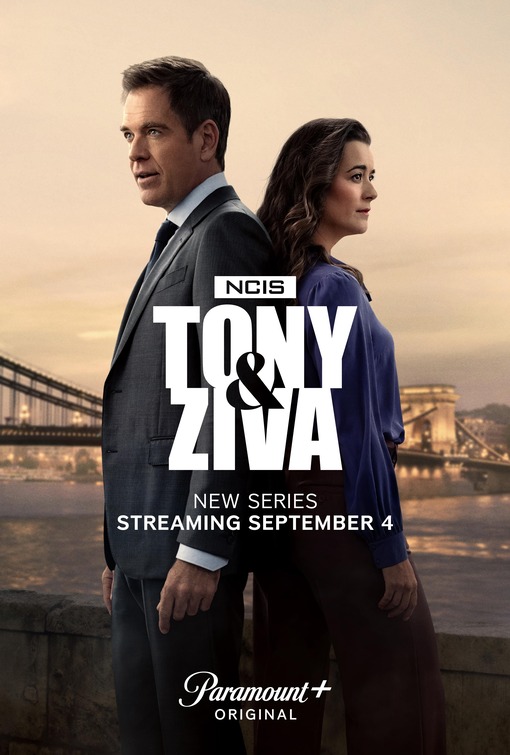
NCIS: Tony & Ziva is a Paramount+ action-drama and the latest spinoff in the long-running NCIS franchise, reuniting two of the mothership series' most beloved characters. Michael Weatherly and Cote de Pablo reprise their roles as Tony DiNozzo and Ziva David, the will-they-won't-they fan favorites whose romance was one of the original show's defining threads. Created by John McNamara, the series finally reunites the pair years after each departed the flagship show.
The story finds Tony raising the couple's daughter, Tali, while running a security company in Paris. When he comes under attack, Tony and Ziva are thrown back together and forced to go on the run across Europe, trying to uncover who is targeting them while navigating their complicated history as parents and partners. The result blends globe-trotting, espionage-tinged action with the character-driven banter that made the duo so popular.
Premiering on Paramount+ in September 2025, the series capitalized on years of fan demand for a Tony and Ziva reunion and extended the NCIS brand into serialized, internationally set storytelling. Filmed in Europe, it leans on the star chemistry of Weatherly and de Pablo to carry a fresh chapter in one of television's most durable franchises. NCIS: Tony & Ziva streams on Paramount+.

"Psych TV Show" features slick psychic crime-fighter with no psychic gifts. Unlike most basic cable networks, USA has generated many of its own hit shows on the strength of excellent characters and situations enhanced by exceptional writing. As bigger networks go into hibernation between seasons, USA wisely introduces its powerhouse programming. Among the network's original scripted dramas, "Psych TV show" has become one of the favorites. Walking the margin between crime drama and satire with tongue very deeply in cheek, "Psych TV series" stars James Roday as a fast-talking, exceptionally observant private investigator who manages to persuade the Santa Barbara police that he actually is a psychic. The backstory shows the tension between father and son, and it emphasizes how dad trained Shawn to pay attention to the most minute details, coincidences, and anomalies in everything he observes. Acute powers of observation easily pass for mystic revelations, and a healthy dose of wise-cracking charisma seals the deal. Over the objections of his disapproving police officer father, law enforcement officials reluctantly hire Shawn Spencer, psychic, to assist with solving their most challenging cases. Of course, Spenser and his reluctant sidekick Gus, brilliantly brought to life by Dule Hill, succeed where others fail.

For all the right reasons, "Community" has become one of the mainstays in NBC's comedy line-up. During its first season, "Community" focused on attorney Jeff Winger, disbarred after the accreditation committee discovered his undergraduate degree was from Colombia the country, not the university. Determined to win reinstatement in his old profession, Winger enrolls in community college, forming a Spanish-class study group which includes, among others, a cynical divorcee and a mid-life millionaire who made his money in moist towelettes. "Community" bravely exploits the ethnic and economic diversity in the study group, showing its gifts as an equal opportunity satirizer. The writers also have courage to wring big laughs from realistic representation of life and attitudes in "junior college." During the second season, "Community" had large and loyal enough following to encourage writers' development of plots centered on characters other than Winger, and they developed some of their best material by focusing on the dynamics of the group itself. Every member of "Community's" all-star ensemble cast has impeccable comedy or small-screen credentials: Chevy Chase's resume, of course, reads simply "legend." Joel McHale, Gillian Jacobs, Yvette Nicole Brown, and the rest of the cast bring a combined gazillion years of small-screen experience into the mix, and they have imprinted their distinctive styles on their roles. Similarly, all the partners in the production team boast high-powered Hollywood pedigrees and trophy cases full of Emmys. If "Community" had gone dark after the first thirteen episodes, television sets all over North America would have gone straight to test-patterns, because NBC writers and producers would have abandoned all hope for traditional sit-coms' futures.

"Burn Notice" is the drama-comedy TV show featured on USA channel. The title of "Burn Notice" TV show is derived from the term used in U.S. intelligence that indicates unreliability of a certain agent or source of information. "Burn Notice" has its own unique style: the story told by the first person mixed with the "stream of consciousness" behind the scenes on behalf of the former agent Michael Westen, played by Jeffrey Donovan. Having escaped from the mission in Nigeria, ripped by the sudden "Burn Notice", he finds himself in his hometown of Miami, Florida. Next to him, Michael discovers his ex-girlfriend. He is under constant surveillance by the feds, and his personal bank accounts frozen by the government. The only thing he could learn from his chief liaison to the government - some major "boss" wants to keep him (possibly for life) in Miami. If he tries to leave all the police forces of the country his feet will be raised to take him. Westen begins working as a private detective without a license; as a spy-to-hire for those who can pay his bills to finance his own investigation "“ who and why issued the "Burn Notice" against him.

Admittedly indebted to Jack Kerouac and the cinematic stylings of Harrison Ford in the Indiana Jones series, "Supernatural TV show" wobbled as it took its first tentative steps into the paranormal, but it has grown stronger and smarter with age and experience. Fans of "The Gilmore Girls" immediately will recognize Jared Padalecki who plays Sam, a Stanford undergrad who wants nothing more than to escape his family's ghost-busting business and go to law school. Of course, that's not gonna happen. Instead, Sam gets stuck riding shotgun on a road trip with his profligate brother Dean, played well by Jensen Ackless recently of "Smallville fame. As the boys travel from San Francisco to LA, normally a boring ten-hour trip, they encounter ghoulish and ghostly creatures brought to life from American folklore and legends. Describing steady improvement in the show's writing and acting, one critic said it went from being "a pretty good show to being a pretty great show." Just before the show launched its fifth season, Rolling Stone was more effusive in its praise as it numbered "Supernatural" among its "Fifty Best Reasons to Watch TV".

As the story begins, Chuck is a twenty-something computer geek working at the Burbank, California, "Buy More" store. Chuck receives an e-mail from Bryce Larkin, his former Stanford roommate, who is now a CIA agent, allegedly a rogue. When Chuck opens and reads the e-mail, it embeds "The Intersect" a "neural super-computer" in his brain, making "Nerd Herd" guy the repository of all the CIA's intelligence information. The CIA dispatches Agent Sarah Walker, of course a beautiful blonde, to protect Chuck by posing as his girlfriend. Drama, action, and comedy ensue. The producers describe "Chuck" as an "action-comedy-drama" series. Originally NBC's lead-in to short-lived but monumentally popular "Heroes," "Chuck" has retained the look and feel of the warm-up act for the bigger talent; but the network has failed to deliver the headline act that would save poor "Chuck" from its life constantly on the threshold of cancellation. Critics complain that "Chuck," although clever and loaded with potential, never quite satisfies the requirements of action or comedy or drama, let alone hitting the trifecta. The series has survived largely on the strength of its cute-power and a core of exceptionally loyal fans who know how to use Twitter and Facebook.

By some miracle, everybody in America knows all about "30 Rock," and everybody loves Tina Fey, the show's creator and star, but relatively few viewers tune-in every week. During its first season, "30 Rock" toted-up a record twenty-two Emmy nominations, but its ratings ranked 102nd of 142 primetime shows. NBC stayed with the project on the assumption that Fey's popularity and the intense critical buzz eventually would translate to ratings; and the gamble paid off as viewership steadily rose over the comedy's first six seasons. Based on Fey's experiences as head writer for "Saturday Night Live," the show satirizes life behind the scenes of a network comedy, trapping co-star Alec Baldwin in corporate intrigues as the writers and actors endure the trials and tribulations of producing a live weekly broadcast. Strong characters and brilliant badinage distinguish "30 Rock" from the standard sitcom fare, and the thirteen-member ensemble cast puts the plausibility in improbably characters.

Sometimes "Bravo" serves-up high-quality instruction at least as powerfully as "The Learning Channel" and "National Geographic." Case in point: "Kell on Earth" reveals the ecology of New York's fashion industry, vividly illustrating the perilous lives of smaller fish on the couture food chain, and charting the symbiosis between design houses and the fashion press. The "Kell" in "Kell on Earth" refers to hyper-manic high-powered fashion publicist Kelly Cutrone, diva-dominatrix of public relations firm "People's Revolution." Although eponymous Kell gets the most air-time, "Kell on Earth" is not automatically all about her; instead, it shows the harried lives of second-tier stylists, public relations interns, and personal trainers who dwell near the bottom of New York's tumultuous, tempest-tossed fashion fishbowl. Observant viewers will note striking similarity between People's Revolution and Lauren Conrad's workplace on "The Hills" and "The City," which brought Cutrone into the public eye. Those same insightful viewers will see, however, that real-reality show "Kell on Earth" proves Cutrone's "little people" frequently sweat, swear, and stress, really working for their paychecks.

Creators and critics refer to "Caprica TV show" as a spin-off from the classic "Battlestar Gallactica," but the allusion deceives devoted viewers of the old space drama, and it flies right over the heads of the new show's most enthusiastic viewers"”adolescent boys obsessed with all things technological. Strictly speaking, "Caprica" is a prequel to the final struggle for survival dramatized in "Battlestar Gallactica": The stories are set approximately sixty years before the Cylons began plotting to destroy humanity, and it focuses on a tech-crazy world drunk on its own runaway success. The stories dramatize dangerous, self-destructive tendencies in people so completely self-absorbed and so thoroughly addicted to their gadgets they become oblivious to the world that lives beyond their arms' reach, palpable instead of digitized. Characteristic of the best science fiction writers, "Caprica's" crew subtly allegorizes the serious ethical ramifications of post-modern advances in artificial intelligence and robotics. In the United States, the SyFy channel put "Caprica TV show" on hiatus late in 2010, holding back just a few new episodes for first broadcast sometime early in 2011. Despite the show's uncertain American future, the production team continued making new episodes for air in the United Kingdom and Canada.

One critic characterized "Breaking Bad's" dark humor as "Thelma and Louise as seen by Dostoyevsky" and that was one of the perkier, more optimistic descriptions. A seven-part AMC series, "Breaking Bad" TV show tells the story of Walt White, high school chemistry teacher turned methamphetamine cooker and dealer. Of course, as Glenn Frye crooned, "The lure of easy money has a very strong appeal," but "Breaking Bad" does not allow for even a split-second of sunshine through the abysmal darkness. In this corner of the universe, crime never-ever pays. Walt, expertly portrayed by Bryan Cranston of "Malcolm in the Middle" fame, is neck-deep in problems, complications, and flat-out ugliness from the minute he lights the Bunsen burner. Although the writers have woven-in some amazingly ironic lines, known in the trade as "comic relief," the characters deliberately deliver their quips in such a super-slow, slack-jawed drawl they seem more tragic than funny. Of course, "Breaking Bad" TV series make some pretense toward allegory of the American middle class struggling through the throes of deep recession, and it scores some hard hits. Most of all, though, "Breaking Bad" shows that even when fine writers, directors, and actors can find humor and pathos in displaced white-collar workers' undignified struggle for dignity, it still looks awfully damned dreary and ugly.

Intensely cerebral, narrated more or less in the style of a Latin American magic-realist novel which shows the conclusion before the story begins, "Damages" TV show strangely fulfills the immanent promise in cable television programming, appealing very strongly to what the poet Milton called "fit audience though few." "Damages" series'unmistakable style, sophistication, and subtle sizzle are spellbinding, and the writers have crafted heroes you love to love and villains you love to hate with a team of attorneys working both sides of the continental divide between good and evil. Unabashedly stealing its premise from the Bernie Madoff case, "Damages" asks and answers, "What if you were Madoff's antagonist?" Glenn Close plays Patty Hewes, the high-powered and equally high-priced attorney determined to bring down ponzi-schemer Louis Tobin, portrayed by Len Cariou. The word "perfect" appears in most critics' discussions of their performances. A New York Times reviewer aptly summarized, "It's impossible to overestimate how delicious Ms. Close is as this fiercely driven, mercurial and manipulative woman. " In a stroke of casting genius, the producers chose Lily Tomlin to quicken the character of Mrs. Tobin, long-suffering wife of the arch-villain; the audience remains in suspense about her true colors and motives, suspecting she may be "Damages'" answer to Lady Macbeth. Martin Short also stars as Tobin's family attorney.