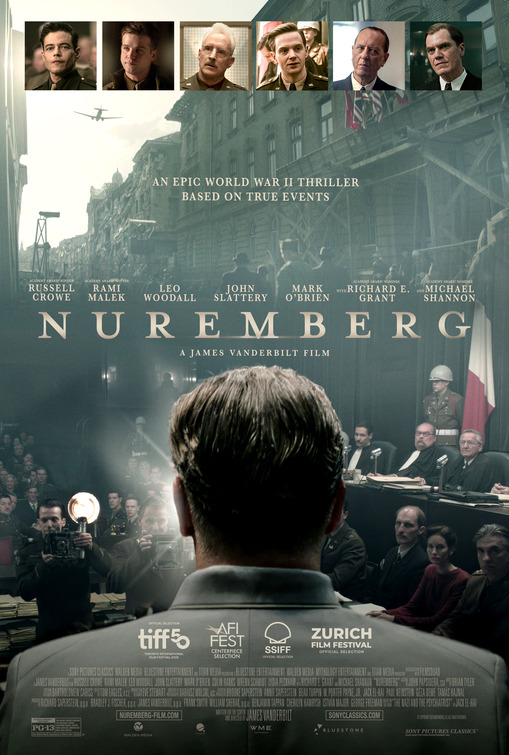
Nuremberg is a 2025 historical drama written and directed by James Vanderbilt, adapted from Jack El-Hai's nonfiction book The Nazi and the Psychiatrist. Released by Sony Pictures Classics, it dramatizes the months surrounding the first Nuremberg trial, when the surviving leaders of the Third Reich were brought before an international tribunal, and centers on the unsettling relationship that formed between a captive Nazi and the American doctor assigned to gauge his sanity.
Rami Malek plays Douglas Kelley, the U.S. Army psychiatrist tasked with evaluating the imprisoned Nazi high command, while Russell Crowe delivers a commanding turn as Hermann Göring, the charismatic and manipulative Reichsmarschall who becomes both his subject and his adversary. Michael Shannon plays Supreme Court Justice Robert H. Jackson, the chief American prosecutor determined to build a lasting framework of international law, with Richard E. Grant, Leo Woodall, John Slattery, and Colin Hanks filling out the ensemble.
Premiering at the Toronto International Film Festival to one of its longest standing ovations, the film earned praise for Crowe's magnetic, chilling performance and for its sober reckoning with how ordinary-seeming men rationalized atrocity. A courtroom drama and a psychological duel in equal measure, it grossed more than $70 million worldwide. Nuremberg is streaming on Netflix.
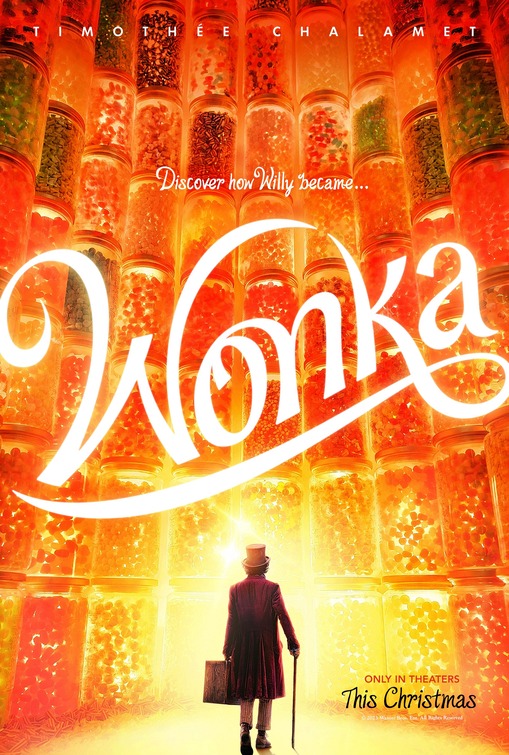
Wonka (2023) is the enchanting origin story of Willy Wonka, the eccentric chocolatier whose boundless imagination would one day reshape the confectionery world. Directed by Paul King — the visionary behind the Paddington films — the movie stars Timothée Chalamet in a career-defining performance as the young, wide-eyed dreamer who arrives in a grand city with little more than a battered hat and an irrepressible belief in magic. Bursting with colour, music, and heartfelt warmth, the film dazzles as a theatrical celebration of creativity and the power of dreams.
Set against a backdrop of cobblestone streets, towering guilds, and a corrupt chocolatier cartel determined to crush any competition, Wonka must navigate deception, poverty, and even a laundry-debt indenture before he can open his very first chocolate shop. The story weaves in memorable supporting characters — including a wide cast of quirky allies and a small Oompa Loompa played by Hugh Grant — while never losing sight of its joyful core: that a single extraordinary idea, pursued with enough stubbornness and heart, can change everything.
The film earned over $630 million worldwide at the box office and was praised for its inventive musical sequences and Chalamet's radiant charm. As both a prequel to the beloved Roald Dahl universe and a standalone adventure for new audiences, Wonka strikes the rare balance between crowd-pleasing spectacle and genuinely touching storytelling, leaving viewers with the warm conviction that a little bit of magic really does exist in the world.

From writer-director Alex Garland (Ex Machina, Annihilation), Civil War is one of the most audacious and deliberately uncomfortable films of 2024 — a near-future war thriller that refuses easy political allegiances in favor of a raw examination of what conflict does to the human spirit. The film follows Lee Smith (Kirsten Dunst), a legendary war photographer numbed by years of documenting atrocities, who joins veteran journalist Joel (Wagner Moura) and two younger colleagues on a perilous road trip across a fractured United States to reach Washington, D.C., before the Western Forces close in on a besieged president.
Garland is deliberately opaque about the political specifics: we learn only that Texas and California have formed an unlikely alliance as the Western Forces, and that the president (Nick Offerman) has abolished the FBI and ordered drone strikes on American citizens. This ambiguity is intentional — Garland is less interested in the cause of the war than in the moral and psychological cost of bearing witness to it. The film's set pieces are extraordinarily intense, including a sniper standoff that has been widely cited as one of the most harrowing scenes in recent cinema, and a final White House assault that is brutal and visually stunning in equal measure.
At its heart, Civil War is about photojournalism and the ethics of documenting violence for a distant audience. Cailee Spaeny is a revelation as Jessie, a young photographer whose gradual desensitization mirrors the film's central thesis about the cost of covering war. Kirsten Dunst — delivering arguably the finest performance of her career — is both mentor and cautionary tale, a woman who has given so much to her work that she can no longer process the world except through a camera lens. It is a challenging, provocative film that does not offer comfort, but richly rewards those willing to sit with its difficult questions.
.jpeg)
In a quiet 1990s suburb, two teenagers bond over their shared obsession with a supernatural TV show called The Pink Opaque. When the show suddenly disappears and one of them begins to suspect that the line between television and reality has collapsed entirely, both are drawn into an existential spiral that threatens to swallow their sense of identity whole.
Written and directed by Jane Schoenbrun, I Saw the TV Glow is a haunting, deeply personal horror film about suburban alienation and the terrifying feeling of living inside a life that doesn't feel like yours. Starring Justice Smith and Brigette Lundy-Paine, the film bathes its nightmare in vivid nostalgia and then slowly reveals the rot beneath.
Premiering at Sundance to immediate acclaim, the film was hailed as one of the most formally adventurous American horror films in years. Schoenbrun's direction is genuinely unsettling in the way that only deeply felt personal filmmaking can be, and the film's devastating, ambiguous ending lingered in conversations throughout 2024.
.jpeg)
In 1936 Pittsburgh, the Charles family is torn apart by the arrival of their piano, an antique heirloom carved with the faces of their enslaved ancestors. When Boy Willie arrives from Mississippi determined to sell the piano and buy land, his sister Berniece refuses to let the family's history be traded away for profit, setting off a simmering conflict that forces everyone to confront what they owe the dead.
Directed by Malcolm Washington in his feature debut, The Piano Lesson adapts August Wilson's Pulitzer Prize-winning play with a fiery ensemble led by John David Washington and Danielle Deadwyler. The film honors Wilson's dense, poetic language while opening the story up visually, finding new power in the silences and spirits that haunt the Charles household.
Arriving on Netflix with the weight of Wilson's legacy behind it, the film earned passionate reviews for Deadwyler's volcanic performance as Berniece and for the care with which it handles themes of Black ownership, memory, and the cost of moving forward. It stands as a vital piece of American drama brought to a new generation of viewers.
.jpeg)
Two young Mormon missionaries arrive at the home of a peculiar stranger, Mr. Reed, hoping to discuss their faith. What begins as a routine visit quickly descends into a harrowing battle of wills when the charming yet unsettling host reveals an encyclopedic knowledge of religion and no intention of letting them leave.
Directed by Scott Beck and Bryan Woods, Heretic is a razor-sharp psychological thriller anchored by a career-best performance from Hugh Grant as Mr. Reed. The film transforms a single drawing room into an arena of theological debate and creeping dread, as the missionaries played by Sophie Thatcher and Chloe East fight to maintain their faith and their lives against a man who seems to have anticipated their every argument.
Praised by critics as a taut, cerebral horror film with genuine wit, Heretic earned a 90% approval rating on Rotten Tomatoes and became one of the most talked-about genre films of 2024. Hugh Grant's chilling turn as a cultured intellectual who treats religion like a board game he intends to win makes this a must-watch for fans of elevated horror.

Transformers One is a 2024 animated prequel to the entire Transformers franchise, directed by Josh Cooley and set on Cybertron long before Optimus Prime and Megatron became the greatest enemies in the known universe. The film answers the question embedded in every Transformers story: how did two beings who were once best friends and allies become the opposing leaders of the Autobots and Decepticons? What it discovers is a story about ambition, ideology, systemic oppression, and the particular tragedy of two people who share a dream but find themselves on opposite sides of the methods required to achieve it.
Chris Hemsworth voices Orion Pax, the future Optimus Prime — optimistic, loyal, and idealistic, a maintenance worker in a caste society who discovers that the Cybertron he loves is built on a lie. Brian Tyree Henry voices D-16, the future Megatron — brilliant, proud, and increasingly uncompromising, whose understanding of that same lie leads him toward a different and more violent conclusion. Scarlett Johansson, Keegan-Michael Key, Jon Hamm, and Steve Buscemi round out the cast in a film that plays as both a franchise origin story and a surprisingly moving meditation on how friendships fracture under political and ideological pressure.
Transformers One arrived as the most critically acclaimed entry in the franchise in over a decade, with reviewers praising the film's emotional ambition, its gorgeous Cybertron production design, and the voice performances at its center — particularly Henry's D-16, who emerges as the film's most complex and sympathetic figure. It performed modestly at the box office relative to the live-action blockbusters that preceded it, but generated enormous goodwill from both longtime fans and newcomers who found in it something the franchise had rarely offered: a genuinely moving story about the costs of losing a friend to ideology. Available on Paramount+.
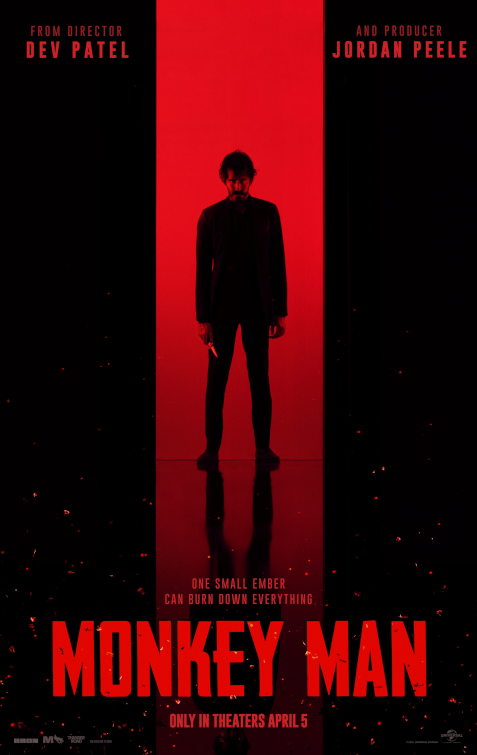
Monkey Man is a 2024 action thriller that marks the feature directorial debut of Dev Patel, who also co-wrote the screenplay and stars as the unnamed protagonist — a young man known only as Kid who ekes out a living as a masked fighter in an underground fighting circuit, selling losses for meager pay. Set in a fictional Indian city, the film draws on the Hindu myth of Hanuman, the divine monkey warrior, as a framework for a visceral revenge story about a man who survived a massacre as a child and has spent his entire adult life engineering a return to the halls of power where the killers live and thrive.
The film's first act builds its world with unusual patience — the city's class stratifications, its corrupt police structures, the spiritual community that gave Kid shelter, and the gleaming towers of the elites who destroyed his village are all rendered with specificity that makes the violence to come feel earned. When Kid infiltrates the hotel where his targets operate, the film shifts into a propulsive action mode that draws clear comparisons to John Wick while retaining a distinctly Indian cinematic sensibility — the choreography borrows from kalaripayattu and kushti wrestling as much as from Hong Kong martial arts cinema, and the production design keeps the mythology always visible beneath the genre surface.
Monkey Man had a complicated production history: originally acquired by Netflix, the streaming service passed on the finished film, leading Universal Pictures to pick it up for theatrical release, where it exceeded box office expectations and earned widespread critical praise for Patel's ambition and the film's emotional conviction. Dev Patel became only the second person of Indian heritage to direct a wide-release Hollywood action film, and Monkey Man's success opened conversations about representation in the action genre that continued well past its theatrical run. The film streams on Peacock.
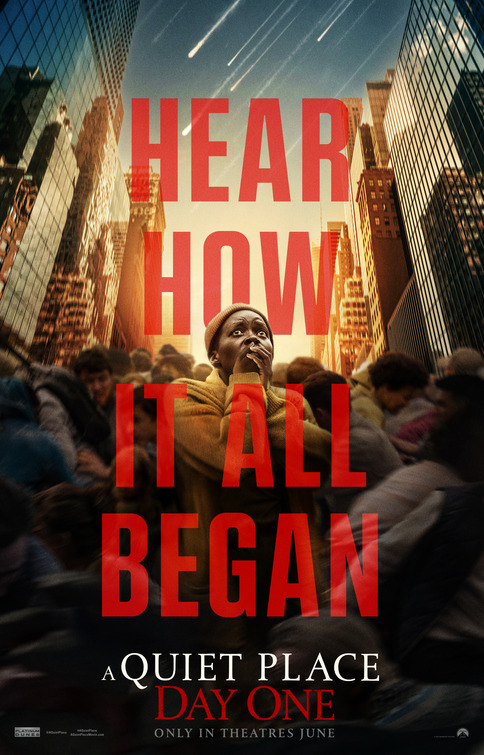
A Quiet Place: Day One is a 2024 science fiction horror film directed by Michael Sarnoski and produced by John Krasinski, who created the franchise with the 2018 original. The film serves as a prequel set during the first hours of the alien invasion that defined the series — not a continuation of the Abbott family story but a standalone narrative set in New York City as the creatures arrive and silence becomes the only strategy for survival. The premise positions the film as a different kind of Quiet Place story: expansive, urban, and populated by characters encountering the invasion without the foreknowledge the Abbotts would develop over years.
The film stars Lupita Nyong'o as Samira, a terminally ill woman in a Manhattan hospice who finds herself caught in the initial wave of the invasion. Her arc — from a person with reasons to give up to one fighting desperately to survive — gives the film an emotional specificity that distinguishes it from the franchise entries before it. Joseph Quinn plays Eric, an English law student she encounters in the chaos, and their unlikely partnership becomes the film's emotional spine. Sarnoski takes advantage of New York's density and architecture to explore how the silence imperative plays out in an environment the franchise had never visited.
A Quiet Place: Day One opened in June 2024 to strong reviews praising Lupita Nyong'o's committed performance and Sarnoski's efficient command of suspense, earning approximately $261 million worldwide on a modest budget and confirming the franchise's continued commercial vitality. It streams on Paramount+.
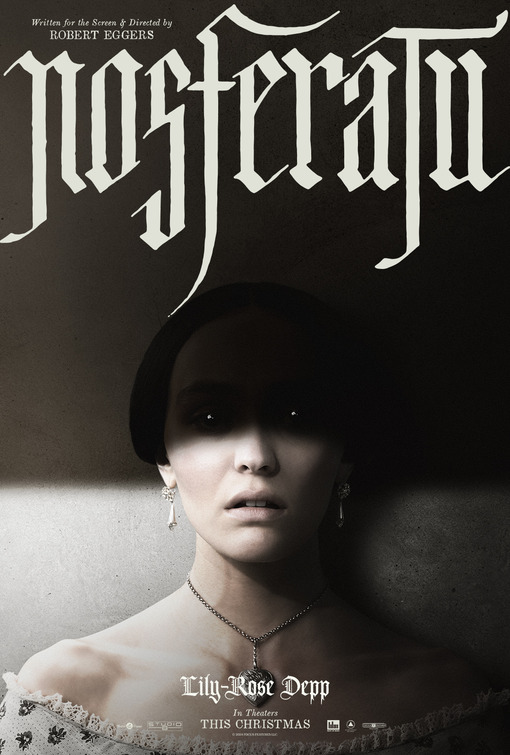
Nosferatu is a 2024 gothic horror film written and directed by Robert Eggers, whose previous work — The Witch, The Lighthouse, and The Northman — established him as one of contemporary cinema's most distinctive voices. The film is a full reimagining of F.W. Murnau's 1922 silent horror classic, transposed into 19th-century Wallachia and the fictional German city of Wisborg. Eggers had been developing the project for nearly a decade, and the result is a film of extraordinary period precision and psychological intensity — less a remake than a genuine reckoning with the source material from a filmmaker who has spent years thinking about it.
The story follows Ellen Hutter (Lily-Rose Depp), a young woman in 1830s Germany tormented since childhood by a presence she cannot name. When her husband Thomas (Nicholas Hoult) travels to Transylvania to finalize a real estate deal with the reclusive Count Orlok (Bill Skarsgård), he draws the ancient vampire's obsession toward Ellen into their home. Eggers renders the relationship between Ellen and Orlok as something magnetic and deeply interior — far removed from the theatrical villain tradition the character has accumulated across a century of adaptations.
Nosferatu opened on Christmas Day 2024 to some of the most enthusiastic reviews of the year, earning particular praise for Jarin Blaschke's sinuous cinematography, Bill Skarsgård's genuinely unsettling transformation into Orlok, and Lily-Rose Depp's performance carrying the film's psychological architecture nearly alone. It became one of the most acclaimed horror films of the decade and is available to stream on Peacock.

Based on Priscilla Presley’s memoir Elvis and Me, the film tells the story of a lonely teenager who falls under the spell of Elvis Presley when she meets him at a party in Germany in 1959. As she grows into a young woman inside the gilded cage of Graceland, Priscilla must find her own identity in the shadow of the world’s biggest star.
Sofia Coppola brings her signature sensibility — delicate, interior, deeply sympathetic to women in gilded cages — to a story that could easily have become hagiography. Instead, Priscilla is a quietly devastating portrait of a young woman whose formative years are shaped entirely by one man’s gravitational pull, and whose eventual awakening to her own personhood costs her everything she has known.
Cailee Spaeny won the Best Actress award at the Venice Film Festival for her performance, embodying Priscilla’s transformation from a wide-eyed teenager to a grown woman whose quiet dignity becomes its own form of resistance. Jacob Elordi’s Elvis is charming, possessive, and fundamentally unknowable — a figure who fills the frame without ever quite becoming a person.