Nuremberg is a 2025 historical drama written and directed by James Vanderbilt, adapted from Jack El-Hai's nonfiction book The Nazi and the Psychiatrist. Released by Sony Pictures Classics, it dramatizes the months surrounding the first Nuremberg trial, when the surviving leaders of the Third Reich were brought before an international tribunal, and centers on the unsettling relationship that formed between a captive Nazi and the American doctor assigned to gauge his sanity.
Rami Malek plays Douglas Kelley, the U.S. Army psychiatrist tasked with evaluating the imprisoned Nazi high command, while Russell Crowe delivers a commanding turn as Hermann Göring, the charismatic and manipulative Reichsmarschall who becomes both his subject and his adversary. Michael Shannon plays Supreme Court Justice Robert H. Jackson, the chief American prosecutor determined to build a lasting framework of international law, with Richard E. Grant, Leo Woodall, John Slattery, and Colin Hanks filling out the ensemble.
Premiering at the Toronto International Film Festival to one of its longest standing ovations, the film earned praise for Crowe's magnetic, chilling performance and for its sober reckoning with how ordinary-seeming men rationalized atrocity. A courtroom drama and a psychological duel in equal measure, it grossed more than $70 million worldwide. Nuremberg is streaming on Netflix.

A reclusive gym manager in a small New Mexican desert town falls for an ambitious bodybuilder passing through on her way to a competition in Las Vegas. Their intense romance quickly spirals into violence and crime when Jackie’s past and Lou’s dangerous family collide in ways neither anticipated.
British director Rose Glass follows up her debut Saint Maud with a film that defies easy categorization: part neo-noir, part body-horror, part love story, and part fever dream. Love Lies Bleeding wraps genuine human longing inside a plot of escalating menace, building toward sequences that embrace pure surrealist cinema while never losing sight of its characters’ raw vulnerability.
Kristen Stewart delivers one of her most physically and emotionally committed performances, while Katy O’Brian transforms herself convincingly into a competitive bodybuilder with dreams too big for the desert that surrounds her. Ed Harris and Dave Franco round out an ensemble that gives even the film’s most morally compromised characters their own warped internal logic.
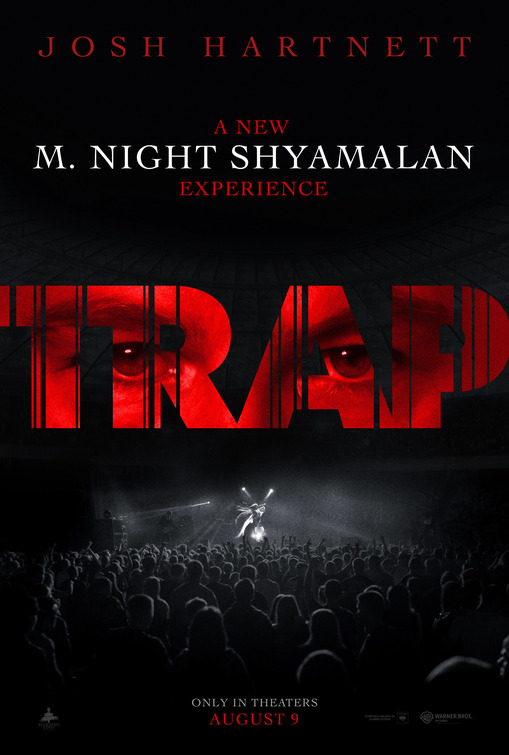
A father takes his teenage daughter to a pop concert only to discover that the entire event is a massive police trap designed to capture a notorious serial killer — and he is that killer. As the walls close in around him, he must use every tool at his disposal to evade capture while keeping his double life hidden from his own daughter.
Set almost entirely within the walls of a packed arena, Trap is a high-concept thriller that turns the spectacle of a live concert into a nerve-shredding game of cat and mouse. Director M. Night Shyamalan shoots the neon-soaked venue as a place of claustrophobic dread, packing the frame with thousands of unsuspecting witnesses while his protagonist silently dismantles escape route after escape route.
Josh Hartnett delivers a performance of coiled menace and darkly comic domesticity as Cooper, a man whose suburban warmth masks something truly terrifying. The film’s willingness to play its central premise straight — never winking at its own absurdity — makes its genre shifts and escalating revelations land with maximum impact.

Longlegs is Osgood Perkins's audacious, unsettling horror film — the most genuinely disturbing wide-release American horror movie in years — starring Maika Monroe as Lee Harker, an FBI agent with an inexplicable intuitive gift for anticipating the movements of a serial killer whose cases have confounded law enforcement for decades. The killer is Longlegs (Nicolas Cage), a figure whose crimes are so strange and so consistent over thirty years that the FBI has never been able to identify a pattern. Lee is assigned to the case by her supervisor (Blair Underwood) and immediately begins to sense a connection to the murders that goes beyond professional insight — something more personal, more dreadful, and harder to name.
Perkins shoots Longlegs with the compositional precision and ambient dread of classic European horror, building unease through framing, sound design, and a color palette that feels perpetually overexposed and wrong. Monroe delivers one of the finest horror performances in recent memory — introverted, strange, perceptive in ways she cannot explain — and she grounds the film when Cage threatens to tip it into pure expressionism. And Cage's Longlegs is extraordinary: a creation of pure theatricality and genuine menace, a figure so physically committed and so free of vanity that the performance crosses from alarming into something closer to awe.
Longlegs became one of the biggest horror hits of 2024, distributed by NEON and earning more than $70 million on a tiny budget. It divided critics who wanted conventional horror mechanics and won passionate admirers who recognized Perkins as a filmmaker working in a mode closer to Argento or Lynch than to mainstream genre filmmaking. It streams on Hulu and rewards multiple viewings for viewers willing to let it work on its own unsettling terms.
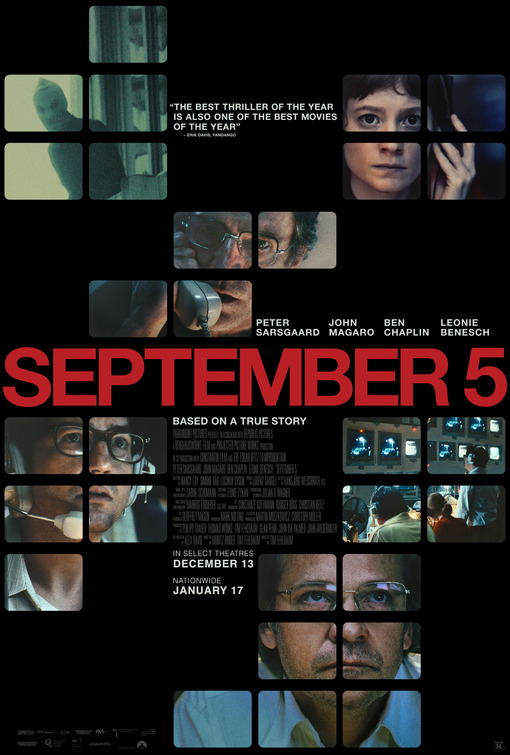
September 5 is Tim Fehlbaum's taut, meticulous reconstruction of one of the most consequential days in television history — September 5, 1972, the morning a Palestinian militant group took eleven Israeli Olympic athletes hostage in Munich and ABC Sports found itself, entirely by accident, covering a live act of terrorism in real time. The film is set almost entirely inside the ABC broadcast truck and control room, following producer Geoffrey Mason (John Magaro) and the network's sports team as they improvise their way through hours of coverage for which no protocol, no precedent, and no ethical framework existed. Roone Arledge (Peter Sarsgaard), the visionary ABC Sports chief, drives them forward with the ruthless logic of live television: stay on the air, be first, be there.
Fehlbaum shoots on grainy, period-appropriate film stock and keeps the camera inside the cramped broadcast infrastructure — cables, monitors, reel-to-reel machines, men in headsets shouting over each other — building a physical and moral claustrophobia that perfectly mirrors the impossible position the journalists occupy. The film does not flinch from the question at its center: what responsibility does live media have when covering human catastrophe, and when does coverage become complicity? John Magaro carries the film's moral weight with quiet intensity, and Ben Chaplin as the network's veteran anchor provides a counterpoint of hard-won restraint.
September 5 arrives as a film acutely relevant to an era saturated in live-streamed violence and real-time social media coverage of atrocities, making Fehlbaum's decision to tell this specific story feel both historically grounded and urgently contemporary. It is a masterwork of restraint — a thriller that never leaves its rooms but generates almost unbearable tension from what those rooms cannot see. Available to stream on Paramount+.
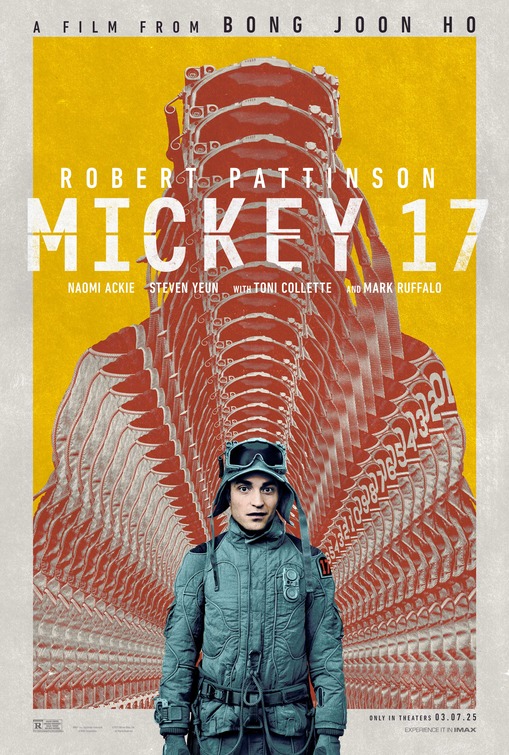
Mickey 17 is Bong Joon-ho's wildly inventive science-fiction black comedy, adapted from Edward Ashton's novel Mickey7, and it finds the South Korean auteur working on a canvas of pure genre spectacle while keeping his needle-sharp eye fixed on class, exploitation, and what it means to be expendable. Robert Pattinson plays Mickey Barnes, a man so desperate to escape debt that he signs up to be an "expendable" — a human guinea pig on an interstellar colonization mission who can be cloned and reprinted whenever he dies, carrying all his memories into each new body. The catch is that there should only ever be one Mickey at a time, so when Mickey 17 survives a seemingly fatal fall and returns to the ship to find Mickey 18 already printed and living his life, the situation quickly escalates into something the mission's ruthless commander (Mark Ruffalo, magnificently unhinged) considers a grave liability.
Bong Joon-ho orchestrates the film's tonal shifts with the precision of a conductor moving between movements — tender one moment, brutally comic the next, laced throughout with a fury at systems that treat human beings as renewable resources. Pattinson commits entirely to the dual performance, finding two distinct personalities within the same face and body. Naomi Ackie is sharp and funny as Mickey's girlfriend Nasha, and Toni Collette delivers a cameo of gleeful absurdity as the commander's equally power-drunk spouse. The film's alien world is rendered with a lushness and practical texture that makes the CGI feel earned rather than lazy.
Mickey 17 is Bong Joon-ho at his most playful and his most angry simultaneously, a film that wears its science fiction trappings lightly while delivering a scalding commentary on corporate expendability, human commodification, and the casual cruelty of those at the top of a hierarchy looking down at the people they consider easily replaceable. It is one of the most original blockbusters in years, and it streams on Max.
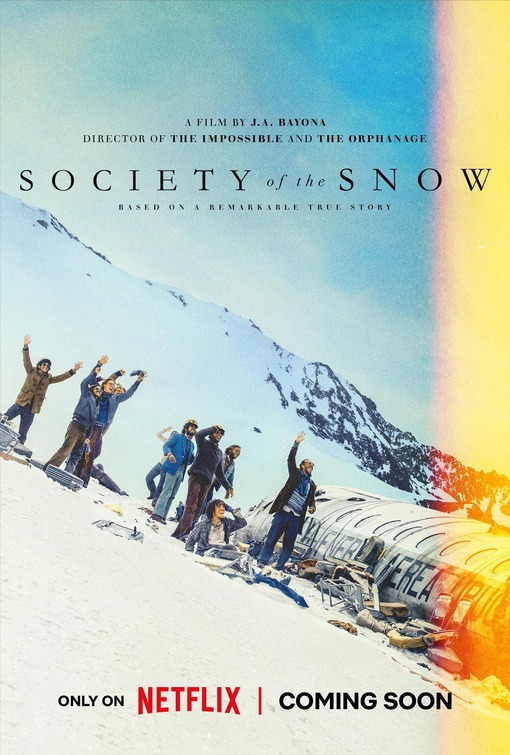
Society of the Snow is J.A. Bayona's devastating and visually extraordinary retelling of the 1972 Andes flight disaster, in which Uruguayan Air Force Flight 571 crashed in the remote Andes mountains carrying the Old Christians Rugby Club and their families. Forty-five people were aboard; sixteen survived after seventy-two days of desperate improvisation, extreme cold, starvation, and the agonizing moral decision to consume the flesh of their dead teammates in order to stay alive. Bayona's film — a Spanish-language production drawn from Pablo Vierci's 2008 book of survivor testimonies — distinguishes itself from Peter Weir's 1993 Alive by its collective focus: this is an ensemble story, not a hero's journey.
Shot in the actual Andes at altitude and with meticulous period detail, the film achieves a physical authenticity that previous versions could not match. The survivors are presented not as extraordinary individuals but as ordinary young men placed in an impossible situation and forced to discover resources within themselves they could not have imagined. The decision to use flesh for survival is treated with exactly the moral and spiritual gravity it demands — not sensationalized, not glossed over, but examined as an act of love and community, a final gift from those who died to those who still lived.
Society of the Snow won the BAFTA Award for Best Film Not in the English Language and was Spain's submission for the Academy Award for Best International Feature Film, where it earned a nomination. The film is available on Netflix and represents one of the finest survival dramas ever committed to film — a work that honors its subjects by refusing to simplify the profound ethical territory they were forced to occupy.

Napoleon is Ridley Scott's grand, irreverent, and deliberately provocative biography of France's most consequential military and political figure, played with idiosyncratic intensity by Joaquin Phoenix. The film chronicles Napoleon Bonaparte's rise from a relatively obscure Corsican artillery officer to Emperor of France, his campaigns across Europe, and his obsessive, mercurial relationship with Joséphine de Beauharnais (Vanessa Kirby) — the woman whose influence over him rivaled even his own ambition. Scott approaches the subject not with reverence but with a destabilizing bluntness, presenting Napoleon as a man of exceptional tactical intelligence married to crippling emotional neediness.
The film's spectacular battle sequences — Toulon, Austerlitz, Waterloo — are staged with Scott's characteristic sweep and visceral precision, finding the chaos and carnage of Napoleonic warfare in a way that makes the glory almost inseparable from the butchery. Joaquin Phoenix refuses to play Napoleon as a legend: this is a man who is awkward at dinner, petulant in defeat, and capable of genuine vulnerability in the bedroom. Vanessa Kirby holds her own in every scene against Phoenix, giving Joséphine a layered intelligence that makes her the film's most compelling character.
Napoleon is not a careful, consensus-seeking portrait of its subject — Scott freely acknowledges his willingness to sacrifice historical accuracy to serve the film's emotional and dramatic logic, and the result is something more vivid and alive than many more dutiful biopics. The film is available to stream on Apple TV+ after its theatrical release, and an extended director's cut running over four hours brings additional scenes and a deeper portrait of the marriage.
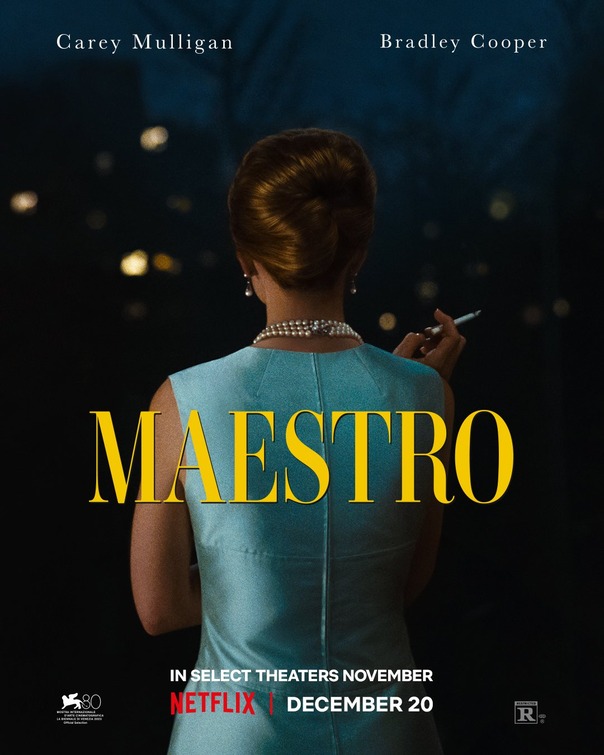
Maestro is Bradley Cooper's deeply personal and technically audacious portrait of Leonard Bernstein, one of the twentieth century's most towering musical figures, following him from his explosive rise as a young conductor in the 1940s through his legendary career as composer, pianist, educator, and activist — while tracing the complex, enduring, and often turbulent romance at the center of his life with actress Felicia Montealegre (Carey Mulligan). Cooper directed, co-wrote, co-produced, and stars in the film, inhabiting Bernstein not just through prosthetics but through an astonishing physical and emotional transformation.
What distinguishes Maestro from the conventional biographical film is its formal audacity. The first act unfolds in luminous black and white, channeling the visual language of Golden Age Hollywood, before the film blooms into color as the decades advance and the relationship deepens — or unravels. At its heart, the film is less about Bernstein's artistic achievements, which are treated as a given, than about the private man behind the public genius: his bisexuality, his ego, his fierce love for Felicia, and the impossible demands his inner life placed on everyone around him.
Carey Mulligan's performance is the film's moral and emotional center, a portrayal of a woman who loved a complicated man with both clear eyes and infinite generosity. Maestro received seven Academy Award nominations including Best Picture, confirming it as one of the more ambitious biographical films of its era, and is available to stream on Netflix.
.jpeg)
Maria is a stunning biographical drama directed by Pablo Larraín, completing his trilogy of films about iconic women of the twentieth century following Jackie (2016) and Spencer (2021). Angelina Jolie delivers a career-defining performance as Maria Callas, the legendary Greek-American soprano widely regarded as the greatest opera singer of the modern era. Set in the final days of Callas's life in Paris in 1977, the film blurs the lines between memory, delusion, and performance as Maria attempts to recapture her voice and confront the full arc of her extraordinary and painful existence.
Larraín's approach is characteristically bold and non-literal. Rather than a conventional biopic chronicling Callas's life from beginning to end, Maria plunges us into the turbulent interiority of its subject, staging her memories and fantasies with operatic grandeur. The film's visual language is ravishing — saturated colors, grand Parisian interiors, and sequences of live performance — yet always in service of understanding a woman who gave everything to her art and paid an enormous personal cost. Jolie's performance is the film's beating heart, requiring her to embody one of classical music's most demanding vocal traditions while portraying profound loneliness and complex self-reckoning.
Maria is not simply a film for opera lovers or fans of classic Hollywood glamour, though it will delight both. It is a meditation on what it means to dedicate a life to art, on the relationship between a performer and her audience, and on the often devastating trade-offs that genius demands. Like Callas herself, the film is flawed, excessive, passionate, and unforgettable — a work of genuine cinematic ambition that stays with the viewer long after the credits roll.
.jpeg)
Sing Sing is an extraordinary drama based on the true story of Divine G (born Clarence Davison), a man incarcerated at Sing Sing Correctional Facility who finds meaning, community, and personal transformation through the prison's Rehabilitation Through the Arts program. Colman Domingo delivers one of the most acclaimed performances of his career as Divine G, bringing profound dignity and intelligence to a man who channels his creative energies into theatrical performance while fighting to have his wrongful conviction overturned.
The film is remarkable for its authenticity — the majority of the supporting cast are current or formerly incarcerated people who were part of the actual RTA program, many playing fictionalized versions of themselves. This gives Sing Sing an intimacy and credibility that no Hollywood casting call could replicate. Director Greg Kwedar creates a space where humor, grief, absurdity, and deep humanity coexist, much like the plays the RTA members themselves put on — finding catharsis through storytelling even in the most constraining of circumstances.
Sing Sing is ultimately a film about the redemptive power of art, the resilience of the human spirit, and the community that can be built even within prison walls. It challenges viewers to reconsider their assumptions about who deserves empathy and what transformation is possible. Equal parts heartbreaking and uplifting, it stands as one of the most vital and morally serious films of recent years — a reminder that behind every statistic about incarceration is a full human life, bursting with creativity and longing for connection.