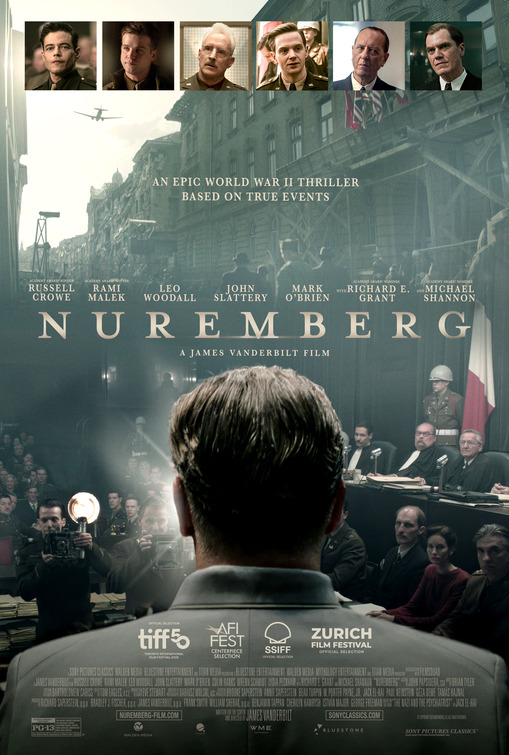
Nuremberg is a 2025 historical drama written and directed by James Vanderbilt, adapted from Jack El-Hai's nonfiction book The Nazi and the Psychiatrist. Released by Sony Pictures Classics, it dramatizes the months surrounding the first Nuremberg trial, when the surviving leaders of the Third Reich were brought before an international tribunal, and centers on the unsettling relationship that formed between a captive Nazi and the American doctor assigned to gauge his sanity.
Rami Malek plays Douglas Kelley, the U.S. Army psychiatrist tasked with evaluating the imprisoned Nazi high command, while Russell Crowe delivers a commanding turn as Hermann Göring, the charismatic and manipulative Reichsmarschall who becomes both his subject and his adversary. Michael Shannon plays Supreme Court Justice Robert H. Jackson, the chief American prosecutor determined to build a lasting framework of international law, with Richard E. Grant, Leo Woodall, John Slattery, and Colin Hanks filling out the ensemble.
Premiering at the Toronto International Film Festival to one of its longest standing ovations, the film earned praise for Crowe's magnetic, chilling performance and for its sober reckoning with how ordinary-seeming men rationalized atrocity. A courtroom drama and a psychological duel in equal measure, it grossed more than $70 million worldwide. Nuremberg is streaming on Netflix.

"Gray's Anatomy" is a 1996 experimental film directed by Steven Soderbergh. The film presents the monologue of Spalding Gray, a famous storyteller and actor, who shares his experiences of visiting various alternative medicine practitioners to cure an eye condition known as a macular pucker. The film intercuts Gray's monologue with dramatized reenactments and actual footage of surgeries.
The film premiered at the 1996 Cannes Film Festival and received positive reviews from critics for its unique presentation and Gray's performance. The film's title is a reference to the medical textbook "Gray's Anatomy," which serves as a metaphor for the human body and the various medical procedures and treatments that Gray undergoes.
Soderbergh's use of experimental techniques and the film's mixture of fact and fiction make it a fascinating exploration of human vulnerability and the search for a cure. Gray's candid and humorous monologue, combined with the surreal imagery and reenactments, provides an intriguing commentary on the limits of traditional medicine and the ways in which we cope with illness and mortality. The film's innovative approach to storytelling and its subject matter make it a unique and compelling piece of cinema.

"The Great Dictator" is a 1940 American political satire comedy-drama film written, produced, directed by, and starring Charlie Chaplin. It tells the story of a Jewish barber who is mistaken for a ruthless dictator named Adenoid Hynkel, and is thrown into a series of absurd situations. The film criticizes Hitler, fascism, anti-Semitism, and the Nazi regime.
The film's production was met with controversy and backlash, particularly from the Nazi regime and American isolationists who feared that the film would provoke Germany and harm the country's relationship with the US. Despite this, the film was a commercial success and received critical acclaim, with many praising Chaplin's performance and the film's message.
"The Great Dictator" has since been considered a classic and one of Chaplin's greatest works. In 1997, it was selected for preservation in the United States National Film Registry by the Library of Congress for being "culturally, historically, or aesthetically significant." The film's final speech by Chaplin, in which he directly addresses the audience, has become particularly famous and is still widely remembered and quoted today.

Withnail and I is a British comedy-drama film that was released in 1987. It was written and directed by Bruce Robinson, and stars Richard E. Grant, Paul McGann, and Richard Griffiths. The movie is set in 1969 and follows two unemployed actors, Withnail and Marwood, as they leave their squalid apartment in London and escape to the countryside for a holiday.
The movie was not a box office success upon its release, but it has since become a cult classic. It is known for its witty dialogue, memorable characters, and dark humor. The movie also features an iconic performance by Richard E. Grant as the flamboyant and alcoholic Withnail.
Withnail and I is often praised for its depiction of a generation that was disillusioned with society and struggling to find their place in the world. The movie also explores themes of friendship, addiction, and the search for meaning in life. The movie's ending is bittersweet, with Withnail choosing to remain in his destructive lifestyle while Marwood moves on to a new chapter in his life. The movie's final scene, in which Withnail recites a soliloquy from Hamlet, has become one of the most famous moments in British cinema.

Sweetie is a 1989 Australian drama film directed by Jane Campion. The film follows Kay, a woman in her twenties who lives with her parents in their suburban home and works at a motel. Her life is turned upside down when her estranged sister, Sweetie, comes to live with the family. Sweetie is mentally unstable and has a history of causing chaos wherever she goes. Her presence causes tension and reveals the dysfunctional nature of the family.
The film explores themes of family dysfunction, mental illness, and the complexity of sibling relationships. Kay's attempts to understand and connect with her sister are met with resistance, as Sweetie's erratic behavior and refusal to conform to societal norms create conflict. The film is noted for its unconventional narrative structure and use of surreal imagery to convey the characters' emotional states.
Sweetie premiered at the Cannes Film Festival in 1989 and received critical acclaim for its originality and boldness. The film was a commercial success in Australia and helped to establish Campion as a major talent in international cinema. Sweetie is now considered a classic of Australian cinema and a landmark in feminist filmmaking, with its exploration of the complexity of women's lives and relationships.

"The Kid" is a silent film from 1921, written, directed, produced and starring Charlie Chaplin. The film tells the story of a single mother who abandons her newborn child, which is later discovered by Chaplin's character, the Tramp. He decides to take care of the baby, raising him as his own son. When the child is around five years old, the mother returns and tries to reclaim her son, but the Tramp fights to keep the child in his care.
"The Kid" was a commercial and critical success, and it is still regarded as one of Chaplin's finest films. The film's themes of poverty, parenthood, and the human condition still resonate with audiences today. The film also marked the debut of child actor Jackie Coogan, who played the young boy.
"The Kid" was Chaplin's first full-length feature, and it cemented his status as one of the greatest filmmakers of the silent era. The film's blend of comedy and drama was revolutionary for its time, and it influenced countless filmmakers who came after Chaplin. Today, "The Kid" is considered a classic of early cinema and an important piece of film history.

"Lola" is a 1981 drama film directed by Rainer Werner Fassbinder. The movie is set in post-World War II Germany and tells the story of Lola, a young and ambitious cabaret singer who dreams of becoming a famous actress. She becomes involved with a powerful businessman, Schuckert, who helps her career but also leads her down a path of corruption and compromise.
As the story unfolds, Lola becomes torn between her love for Schuckert and her desire for independence and self-respect. She also becomes embroiled in a political scandal involving Schuckert and a corrupt city government. These conflicts come to a head in a powerful and tragic climax.
The film explores themes of love, power, and corruption in post-war Germany. It has been praised for its complex characters, sharp social commentary, and stylish cinematography. The movie is remembered as one of Fassbinder's best works and a classic of German cinema. It stars Barbara Sukowa as Lola and Mario Adorf as Schuckert.

"Divorce Italian Style" is a 1961 Italian comedy film directed by Pietro Germi. The movie stars Marcello Mastroianni as Ferdinando Cefalù, a Sicilian nobleman who is unhappily married to his cousin, Rosalia. Divorce was illegal in Italy at the time, so Ferdinando concocts a plan to make his wife cheat on him so he can catch her in the act and legally kill her.
As the story progresses, Ferdinando's plan becomes more complicated as he falls in love with his teenage cousin, Angela, played by Stefania Sandrelli. Ferdinando's attempts to win Angela's love while still married to Rosalia lead to a series of hilarious and absurd situations.
The film explores themes of love, marriage, and societal expectations. It won the Academy Award for Best Original Screenplay and was nominated for Best Director and Best Actor for Marcello Mastroianni's performance. The movie is remembered as a classic example of Italian cinema and is often cited as one of the best comedies ever made.

"Doc Hollywood" is a 1991 romantic comedy film directed by Michael Caton-Jones. The movie stars Michael J. Fox as Ben Stone, a young doctor who is on his way to Beverly Hills for a job interview when his car breaks down in a small South Carolina town. While he waits for his car to be fixed, he gets roped into serving as the town's temporary doctor.
As Stone spends more time in the town, he begins to fall in love with the people and the way of life there. He also becomes attracted to a local woman named Lou, played by Julie Warner. However, Stone is conflicted because he still wants to pursue his career in Beverly Hills.
The film explores themes of love, career aspirations, and the value of small-town life. It received mixed reviews upon its release but has since become a cult classic. The movie is remembered for its charming performances, witty dialogue, and picturesque small-town setting. It is often cited as one of Michael J. Fox's best roles outside of the "Back to the Future" franchise.

"Coup de Torchon" is a French film from 1981 directed by Bertrand Tavernier. The movie is based on a novel by Jim Thompson, "Pop. 1280," and is set in a small town in French West Africa in the 1930s. It tells the story of Lucien Cordier, a timid and passive police chief who is constantly ridiculed and mistreated by the townspeople and his wife.
As the story unfolds, Cordier reaches a breaking point and decides to take matters into his own hands. He begins to use his power as police chief to exact revenge on those who have wronged him. This leads to a series of violent and unexpected events that turn the town upside down.
The film explores themes of power, corruption, and morality. It has been praised for its complex characters and themes, as well as its stunning cinematography. The movie received critical acclaim and won the César Award for Best Film, Best Director, and Best Actor for Philippe Noiret's portrayal of Lucien Cordier. It is considered one of the best French films of the 1980s and a classic example of the film noir genre.

"The Reluctant Debutante" is a 1958 romantic comedy film directed by Vincente Minnelli. It tells the story of Jane Broadbent, a 17-year-old American girl who goes to London with her mother to make her debut in high society. However, Jane is not interested in the social scene and falls in love with a young man named David, who is not from the same upper-class background as her.
The film stars Rex Harrison as Jane's father, Lionel, who is trying to find a suitable husband for his daughter and Kay Kendall as Jane's mother, Sheila, who is excited about the prospect of her daughter's debut. Sandra Dee plays Jane and John Saxon plays David. The film is set in London and features many scenes of high society parties and events.
The film explores themes of class and social expectations, as well as the struggles of young love. It received positive reviews upon its release and was nominated for an Academy Award for Best Art Direction-Set Decoration, Black-and-White. The film is considered a classic example of 1950s romantic comedies and is remembered for its witty dialogue and charming performances.