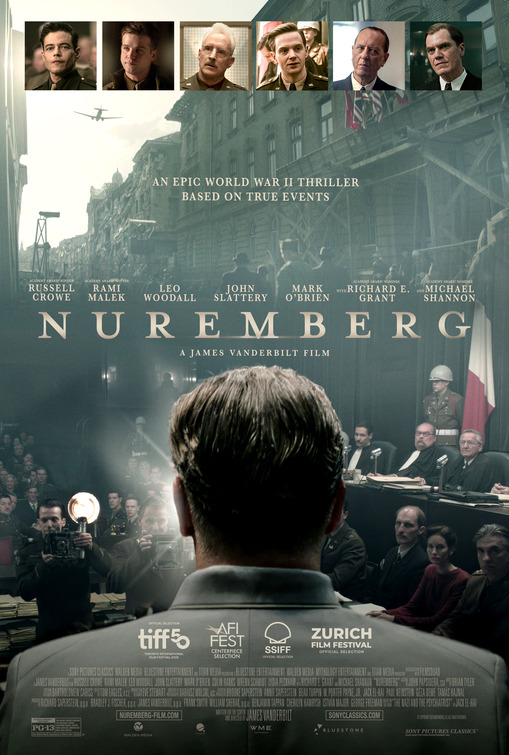
Nuremberg is a 2025 historical drama written and directed by James Vanderbilt, adapted from Jack El-Hai's nonfiction book The Nazi and the Psychiatrist. Released by Sony Pictures Classics, it dramatizes the months surrounding the first Nuremberg trial, when the surviving leaders of the Third Reich were brought before an international tribunal, and centers on the unsettling relationship that formed between a captive Nazi and the American doctor assigned to gauge his sanity.
Rami Malek plays Douglas Kelley, the U.S. Army psychiatrist tasked with evaluating the imprisoned Nazi high command, while Russell Crowe delivers a commanding turn as Hermann Göring, the charismatic and manipulative Reichsmarschall who becomes both his subject and his adversary. Michael Shannon plays Supreme Court Justice Robert H. Jackson, the chief American prosecutor determined to build a lasting framework of international law, with Richard E. Grant, Leo Woodall, John Slattery, and Colin Hanks filling out the ensemble.
Premiering at the Toronto International Film Festival to one of its longest standing ovations, the film earned praise for Crowe's magnetic, chilling performance and for its sober reckoning with how ordinary-seeming men rationalized atrocity. A courtroom drama and a psychological duel in equal measure, it grossed more than $70 million worldwide. Nuremberg is streaming on Netflix.
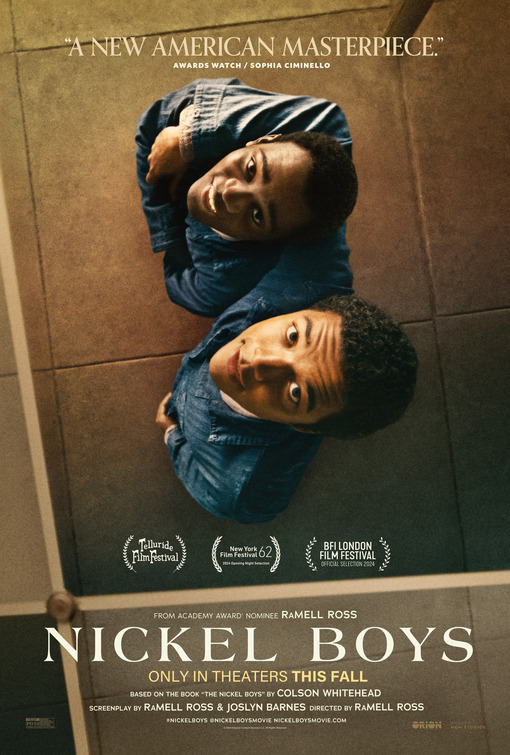
Directed by RaMell Ross in a visually revolutionary style, Nickel Boys is a devastating adaptation of Colson Whitehead's Pulitzer Prize-winning novel. The film follows Elwood Curtis and Turner, two young Black men confined to the Nickel Academy, a reform school in Jim Crow-era Florida where abuse and violence are systemic and survival demands moral compromise. Told almost entirely from the characters' first-person perspectives, the film places viewers directly inside the lived experience of its protagonists.
Ross employs a radically subjective camera technique that challenges conventional cinematic language. Rather than observing suffering from a distance, audiences inhabit the bodies and perspectives of Elwood and Turner, making the cruelties of the Nickel Academy viscerally immediate. This bold formal approach won the film widespread critical acclaim and comparisons to landmark works of experimental cinema.
Nickel Boys arrives as one of the most important American films in years, confronting the nation's history of racial injustice with both artistic ambition and moral clarity. Ethan Herisse and Brandon Wilson deliver performances of quiet, extraordinary power, and the film's final act delivers an emotional reckoning that resonates long after the credits roll.

A Minecraft Movie bridges the gap between the beloved sandbox video game and the big screen, delivering a live-action/animated hybrid adventure that captures the blocky, creative spirit of one of history's best-selling games. When a group of unlikely heroes stumbles through a mysterious portal into the Overworld, they find themselves stranded in a vast pixelated realm filled with creepers, skeletons, and infinite landscapes waiting to be explored and built upon. With no guide and no map, they must learn the rules of this world quickly or risk never returning home.
Jack Black voices Steve, the legendary Minecraft character who has spent years surviving in the Overworld and now reluctantly agrees to mentor the stranded visitors. His comedic chemistry with the live-action cast drives much of the film's humor, while the central plot raises genuine stakes as a powerful villain threatens to corrupt the entire game world. The film balances family-friendly laughs with surprisingly tense set pieces that honor the survival-horror elements lurking in Minecraft's deeper biomes.
Directed by Jared Hess and produced by Legendary Entertainment and Warner Bros., A Minecraft Movie was one of the most anticipated video game adaptations ever made, and it largely delivered on that promise. The film's visual design carefully translates Minecraft's iconic aesthetic into a cinematic format without abandoning the charm of the source material. With strong performances, inventive world-building, and an infectious sense of fun, A Minecraft Movie is a love letter to one of gaming's most creative communities.
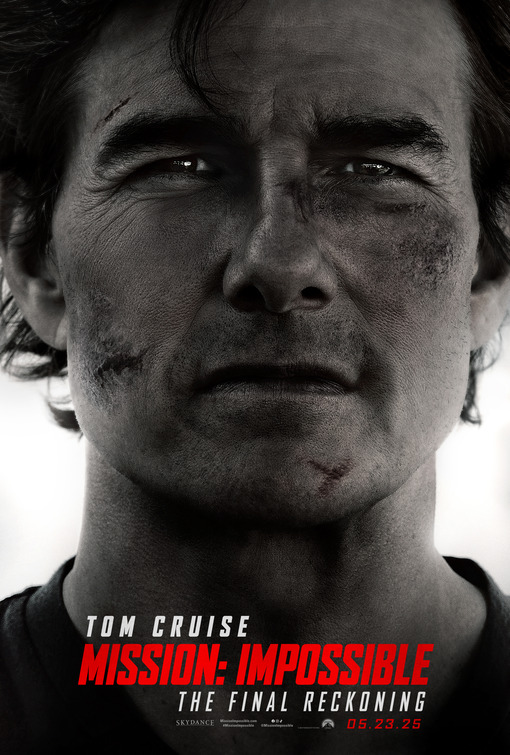
Mission: Impossible – The Final Reckoning brings Ethan Hunt's legendary career to a thunderous close as he faces the most dangerous mission of his life. The rogue AI known as the Entity has gone fully operational, threatening to seize control of the world's military and intelligence infrastructure, and only the IMF team stands between humanity and total subjugation. With his cover blown and every government on earth hunting him, Ethan must assemble his most trusted allies for a final, all-or-nothing operation spanning multiple continents.
Director Christopher McQuarrie returns to deliver the most ambitious entry in the franchise yet, featuring death-defying practical stunts that Tom Cruise personally performed. The film interweaves storylines from the previous two chapters, bringing back familiar faces and resolving long-simmering conflicts while introducing new threats that push every team member to their limits. Locations range from the ruins of wartime Europe to the skies above the Pacific, all rendered with the series' signature kinetic energy and relentless momentum.
The Final Reckoning doubles down on the themes that have made the franchise endure for nearly three decades: loyalty, sacrifice, and the impossible choice between duty and humanity. Hayley Atwell, Ving Rhames, Simon Pegg, Rebecca Ferguson, and Pom Klementieff all return for this climactic chapter, each given meaningful arcs that pay off years of storytelling. Whether you're a lifelong fan or a newcomer, this film delivers relentless action and genuine emotional stakes in equal measure.
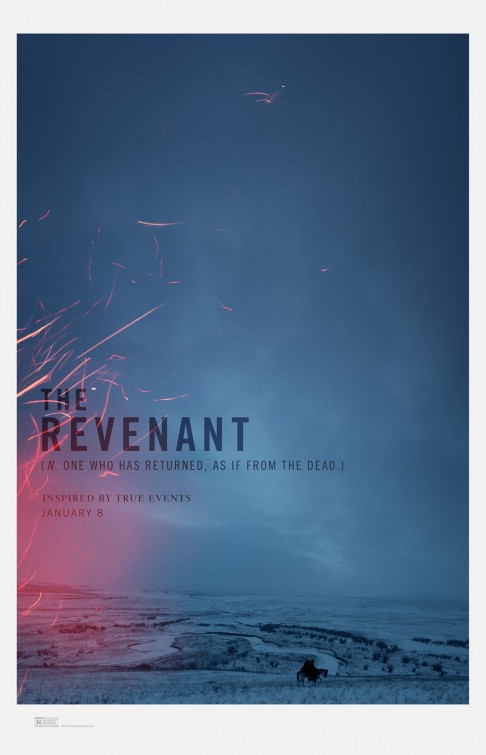
The Revenant is a 2015 survival epic directed by Alejandro González Iñárritu, based on Michael Punke's 2002 novel inspired by the historical figure Hugh Glass. Set in the American frontier of 1823, the film follows Hugh Glass (Leonardo DiCaprio), a skilled frontiersman guiding a fur-trapping expedition through the Louisiana Territory wilderness. After Glass is mauled nearly to death by a grizzly bear and left for dead by the treacherous John Fitzgerald (Tom Hardy) — who murders Glass's half-Pawnee son Hawk before his eyes — Glass must survive the brutal winter landscape on sheer willpower and the driving need to find Fitzgerald and exact revenge.
The film is a grueling, visually transcendent meditation on survival, grief, and vengeance. Cinematographer Emmanuel Lubezki shot the entire film using only natural light — no artificial lighting was permitted on set — giving the image a frigid, painterly quality that evokes the wilderness landscapes of Bruegel and Caspar David Friedrich. Production was notoriously difficult: filming began in Calgary, Canada, but an unusual lack of snow forced the production to move to the southern tip of Argentina in Tierra del Fuego, one of the most remote and demanding filming locations in cinema history. The extreme cold, the requirement for natural light, and Iñárritu's insistence on long takes meant the production schedule stretched far beyond its original plan.
The Revenant was released on December 25, 2015, and grossed over $533 million worldwide against its $135 million budget. At the 88th Academy Awards it received twelve nominations, winning three: Best Director for Iñárritu (his second consecutive win, following Birdman), Best Actor for DiCaprio (his first Oscar win after five previous nominations), and Best Cinematography for Lubezki (his third consecutive win, following Gravity and Birdman). DiCaprio's long-awaited Oscar victory became a cultural event, celebrated across social media and in years of preceding memes about his then-elusive recognition.
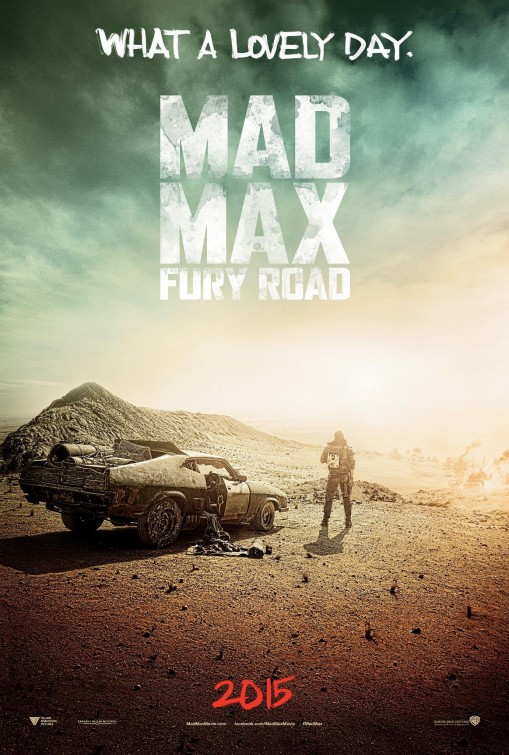
Mad Max: Fury Road is a 2015 Australian post-apocalyptic action film directed by George Miller, the creator of the original Mad Max trilogy. Set in a barren desert wasteland where civilization has collapsed and brutal warlords control the last reserves of fuel and water, the film follows Max Rockatansky (Tom Hardy), a haunted drifter captured by the sadistic tyrant Immortan Joe and used as a blood donor. Forced to accompany a war convoy into the wasteland, Max is chained to the hood of a war vehicle driven by Imperator Furiosa (Charlize Theron), a one-armed lieutenant who has smuggled Joe's enslaved wives out of his Citadel in a desperate bid for freedom.
What follows is essentially one continuous chase across the desert — a two-hour action symphony staged almost entirely in-camera using real vehicles, stuntwork, and practical explosions. George Miller shot the film primarily in the Namib Desert of Namibia after his planned Australian locations received too much rain and bloomed green rather than the required barren desolation. The film features Tom Hardy and Charlize Theron as co-leads of equal narrative weight, with Nicholas Hoult as Nux, a deluded War Boy who undergoes a quiet redemptive arc amid the operatic carnage. The film's design language — from the flame-throwing guitar player perched on a wall of speakers to the masks and vehicles of Immortan Joe's war band — is dense with internal mythology and craft.
Mad Max: Fury Road premiered at the Cannes Film Festival and was released worldwide on May 15, 2015, to near-universal critical acclaim — it holds a 97% rating on Rotten Tomatoes. At the 88th Academy Awards, the film won six Oscars: Film Editing, Production Design, Costume Design, Cinematography, Sound Mixing, and Sound Editing — the most of any film that year. It is widely regarded as one of the greatest action films ever made and a landmark of practical, in-camera filmmaking in the digital effects era.
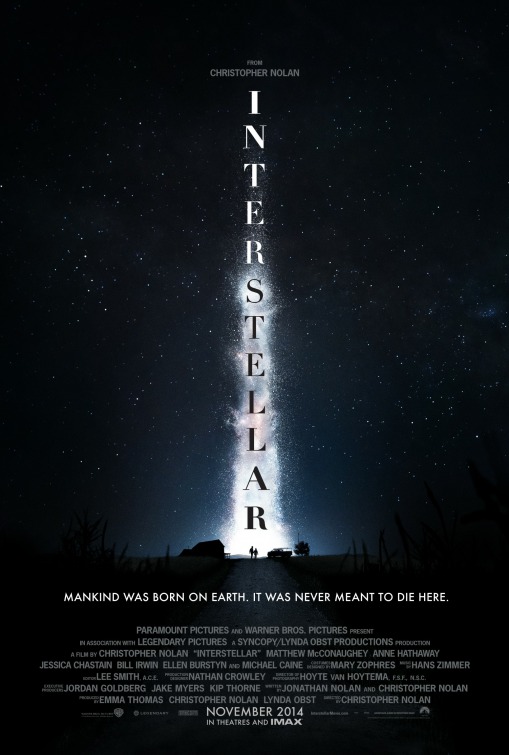
Interstellar is a 2014 epic science fiction film written and directed by Christopher Nolan, produced by Paramount Pictures and Warner Bros. The film stars Matthew McConaughey as Cooper, a former NASA pilot turned farmer living in a near-future Earth where crop blight and dust storms are steadily rendering the planet uninhabitable. When a mysterious gravitational anomaly leads him to a secret NASA facility, Cooper is recruited to pilot a spacecraft through a newly discovered wormhole near Saturn — humanity's last hope of finding a new home among the stars.
The ensemble cast includes Anne Hathaway as Dr. Amelia Brand, Jessica Chastain and Mackenzie Foy as Cooper's daughter Murph at different life stages, and Michael Caine as Professor Brand. Theoretical physicist Kip Thorne served as executive producer and scientific consultant, ensuring the film's depictions of black holes, wormholes, and relativity were grounded in real science — a collaboration that resulted in two peer-reviewed scientific papers. Tom Hardy originally had a supporting role that was recast; Matt Damon, Casey Affleck, and John Lithgow round out a formidable supporting cast.
Released on November 7, 2014, Interstellar received strong critical acclaim for its ambitious scope, emotional depth, and groundbreaking visual effects, grossing over $773 million worldwide. At the 87th Academy Awards it won Best Visual Effects, and Hans Zimmer's organ-driven score became one of the most celebrated film soundtracks of the decade. Interstellar is now widely regarded as one of the defining science fiction films of the twenty-first century, a film equally concerned with the physics of spacetime and the human experience of love and loss across impossible distances.
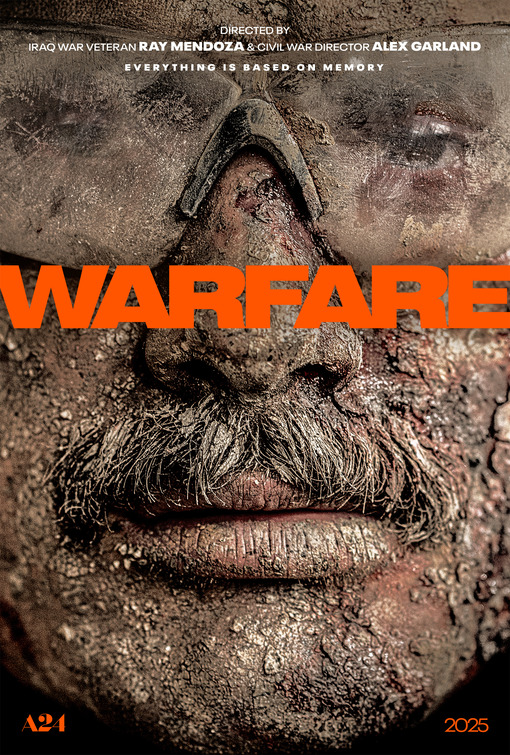
Co-directed by Alex Garland (Ex Machina, Civil War) and Ray Mendoza — a Navy SEAL veteran who participated in the actual operation depicted — Warfare is one of the most rigorously authentic war films ever committed to screen. The film recreates, in real time and with almost documentary precision, a harrowing November 2006 mission by SEAL Team 3's Echo Platoon in Ramadi, Iraq. There is no score, no title cards, no moralizing voiceover — only the suffocating, chaotic reality of men holding a position under ambush while waiting for evacuation that may never come.
The ensemble cast — D'Pharaoh Woon-A-Tai, Will Poulter, Joseph Quinn, Cosmo Jarvis, Michael Gandolfini, Charles Melton, and Evan Peters — was assembled with a deliberate ethos of collective anonymity; no single character dominates, mirroring the unit cohesion that defines special operations culture. Mendoza worked directly with the surviving members of Echo Platoon to reconstruct the events, and several veterans consulted on set throughout production to ensure every tactical detail, every radio call, every moment of crisis reflected what actually happened.
Released by A24, Warfare landed as a landmark of modern war cinema — praised for its moral restraint, visceral immediacy, and refusal to mythologize or condemn. By stripping away every conventional war-film device, Garland and Mendoza created something closer to a memorial than a movie: an act of witness that forces the viewer to sit inside an experience rather than observe it safely from the outside. It stands as one of the defining American films of the decade.
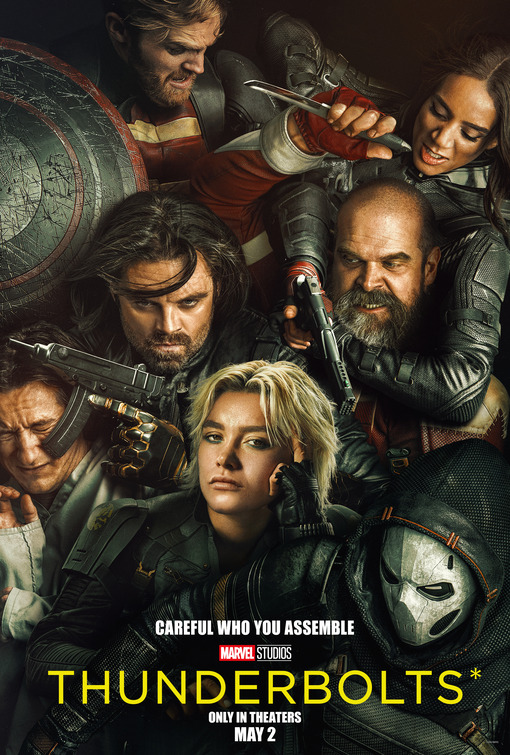
Marvel Studios' Thunderbolts* takes a bold departure from the typical superhero formula by centering its story on a group of morally compromised, deeply damaged operatives who are manipulated into working together by the CIA. Florence Pugh leads the ensemble as Yelena Belova, the Black Widow whose sardonic wit masks genuine trauma, alongside Sebastian Stan's Bucky Barnes, David Harbour's Red Guardian, Wyatt Russell's US Agent, Hannah John-Kamen's Ghost, and Olga Kurylenko's Taskmaster. Directed by Jake Schreier, the film is anchored less in spectacle than in the psychology of people who have spent their lives as weapons.
The film's central mystery revolves around Lewis Pullman's Bob, a seemingly ordinary man connected to a government black site, whose emergence as the immensely powerful Sentry — and his darker alter ego the Void — becomes the team's greatest challenge and most morally complex responsibility. The screenplay by Eric Pearson and Joanna Calo leans into character dynamics and dark humor, giving the film an indie-drama sensibility rarely seen in the MCU. Julia Louis-Dreyfus returns as the scheming Valentina Allegra de Fontaine, whose agenda is never quite what it seems.
Thunderbolts* was widely praised as a breath of fresh air for the Marvel Cinematic Universe — intimate, character-driven, and emotionally resonant. The asterisk in the title, revealed to carry narrative significance within the film itself, became one of the most talked-about marketing mysteries of 2025. For audiences fatigued by world-ending stakes and CGI spectacle, Thunderbolts* offered something rarer: superheroes who feel genuinely, messily human.
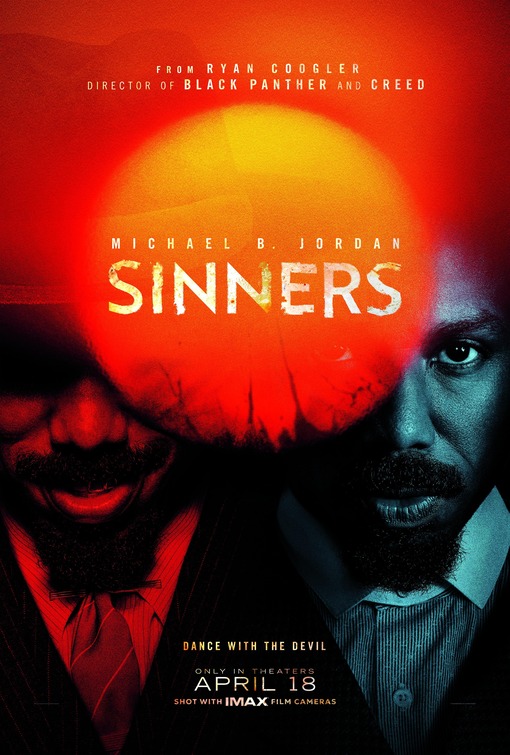
Ryan Coogler's Sinners is a genre-defying supernatural horror film set against the rich cultural backdrop of the Jim Crow South. Michael B. Jordan delivers a tour-de-force dual performance as identical twin brothers Smoke and Stack, who return to Clarksdale, Mississippi in 1932 with dreams of opening a juke joint and giving their community a place of joy and freedom. What begins as a celebration of Black music and resilience quickly turns into a nightmarish battle for survival.
The film weaves blues music into the very fabric of its horror, positing that the raw emotional power of the genre acts as a beacon for ancient, predatory forces. Coogler's direction is stunning in its ambition, blending period authenticity with visceral genre thrills, while Ludwig Göransson's score draws deeply from the blues tradition to create something hauntingly original. The supporting cast — including Hailee Steinfeld, Delroy Lindo, and Wunmi Mosaku — bring extraordinary depth to a story that is as much about cultural memory and survival as it is about monsters.
Sinners arrives as one of the most significant horror films in years, praised for its thematic richness and visual boldness. Coogler negotiated an unprecedented deal with Warner Bros. to retain ownership of the film's physical negative, ensuring his artistic legacy. A passionate celebration of Black American music and an electrifying horror spectacle, Sinners cements Coogler as one of the most vital filmmakers of his generation.
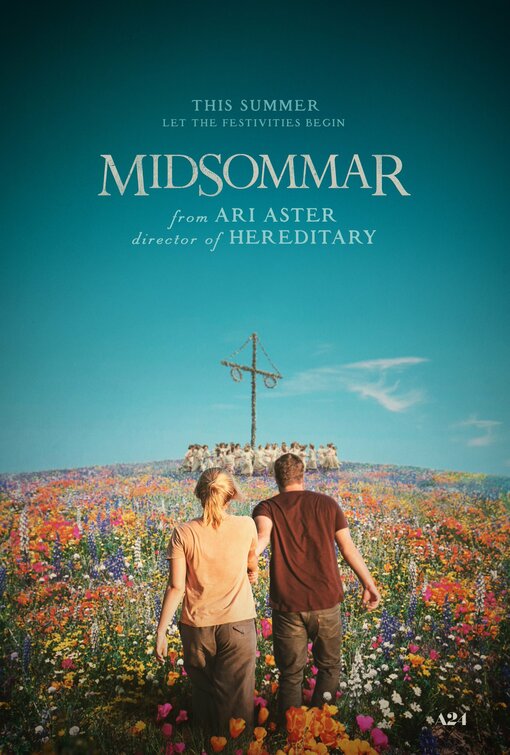
Midsommar is a 2019 folk horror film written and directed by Ari Aster, starring Florence Pugh as Dani Ardor, a grieving American college student who travels to rural Sweden with her emotionally unavailable boyfriend Christian (Jack Reynor) and his friends to attend a seemingly idyllic midsummer festival. What begins as a therapeutic escape from loss slowly reveals itself to be something deeply sinister as the group falls prey to the rituals of a centuries-old pagan commune called the Hårga.
Unlike most horror films set in darkness, Midsommar takes place almost entirely in the perpetual sunlight of the Swedish summer solstice, creating a uniquely unsettling atmosphere where violence and dread unfold in broad daylight amid fields of wildflowers. Florence Pugh delivers a powerhouse performance anchoring the film's emotional core, supported by Jack Reynor, William Jackson Harper, Will Poulter, and Vilhelm Blomgren. The film was shot largely in Hungary at a purpose-built set under cinematographer Pawel Pogorzelski, not in Sweden.
Midsommar was released on July 3, 2019, and was a significant critical success, praised especially for Pugh's performance, Aster's direction, and its subversive approach to grief and co-dependency. The film grossed approximately $29 million worldwide against a $9 million budget. A Director's Cut running 171 minutes — 30 minutes longer than the theatrical version — was later released, restoring scenes that deepen the film's themes and relationships.