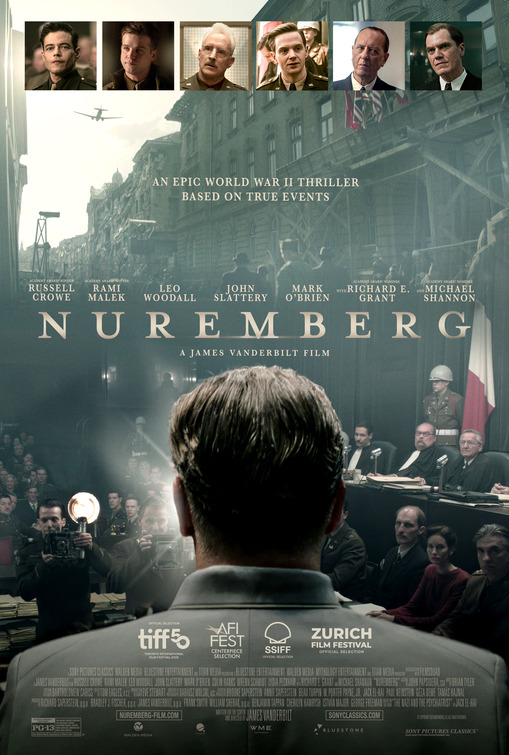
Nuremberg is a 2025 historical drama written and directed by James Vanderbilt, adapted from Jack El-Hai's nonfiction book The Nazi and the Psychiatrist. Released by Sony Pictures Classics, it dramatizes the months surrounding the first Nuremberg trial, when the surviving leaders of the Third Reich were brought before an international tribunal, and centers on the unsettling relationship that formed between a captive Nazi and the American doctor assigned to gauge his sanity.
Rami Malek plays Douglas Kelley, the U.S. Army psychiatrist tasked with evaluating the imprisoned Nazi high command, while Russell Crowe delivers a commanding turn as Hermann Göring, the charismatic and manipulative Reichsmarschall who becomes both his subject and his adversary. Michael Shannon plays Supreme Court Justice Robert H. Jackson, the chief American prosecutor determined to build a lasting framework of international law, with Richard E. Grant, Leo Woodall, John Slattery, and Colin Hanks filling out the ensemble.
Premiering at the Toronto International Film Festival to one of its longest standing ovations, the film earned praise for Crowe's magnetic, chilling performance and for its sober reckoning with how ordinary-seeming men rationalized atrocity. A courtroom drama and a psychological duel in equal measure, it grossed more than $70 million worldwide. Nuremberg is streaming on Netflix.
.jpeg)
We Live in Time is a sweeping romantic drama directed by John Crowley and starring Andrew Garfield and Florence Pugh. The film follows Almut, a driven and fiercely independent chef, and Tobias, a recently divorced cereal-brand executive, as their lives collide unexpectedly outside a hospital. Their relationship unfolds across time, jumping between chance encounters, domestic tenderness, and life-altering crises in a structure that mirrors the fragmented, precious nature of memory itself.
What makes the film so compelling is its non-linear storytelling, which cleverly mirrors how love is experienced — not as a clean narrative arc but as a collection of charged moments. Director Crowley and screenwriter Nick Payne allow the audience to piece together the couple's timeline, so each new scene lands with the weight of everything we know is coming. Andrew Garfield and Florence Pugh give performances of extraordinary generosity and vulnerability, building chemistry that feels entirely authentic.
Ultimately, We Live in Time is a meditation on how much life can be packed into the time we are given, and what it means to love someone fiercely against the backdrop of mortality. It joins the great tradition of films that find beauty in the ordinary — a shared meal, a car journey, a kitchen argument — elevating the mundane into the profound. For fans of deeply felt romantic dramas, it is a film that rewards fully opening your heart to it.
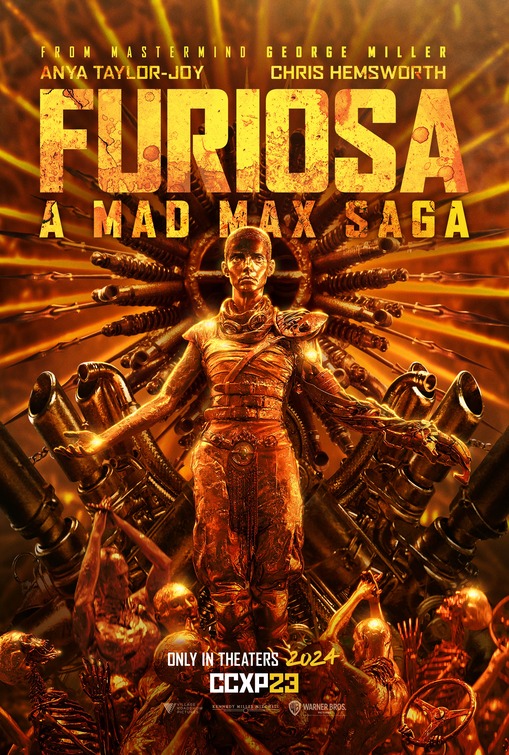
George Miller's Furiosa: A Mad Max Saga is the most ambitious entry in the post-apocalyptic franchise since Mad Max: Fury Road redefined action cinema in 2015. Spanning decades in the life of a warrior who would become one of film's great action heroes, the prequel traces Furiosa's origin from her childhood in the Green Place to her brutal apprenticeship under the warlord Dementus, played with scene-obliterating menace by Chris Hemsworth. This is myth-making on a grand scale, and Miller approaches every frame with the confidence of an artist utterly in command of his craft.
Anya Taylor-Joy steps into the role made iconic by Charlize Theron, and her performance is a revelation — physical, ferocious, and simmering with a grief that slowly calcifies into iron purpose. The film wisely uses silence and restraint as counterweights to its operatic action, giving Taylor-Joy room to convey Furiosa's evolution entirely through expression and physicality. Chris Hemsworth, meanwhile, is unrecognizable beneath layers of prosthetics and a performance that swings between charming and genuinely terrifying.
The action sequences, designed with Miller's signature combination of practical ingenuity and controlled chaos, are among the finest in recent Hollywood history. The centerpiece sequence alone justifies the price of admission, but Furiosa earns its true power in the quieter moments between battles — in the long looks, the stolen memories, and the slow accumulation of loss that makes the eventual warrior Furiosa an inevitable and heartbreaking outcome. It is, without question, one of the decade's most extraordinary studio films.
Thirty-six years after the original haunt-com became a cultural institution, Tim Burton returns to Winter River for Beetlejuice Beetlejuice — a sequel that balances fan service with genuine inventiveness. Lydia Deetz, now a paranormal talk-show host, must travel back to her childhood home with her daughter Astrid following a family tragedy, only to find that the thin veil between the living world and the Netherworld has grown dangerously threadbare. When the name is said three times again, the chaos machine known as the Ghost with the Most roars back to life.
Michael Keaton's return in the title role feels like slipping on a perfectly broken-in pair of shoes — the energy, the mania, and the mischievous spirit are all intact, yet Keaton finds new nuances in a character defined entirely by excess. Winona Ryder is equally assured as the grown-up Lydia, and Jenna Ortega makes a strong impression as Astrid, a teenager whose skepticism toward her mother's supernatural world is tested at every turn. Monica Bellucci and Willem Dafoe round out the ensemble with scene-stealing aplomb.
Burton's vision of the afterlife has never looked more gloriously unhinged, with practical effects and theatrical set design recalling the handcrafted weirdness of the original rather than leaning on sterile CGI. The story threads multiple plot lines with varying success, but the sheer visual audacity and Keaton's magnetic performance carry every scene. Beetlejuice Beetlejuice may not eclipse its predecessor, but it earns its place as a worthy continuation of one of cinema's most singular creative visions.
1917 is a 2019 British epic war film directed by Sam Mendes, who co-wrote the screenplay with Krysty Wilson-Cairns partly inspired by the stories of his grandfather Alfred Mendes, a World War I veteran. The film follows two young British soldiers, Schofield and Blake, played by George MacKay and Dean-Charles Chapman, who are tasked with delivering a critical message across enemy territory on the Western Front. If they fail, 1,600 men will walk into a German trap. What makes the mission feel both intimate and urgent is that the men have only hours to succeed.
The film was designed and shot to appear as a single unbroken take, a technical achievement executed by cinematographer Roger Deakins. This approach places the viewer directly behind the soldiers throughout their harrowing journey, creating a relentless sense of forward momentum and dread unlike any war film before it. The single-shot illusion required painstaking choreography, location scouting in Wiltshire and Hankley Common, and precisely coordinated lighting changes for day-to-night transitions. Every hiding cut had to be invisible to the eye.
1917 received extraordinary critical acclaim and became a major commercial success, grossing over $385 million worldwide. It won three Academy Awards including Best Cinematography for Roger Deakins, Best Sound Mixing, and Best Visual Effects. The film also won the Golden Globe for Best Picture Drama and Best Director, cementing Sam Mendes's reputation as one of the most technically ambitious filmmakers working in Hollywood today.
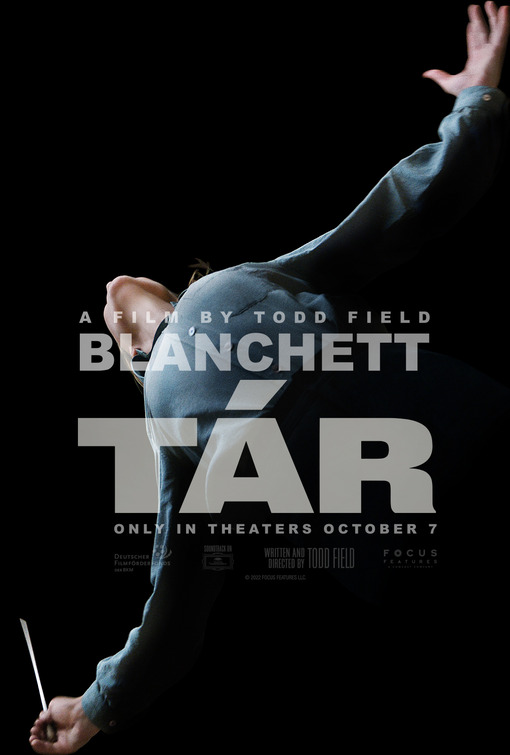
Tár is a 2022 psychological drama film written and directed by Todd Field, his first feature in sixteen years. The film stars Cate Blanchett in what is widely regarded as a career-defining performance as Lydia Tár, a fictional conductor and composer who holds the chief conductor position at the Berlin Philharmonic. As one of the most powerful figures in classical music, Lydia appears to have it all, yet beneath the surface, her life begins to unravel as accusations from her past start to surface in the era of heightened accountability.
The film is a slow-burn character study that resists easy moral categorization. Field's screenplay puts the audience in the uncomfortable position of admiring Lydia's formidable intellect and artistry while also watching her manipulate and abuse those in her orbit. The film explores how power corrupts, how genius is used as a shield, and how institutions protect their most valued assets at the expense of the vulnerable. Structured around a series of escalating crises, Tár builds toward a conclusion that is deliberately ambiguous and deeply unsettling.
Released to critical reverence, Tár earned six Academy Award nominations including Best Picture, Best Director, and Best Actress, with Blanchett winning a Golden Globe and a BAFTA for her performance. Todd Field's meticulous direction, Nina Hoss's understated supporting work, and Florian Hoffmeister's cold, precise cinematography combine to create one of the most discussed and debated films of the decade.
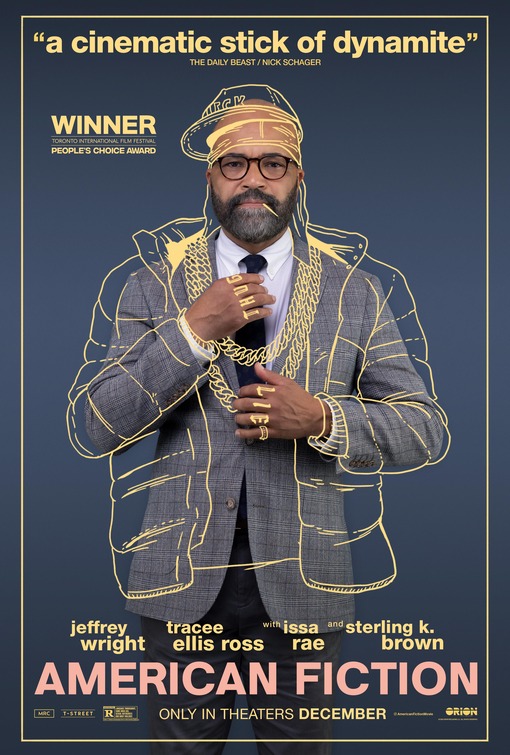
American Fiction is a 2023 satirical drama film written and directed by Cord Jefferson, adapted from Percival Everett's 2001 novel Erasure. The film stars Jeffrey Wright as Thelonious Monk Ellison, a critically respected but commercially overlooked Black novelist who is fed up with the publishing industry's appetite for what it considers authentic Black trauma narratives. Frustrated and financially strained, Monk writes a deliberately offensive manuscript under a pseudonym as a joke, only to watch it become an instant sensation embraced by the very gatekeepers he despises.
The film unfolds as a sharp comedy of errors layered over genuine emotional weight. While Monk wrestles with his literary conscience, he is simultaneously pulled back to his estranged family in Boston, where his mother is in cognitive decline and tensions run high. The dual storyline allows Jefferson to explore themes of identity, the commodification of suffering, and the gap between artistic integrity and commercial success. The ensemble cast, including Tracee Ellis Ross, Sterling K. Brown, and Erika Alexander, elevates the material with warmth and wit.
American Fiction premiered at the Toronto International Film Festival in September 2023 to thunderous acclaim, ultimately earning five Academy Award nominations including Best Picture. Cord Jefferson won the Oscar for Best Adapted Screenplay, making him one of the most celebrated debut feature directors in recent memory. The film stands as a rare Hollywood satire that manages to be both incisive about the industry itself and deeply humane about the people caught within it.
%2520Movie%2520Poster.jpeg)
All of Us Strangers is Andrew Haigh's masterful ghost story and love story braided into one — a film about a lonely screenwriter named Adam (Andrew Scott) who, living alone in a near-empty London tower block, strikes up a tender romance with his downstairs neighbor Harry (Paul Mescal) and simultaneously begins to visit his childhood home, where his parents — who died in a car crash thirty years ago — are somehow still alive and exactly as he remembers them.
Haigh, working from Taichi Yamada's 1987 novel Strangers, shapes the supernatural elements not as horror but as an expression of grief's logic: the way the dead linger in imagination, the conversations we never got to have, the acceptances we never received. The scenes between Adam and his parents (played with devastating warmth by Claire Foy and Jamie Bell) are among the most emotionally precise of any film in recent memory — funny and heartsick and full of the specific texture of a childhood home.
Anchored by Andrew Scott's profoundly open performance and the luminous chemistry between Scott and Mescal, All of Us Strangers asks how we learn to love when we never fully learned it growing up. It is a film of immense compassion, one that aches with the weight of all that grief and loneliness can cost a person — and all that love, however strange and fleeting, can give back.
%2520Movie%2520Poster.jpeg)
Aftersun is Charlotte Wells's achingly tender debut feature, a film that captures a holiday between a young father and his eleven-year-old daughter through the uncertain light of memory and grief. Sophie (Frankie Corio) and her father Calum (Paul Mescal) spend a vacation at a modest Turkish resort, and the film unspools through fragments — video footage Sophie shot on a camcorder, recalled images, half-heard conversations — as an adult Sophie tries to reconstruct what she did not understand as a child.
What makes Aftersun so quietly devastating is what it withholds. Wells refuses easy explanations, allowing meaning to accumulate through texture: the way Calum holds himself when he thinks no one is watching, the tenderness with which he films his daughter, the unbridgeable gap between a parent's inner life and a child's perception of it. Paul Mescal delivers a performance of extraordinary restraint, communicating depths of sadness through gesture and avoidance rather than declaration.
The film works in the tradition of quiet, personal cinema — closer to poetry than plot — and belongs alongside such introspective works as Mike Mills's 20th Century Women and Kelly Reichardt's Certain Women. Released to a rapturous critical reception, Aftersun earned Paul Mescal an Academy Award nomination for Best Actor and established Charlotte Wells as one of the most distinctive voices in contemporary world cinema.
%2520Movie%2520Poster.jpeg)
La La Land is a modern musical love story that sweeps audiences into the golden dream of Los Angeles through the eyes of two aspiring artists. Mia (Emma Stone), a struggling actress working as a barista, and Sebastian (Ryan Gosling), a jazz pianist determined to open his own club, meet by chance and fall into an unexpected romance that both inspires and complicates their individual pursuits of greatness. Writer-director Damien Chazelle conjures a city of dreamers and doers, where ambition and love are both luminous and fragile.
The film is a breathtaking fusion of classic Hollywood musicals and contemporary heartache, its saturated palette and soaring score by Justin Hurwitz evoking the era of Vincente Minnelli while its emotional core remains distinctly modern. Chazelle directs Stone and Gosling — reuniting after Crazy, Stupid, Love — with exquisite delicacy, allowing their chemistry to breathe through stolen glances and halting conversations as much as through the film's showstopping set-pieces, including a sublime dance sequence at the Griffith Observatory.
La La Land swept the 2017 awards season, earning a record-tying fourteen Academy Award nominations and winning six, including Best Director for Chazelle and Best Actress for Stone. Beyond the accolades, the film endures as a bittersweet meditation on what we sacrifice to become who we want to be — and whether the version of ourselves that succeeds is still the person who fell in love.
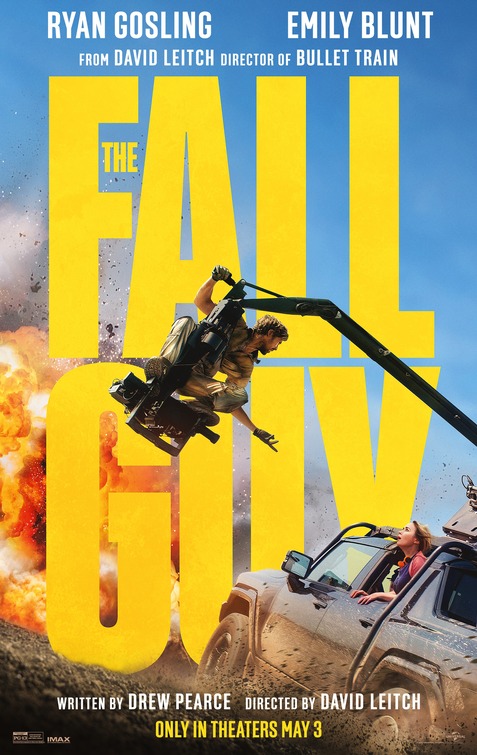
Based on the beloved 1980s television series, The Fall Guy is a high-octane tribute to the unsung heroes of Hollywood: the stunt performers. Ryan Gosling stars as Colt Seavers, a veteran stuntman pulled back into the industry when a major movie star goes missing on the set of a blockbuster production in Australia. Directed by David Leitch, himself a former stuntman, the film is a love letter to the craft that makes cinema's most spectacular moments possible.
Emily Blunt co-stars as Jody Moreno, the film's director and Colt's ex-girlfriend, whose production is thrown into chaos by the disappearance. As Colt investigates, he uncovers a conspiracy involving crime bosses and a desperate cover-up that could derail the entire production. The film balances big action setpieces with sharp comedy, delivering some of the most inventive stunt work seen on screen in years.
The Fall Guy is a crowd-pleasing action-comedy with genuine heart, celebrating the adrenaline and sacrifice behind cinema's biggest thrills. It features a record-breaking cannon roll stunt performed live on camera and a soundtrack perfectly calibrated for maximum cinematic fun, earning devoted audiences globally.