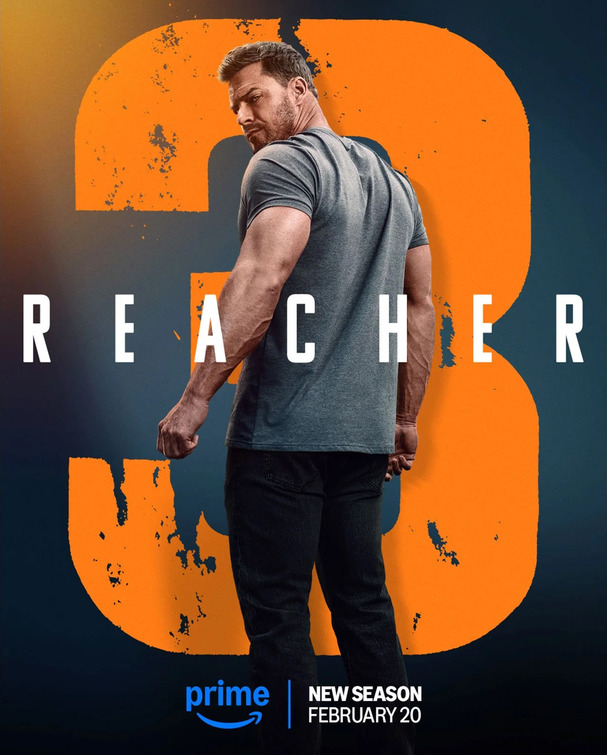
Reacher Season 3 continues Amazon Prime Video's hit action series based on Lee Child's best-selling novels about Jack Reacher, a hulking former military police investigator who drifts across America and inevitably collides with violent conspiracies. One of Prime Video's most-watched originals, the show adapts a different book in the series each season.
Alan Ritchson returns as the imposing, sharp-witted Reacher, this time in an adaptation of Child's fan-favorite novel Persuader, which sends him deep undercover to infiltrate a dangerous criminal operation. Maria Sten returns as his ally Frances Neagley, with new faces including Anthony Michael Hall and, as a towering enforcer, the seven-foot-plus Dutch Giant Olivier Richters.
The season premiered in February 2025 and launched to the strongest reviews in the show's history, around 98% on Rotten Tomatoes, with critics noting that Reacher finally faced an opponent his own size. It remained one of Prime Video's biggest draws. Streaming on Prime Video.
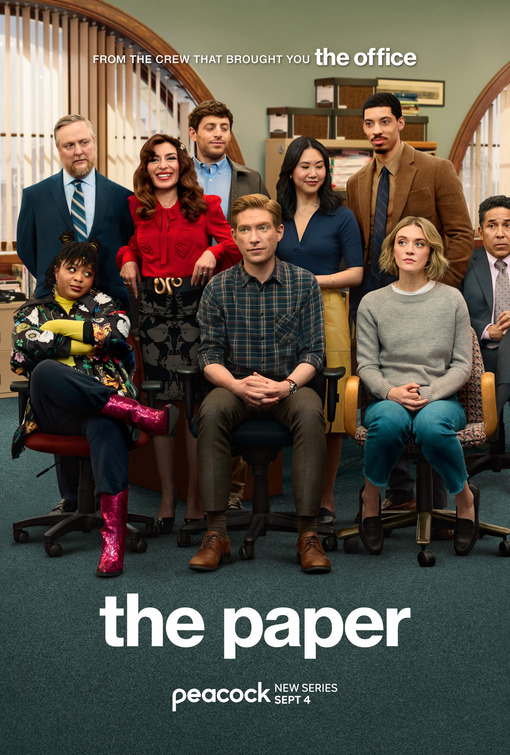
The Paper returns for its second season on Peacock, continuing the mockumentary comedy set in the same universe as The Office. Created by Greg Daniels and Michael Koman, the series follows the very documentary crew that once immortalized Dunder Mifflin as they keep their cameras trained on a new subject: the Toledo Truth Teller, a withering Midwestern newspaper fighting to stay alive.
Domhnall Gleeson returns as earnest editor-in-chief Ned Sampson, alongside Sabrina Impacciatore as managing editor Esmeralda Grand and Oscar Nuñez, reprising accountant Oscar Martinez from the original Office. Season 2 deepens the ensemble of volunteer reporters and newsroom eccentrics, with Chelsea Frei, Melvin Gregg, Gbemisola Ikumelo, and Alex Edelman among the returning staff, and a run of guest turns from comic ringers including Jon Lovitz and Andy Richter.
The first season won warm reviews for finding its own rhythm while honoring the DNA of its predecessor, and Peacock renewed it well ahead of the second season's arrival. By anchoring its workplace comedy to a dying local newspaper, the show keeps a bittersweet, timely edge beneath the laughs. The Paper Season 2 premiered on September 9, 2026, and is streaming on Peacock.

House of the Dragon Season 3 returns HBO's blockbuster Game of Thrones prequel to the heart of the Targaryen civil war, the ruinous succession conflict known as the Dance of the Dragons. Developed by George R.R. Martin and showrunner Ryan Condal, who now steers the series solo, the eight-episode third season picks up from the shattering events that closed Season 2 as both claimants to the Iron Throne finally commit to open war.
Emma D'Arcy and Tom Glynn-Carney return as the rival monarchs Rhaenyra Targaryen and Aegon II, with Olivia Cooke as Alicent Hightower, Matt Smith as the mercurial Daemon, and Ewan Mitchell as the fearsome Aemond. The new season widens the board with major additions including James Norton as Ormund Hightower and Tommy Flanagan as Roderick Dustin, as alliances harden, dragons are drawn into battle, and the realm braces for slaughter on a scale the franchise has not yet shown.
The season premiered on HBO Max on June 21, 2026, and immediately reasserted the show's dominance, drawing more than twenty million viewers worldwide to its premiere and holding a 91% score on Rotten Tomatoes. With a fourth and final season already ordered, Season 3 escalates the tragedy toward its inevitable, fiery conclusion. House of the Dragon Season 3 is streaming on HBO Max.

Nine Puzzles is a Korean crime-mystery thriller released on Disney+ in 2025, which became the platform's most-watched Korean title of the year. Directed by acclaimed filmmaker Yoon Jong-bin in a notable move into series television, the show is a twisty, atmospheric hunt for a serial killer built around a chilling signature.
Kim Da-mi stars as Yun-i, a gifted criminal profiler who, years earlier, was the prime suspect in the shocking murder of her uncle — a case that left her an outsider haunted by suspicion. When a new string of killings begins, each crime scene marked with a piece of a puzzle, she is pulled back in alongside a wary detective played by Son Suk-ku, and the scattered pieces slowly point toward her own buried past.
Praised for its moody visuals, its intricate plotting, and the tense dynamic between its two leads, Nine Puzzles helped reinvigorate Disney+'s Korean slate and was a critical and popular success. Its deliberate, clue-by-clue construction rewards viewers piecing the mystery together alongside its heroine. It is streaming on Disney+.
Bon Appétit, Your Majesty is a Korean fantasy romance drama that streamed on Netflix and aired on tvN in 2025, becoming one of the year's surprise breakout hits. Blending time-travel fantasy, historical intrigue, and mouthwatering culinary spectacle, the series pairs a modern cooking prodigy with a fearsome Joseon-era monarch.
Im Yoon-ah (of Girls' Generation) stars as Yeon Ji-yeong, an acclaimed contemporary chef who is mysteriously transported to the Joseon dynasty, where she must cook to survive at the court of the tyrannical King Yi Heon, played by Lee Chae-min. As she wins favor — and stirs romance — through extraordinary food, her modern techniques collide with palace politics and the king's fearsome reputation, turning each dish into a matter of life and death.
The series was a ratings success in Korea and a strong performer on Netflix internationally, praised for its lavish food styling, comic energy, and the crackling chemistry between its leads. Its winning mix of gastronomy and fairy-tale romance made it one of 2025's most talked-about feel-good K-dramas. It is streaming on Netflix.
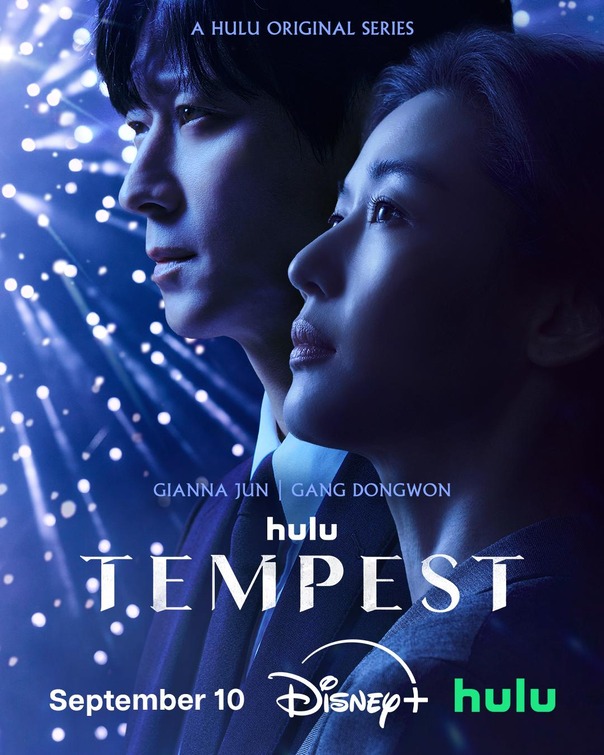
Tempest is a Korean political-action thriller released on Disney+ in 2025, one of the platform's most ambitious and expensive Korean originals to date. Directed by Kim Hee-won and mounted with the scale and star power of a feature film, it was among the most anticipated K-dramas of the year.
Jun Ji-hyun (credited internationally as Gianna Jun) stars as Seo Mun-ju, a celebrated former diplomat and ambassador drawn into a lethal geopolitical conspiracy, while Gang Dong-won plays a mysterious mercenary who becomes her uneasy ally. As an assassination and a web of international intrigue threaten the Korean peninsula, the two are pulled across borders in a high-stakes game of espionage. American actor John Cho appears in a key supporting role, underscoring the show's international ambitions.
Positioned as a globe-trotting tentpole, Tempest drew huge attention for pairing two of Korea's biggest screen stars and for its cinematic production values, delivering shootouts, political brinkmanship, and shifting allegiances across its run. It streams on Disney+.

The Trauma Code: Heroes on Call is a Netflix original Korean medical-action series based on a hit web novel and its webtoon adaptation. Premiering in January 2025, the eight-episode series was one of the streamer's first big global successes of the year, fusing high-stakes hospital drama with a propulsive, almost action-movie energy.
Ju Ji-hoon stars as Baek Kang-hyeok, a brilliant, unorthodox trauma surgeon with battlefield experience who is recruited into the under-funded, understaffed trauma center of a major hospital. Blunt, fearless, and often infuriating to the bureaucrats around him, he sets about transforming the department and galvanizing a demoralized team, with Choo Young-woo as the young doctor pulled into his orbit. The series balances grisly, fast-moving emergency cases with sharp humor and institutional satire.
The Trauma Code shot to the top of Netflix's global non-English charts on release, praised for its brisk pacing, dark comedy, and Ju Ji-hoon's charismatic lead performance, and a second season is in the works. It stands out as a rare Korean medical drama built for pure momentum. It is streaming on Netflix.

Maxton Hall - The World Between Us is a German romantic drama produced for Prime Video, adapted from Mona Kasten's bestselling novel Save Me, the first book in her Maxton Hall trilogy. After its first season became a breakout global hit in 2024 — one of the most-watched non-English titles in Prime Video's history — the series returned for a second season in late 2025.
The story follows Ruby Bell (Harriet Herbig-Matten), a scholarship student with Oxford ambitions at the elite Maxton Hall private school, and James Beaufort (Damian Hardung), the wealthy, arrogant heir who is drawn to her against the rigid expectations of his powerful family. The second season, adapting the darker second novel Save You, deepens their turbulent romance as grief, family duty, and class divides threaten to pull them apart.
A phenomenon particularly among young-adult and romance audiences, the series was renewed for further seasons on the strength of its passionate international fandom. Blending swoony romance with high-gloss production, Maxton Hall has become one of Prime Video's signature international franchises. It streams on Prime Video.

When Life Gives You Tangerines (Korean title Pokssak Sogatsuda) is a Netflix original Korean drama written by Lim Sang-choon and directed by Kim Won-seok, released in 2025 to extraordinary acclaim. Structured as a decades-spanning life story told across sixteen episodes and four seasonal parts, it stands as one of the most celebrated Korean dramas in recent memory.
Set in motion on the southern island of Jeju, it follows the spirited, rebellious Ae-sun and the steadfast, devoted Gwan-sik from their youth in the mid-twentieth century through a lifetime of love, hardship, and family. IU and Park Bo-gum play the couple in their younger years, with acclaimed film actors Moon So-ri and Park Hae-joon portraying them in later life, tracing the sweep of modern Korean history through the intimate joys and sorrows of a single family.
The series became a global phenomenon on Netflix and a critical darling, praised for its luminous performances, its poetic writing, and the emotional force of its multi-generational story, which moved viewers around the world to tears. Widely hailed as a modern classic of the form, it cemented IU and Park Bo-gum as one of the most beloved on-screen pairings of the year. When Life Gives You Tangerines is streaming on Netflix.

Poker Face Season 2 continues Rian Johnson's Peacock mystery series, a loving throwback to the case-of-the-week detective shows of the 1970s. Natasha Lyonne returns as Charlie Cale, the wisecracking drifter with an uncanny, infallible knack for telling when someone is lying, a gift that keeps dragging her into murder after murder as she travels across America.
Back on the road in her battered Plymouth Barracuda, Charlie stumbles into a fresh set of standalone whodunits, each stocked with a rotating roster of guest stars. Season 2's lineup is loaded, featuring the likes of Cynthia Erivo, Awkwafina, Katie Holmes, Kumail Nanjiani, Giancarlo Esposito, John Mulaney and Melanie Lynskey, with the series' signature howcatchem structure showing the crime before Charlie unravels it.
The second season drew generally positive reviews, with critics again crediting Lyonne's magnetic lead performance and the show's inventive, star-studded standalone episodes, even as some felt the formula had grown familiar. Streaming on Peacock.

Only Murders in the Building Season 5 brings back Hulu's Emmy-nominated comic murder mystery, with Steve Martin, Martin Short and Selena Gomez reprising their roles as true-crime podcasters Charles, Oliver and Mabel. After four seasons of solving killings inside their storied Manhattan apartment building, the Arconia, the trio face a case that strikes closer to home than ever.
This season opens with the death of Lester, the Arconia's longtime doorman, plunging Charles, Oliver and Mabel into a New York underworld of mobsters and billionaire power players in a scheme that threatens the very future of their beloved building. As ever, the show stuffs its whodunit with A-list guest stars, this season including Renee Zellweger, Christoph Waltz, Keegan-Michael Key, Tea Leoni, Logan Lerman, Beanie Feldstein and Bobby Cannavale, alongside returning Oscar winner Meryl Streep.
A consistent awards favorite, Only Murders continued its critical run with Season 5, which reviewers praised for returning to the series' fundamentals: warm banter, clever plotting and the irreplaceable chemistry of its three leads. Streaming on Hulu.