Nuremberg is a 2025 historical drama written and directed by James Vanderbilt, adapted from Jack El-Hai's nonfiction book The Nazi and the Psychiatrist. Released by Sony Pictures Classics, it dramatizes the months surrounding the first Nuremberg trial, when the surviving leaders of the Third Reich were brought before an international tribunal, and centers on the unsettling relationship that formed between a captive Nazi and the American doctor assigned to gauge his sanity.
Rami Malek plays Douglas Kelley, the U.S. Army psychiatrist tasked with evaluating the imprisoned Nazi high command, while Russell Crowe delivers a commanding turn as Hermann Göring, the charismatic and manipulative Reichsmarschall who becomes both his subject and his adversary. Michael Shannon plays Supreme Court Justice Robert H. Jackson, the chief American prosecutor determined to build a lasting framework of international law, with Richard E. Grant, Leo Woodall, John Slattery, and Colin Hanks filling out the ensemble.
Premiering at the Toronto International Film Festival to one of its longest standing ovations, the film earned praise for Crowe's magnetic, chilling performance and for its sober reckoning with how ordinary-seeming men rationalized atrocity. A courtroom drama and a psychological duel in equal measure, it grossed more than $70 million worldwide. Nuremberg is streaming on Netflix.

Flow (2024), the Latvian animated film directed by Gints Zilbalodis, is one of the most remarkable cinematic achievements of recent years — a feature made almost entirely by a single person over four years, using open-source software, with no dialogue and no human characters. The film follows a small black cat who survives a catastrophic flood and must share a boat with an unlikely assortment of animals: a capybara, a lemur, a dog, and a secretary bird. What unfolds is a wordless odyssey of survival, distrust, and ultimately fragile cooperation across a submerged world of breathtaking visual invention.
Zilbalodis builds his film entirely through image and sound. There is no narrator, no exposition, and no anthropomorphism beyond the bare fact of survival instinct. The animals behave as animals — curious, cautious, territorial, occasionally cruel — and yet the film's emotional architecture is extraordinarily sophisticated. The cat's journey from solitary wariness to something approaching trust forms the spine of the story, rendered with a patience and precision that most big-studio animated films never achieve.
Flow won the Academy Award for Best Animated Feature at the 97th Oscars, making it the first Latvian film to win in that category and one of the rare non-English-language animated films to take the prize over major studio contenders. Its victory was widely celebrated as recognition of what independent animation can achieve outside the traditional production machine.

Emilia Pérez is a 2024 genre-defying film written and directed by Jacques Audiard, the French filmmaker behind A Prophet and Rust and Bone. Shot entirely in Spanish — a language Audiard does not natively speak — the film blends Mexican cartel thriller, sung musical, and gender-transformation drama into a single, deliberately hybrid form that resists easy categorization. At its center is a cartel kingpin who arranges her own death, undergoes gender reassignment surgery to begin a new life as Emilia Pérez, and finds that escaping one identity does not erase the moral weight of the other.
The film stars Karla Sofía Gascón in the title role, opposite Zoe Saldaña as Rita Mora, the criminal defense lawyer enlisted to facilitate the transformation and disappearance. Selena Gomez plays the cartel boss's abandoned wife, and Adriana Paz rounds out the principal cast as a woman Emilia connects with in her new life. All four actresses jointly received the Best Actress prize at the 2024 Cannes Film Festival — an unprecedented collective award that reflected Audiard's insistence that the performances were too deeply interdependent to single out any one of them.
Emilia Pérez received 13 Academy Award nominations — the most of any non-English language film in Oscar history — and won four, including Best Supporting Actress for Zoe Saldaña and Best Original Song for the number "El Mal." Karla Sofía Gascón became the first openly transgender actress nominated for Best Actress. The film also won the Cannes Grand Jury Prize and became one of Netflix's most-discussed international releases of 2024, praised for its formal boldness and divisive for its approach to its subject matter.
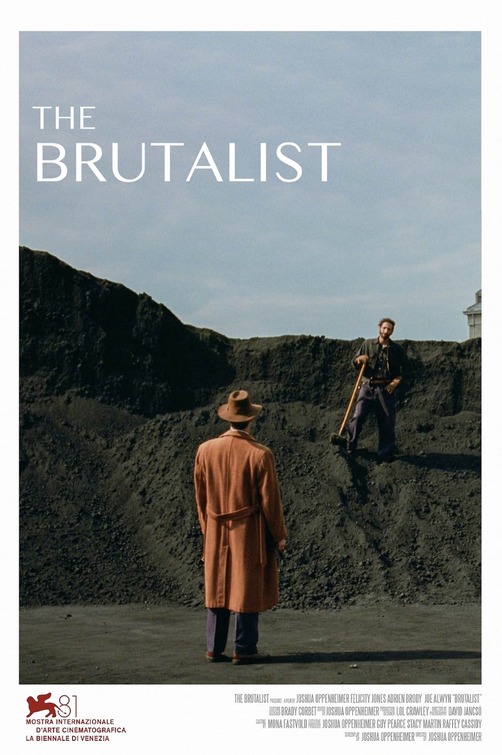
The Brutalist is a 2024 epic drama written and directed by Brady Corbet, the American actor turned filmmaker whose previous features A Song of Innocence and Vox Lux marked him as a singular and uncompromising voice in American independent cinema. The film tells the story of László Tóth (Adrien Brody), a Hungarian-Jewish architect who survives the Holocaust and emigrates to the United States in 1947, carrying with him the legacy of European Modernism and the weight of an unimaginable past. What follows is a sweeping chronicle of the American immigrant experience as seen through the particular prism of art, architecture, and the relentless pursuit of a transformative idea.
The film stars Adrien Brody in what critics immediately recognized as the performance of his career, opposite Felicity Jones as Erzsébet, the wife he leaves behind in war-torn Europe and strains toward across an ocean and years of separation. Guy Pearce plays Harrison Lee Van Buren, a wealthy American industrialist who becomes both László's patron and his most complicated antagonist. Joe Alwyn and Stacy Martin round out a remarkable ensemble. Cinematographer Lol Crawley shot the film in VistaVision — a wide-gauge film format associated with the Hollywood epics of the 1950s — giving the images an expansive, period-appropriate scale that frames László's architectural visions with the grandeur they demand.
The Brutalist premiered at the Venice Film Festival in 2024, where Brody won the Volpi Cup for Best Actor. The film went on to win three Academy Awards at the 97th ceremony: Best Actor for Brody, Best Director for Corbet, and Best Cinematography for Crawley. At three hours and thirty-five minutes — presented with an intermission — it is among the most ambitious American films of the decade, asking its audience to reckon with the American Dream, the nature of artistic genius, and the terrible cost of starting over in an adopted country. Critics placed it among the finest films of 2024.

Hit Man is a 2024 crime comedy film written by Richard Linklater and Glen Powell, inspired by a true story first reported in a 2001 Texas Monthly article about Gary Johnson, a real New Orleans professor and part-time police consultant who spent years posing as a hitman in FBI sting operations. Directed by Linklater — whose career spans Dazed and Confused, Before Sunrise, Boyhood, and School of Rock — the film is a gleeful, stylistically confident blend of comedy, romance, and thriller that stands as one of the director's most purely entertaining and commercially accessible works.
Glen Powell stars as Gary Johnson, a mild-mannered philosophy professor who discovers an unexpected talent and appetite for playing hired killers in undercover operations — slipping effortlessly between personas, costumes, and accents to become whatever the client needs to see. When he meets Madison (Adria Arjona), a woman who comes to him seeking escape from an abusive husband, Gary breaks every protocol by developing real feelings for her — creating a dangerous entanglement between the hitman he plays and the person he actually is. Austin Amelio, Retta, and Sanjay Rao provide strong supporting turns in a film that keeps its audience off-balance about who and what to trust.
Hit Man premiered at the Venice Film Festival in September 2023 and was subsequently acquired by Netflix for a 2024 theatrical and streaming release, becoming one of the platform's most acclaimed original films that year. The film was celebrated for Powell's star-making performance — a comedically expert, physically precise turn that established him as one of Hollywood's most versatile leading men — and for Linklater's assured, playful direction, which brings the same improvisational spirit and philosophical lightness to genre material that has characterized his career's best work.
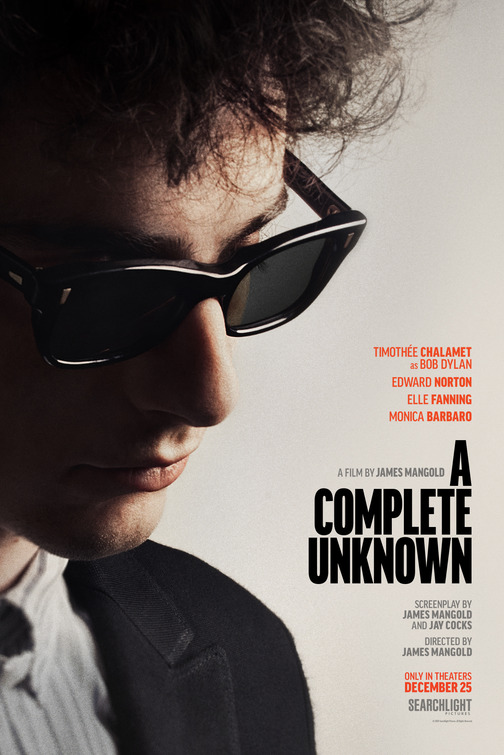
A Complete Unknown is a 2024 biographical drama directed by James Mangold and adapted from Elijah Wald's 2015 book Dylan Goes Electric!, which chronicles the first years of Bob Dylan's life in New York City — from his arrival as an unknown nineteen-year-old folk singer in January 1961 to his electrifying, polarizing performance at the Newport Folk Festival in July 1965, where he abandoned acoustic folk music for an amplified rock band and divided his audience down the middle. Mangold — whose previous work includes Walk the Line, Ford v Ferrari, and Indiana Jones and the Dial of Destiny — brings the full force of his storytelling economy and visual confidence to a story about artistic transformation and the cost of public reinvention.
Timothée Chalamet stars as Dylan, in a performance that required him to sing, play guitar, and play harmonica live on camera without musical doubles — a level of physical commitment that drew extensive critical admiration. The ensemble includes Monica Barbaro as Joan Baez, Elle Fanning as Sylvie Russo (a composite character representing Suze Rotolo), Edward Norton as Pete Seeger, Boyd Holbrook as Johnny Cash, and Norbert Leo Butz as Alan Lomax. The film captures the Greenwich Village folk scene at its creative and political apex, with Dylan moving through a world of coffeehouses, college campuses, and civil rights rallies where the stakes of artistic choices feel genuinely consequential.
Released on Christmas Day 2024, A Complete Unknown earned eight Academy Award nominations including Best Picture and Best Actor for Chalamet — one of the most anticipated performances of that awards cycle. Mangold and Chalamet collaborated closely with Dylan himself during production, and the film presents an intimate, psychologically rich account of how one of popular music's most transformative and elusive figures became who he is — using the Newport controversy as the story's emotional climax and the defining act of artistic self-determination.
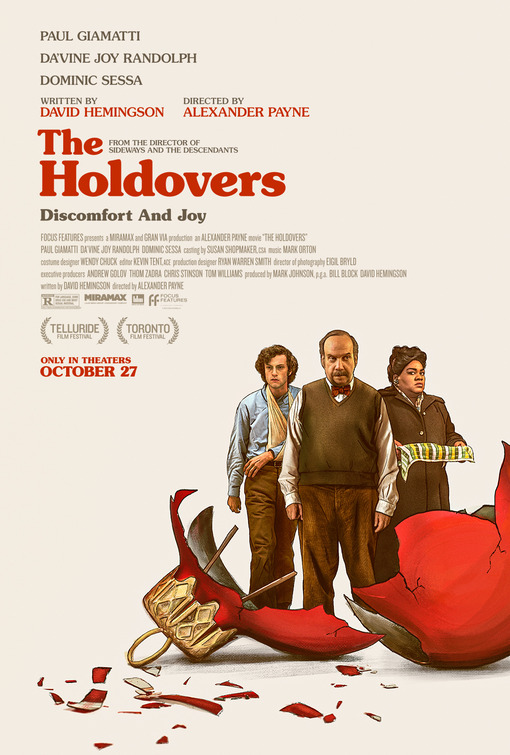
The Holdovers is a 2023 comedy-drama film written by David Hemingson and directed by Alexander Payne, whose previous work includes Sideways, Nebraska, and The Descendants. Set at a fictional New England prep school during the winter break of 1970, the film was produced by Focus Features with a deliberate visual and tonal commitment to the cinema of the 1970s — textured film grain, faded color palette, a setting sealed from the modern world by snow and institutional isolation.
The film stars Paul Giamatti as Paul Hunham, a cantankerous classics teacher with a wandering eye and no known social life, who is grudgingly assigned to watch over students unable to go home for Christmas. When most of the students are spirited away mid-break, Hunham finds himself trapped with just one student — Angus Tully (Dominic Sessa, in his feature debut), a brilliant, furious, grieving teenager — and Mary Lamb (Da'Vine Joy Randolph), the school's head cook carrying her own devastating loss. What unfolds is a three-character study of loneliness, class, grief, and unexpected connection across the frozen holiday weeks.
The Holdovers earned five Academy Award nominations including Best Picture and Best Actor for Giamatti, while Da'Vine Joy Randolph won the Academy Award for Best Supporting Actress — a deeply felt, near-unanimous choice across every awards body that season. Critics celebrated the film's warmth, its refusal to sentimentalize its characters' pain, and its commitment to an older kind of American movie-making that feels both nostalgic and newly necessary. It stands as one of the finest American comedies of the decade.

All Quiet on the Western Front is a German-language anti-war epic directed by Edward Berger, adapted from Erich Maria Remarque's landmark 1929 novel. The film follows Paul Bäumer (Felix Kammerer), a young German soldier who enlists with patriotic fervor during World War I, only to confront the savage, dehumanizing reality of trench warfare on the Western Front. It is the first German-language adaptation of the novel, bringing a native perspective to one of literature's most enduring anti-war masterpieces.
Berger's approach is both visceral and elegiac, plunging viewers into the mud and blood of the trenches while allowing quiet moments of camaraderie and shattered innocence to surface. The production design, cinematography, and sound design combine to create an immersive and harrowing portrait of industrialized death. Daniel Brühl appears in a parallel storyline as German diplomat Matthias Erzberger, negotiating the armistice that will end the war — a storyline not present in the original novel but one that adds devastating dramatic irony to Paul's fate in the film's final hour.
Submitted by Germany as its Academy Award entry, the film received nine Oscar nominations — the most ever for a German film — winning four, including Best International Feature Film, Best Cinematography, Best Original Score, and Best Production Design. It remains the most internationally decorated German film in Oscar history and a landmark achievement in European war cinema that stands alongside the greatest anti-war films ever made.

Saltburn is a darkly seductive psychological thriller written and directed by Emerald Fennell, the Oscar-winning filmmaker behind Promising Young Woman. Set in the summer of 2006, the film follows Oliver Quick (Barry Keoghan), a scholarship student at Oxford who becomes obsessed with the golden, aristocratic Felix Catton (Jacob Elordi). When Felix impulsively invites Oliver to spend the summer at Saltburn, the Catton family's sprawling English estate, the visit takes increasingly sinister turns.
The film is a razor-sharp dissection of class, desire, and obsession, drawing comparisons to Patricia Highsmith's Ripley novels and Brideshead Revisited. Fennell uses the opulent visual language of the English country house to create an atmosphere of gilded menace, contrasting the easy privilege of the Catton family against Oliver's calculated hunger. Rosamund Pike delivers a scene-stealing performance as Elspeth, Felix's magnificent and oblivious mother, while Carey Mulligan, Paul Rhys, and Archie Madekwe round out the ensemble.
Saltburn divided critics and captivated audiences upon its theatrical release, with Barry Keoghan's performance earning particular praise and award attention. The film's final sequence became a cultural talking point, and its stylized visuals and needle-drop soundtrack lodged it firmly in the cultural consciousness of 2023. Available on Amazon Prime Video, it remains one of the most-discussed films of the year.

Past Lives is a deeply moving romantic drama written and directed by Celine Song, based on her own experiences as a Korean immigrant. The film follows Nora (Greta Lee) and Hae Sung (Teo Yoo), two childhood sweethearts in Seoul who are separated when Nora's family emigrates to Canada. Their connection resurfaces through video calls twelve years later, and again when Hae Sung travels to New York City to see Nora, now a playwright married to Arthur (John Magaro).
Set across two decades and multiple continents, the film explores themes of memory, cultural identity, and the paths not taken. Song crafts a narrative that is both intimate and epic in scale, examining what it means to leave one life behind in pursuit of another. The film's title references the Korean concept of in-yeon — the idea that people are connected across many lifetimes — lending a spiritual dimension to an otherwise grounded story.
Past Lives received universal critical acclaim upon its premiere at the Sundance Film Festival in January 2023, where it won the Audience Award. The film went on to earn two Academy Award nominations, including Best Picture, and is widely regarded as one of the finest debut features in recent memory. Greta Lee's nuanced performance anchors the film with extraordinary subtlety and emotional depth.
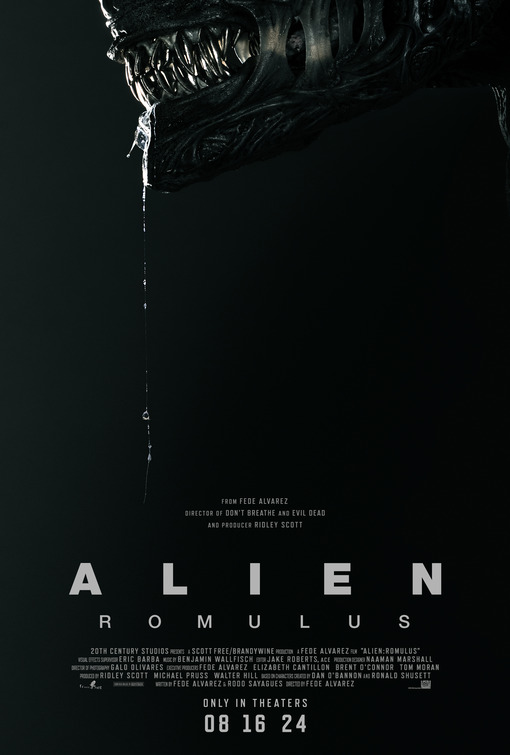
Alien: Romulus is a 2024 science fiction horror film directed by Fede Álvarez and produced by Scott Free Productions and 20th Century Studios, serving as a standalone entry in the Alien franchise set between the events of Ridley Scott's original Alien (1979) and James Cameron's Aliens (1986). The film follows a group of young space colonists who board an abandoned deep-space station and unwittingly encounter the most terrifying life form in the galaxy. Álvarez, whose previous work includes the Evil Dead remake and Don't Breathe, brings his distinctive talent for sustained dread and practical horror craft to the franchise's mythology.
The film stars Cailee Spaeny as Rain Carradine, a colonist desperate to escape her dead-end mining world who leads a small crew onto the derelict station Romulus in search of equipment that could fund their escape to a better planet. David Jonsson plays her android companion Andy, whose shifting allegiances become one of the film's central sources of tension. Archie Renaux, Isabela Merced, Spike Fearn, and Aileen Wu round out the crew. The film generated significant discussion for its use of digitally recreated imagery of the late Ian Holm, who played the android Ash in the original 1979 film.
Alien: Romulus earned strong critical reception and proved a considerable commercial success, grossing over $350 million worldwide against a reported budget in the range of $80 million — making it one of the most profitable entries in the Alien franchise in decades. Critics praised Álvarez's disciplined command of suspense, the film's impressive practical effects work, and its skill in expanding the franchise's mythology while delivering the sustained terror that the series' best installments have always provided. The film was seen as a significant course correction for a franchise that had struggled with its two most recent installments.