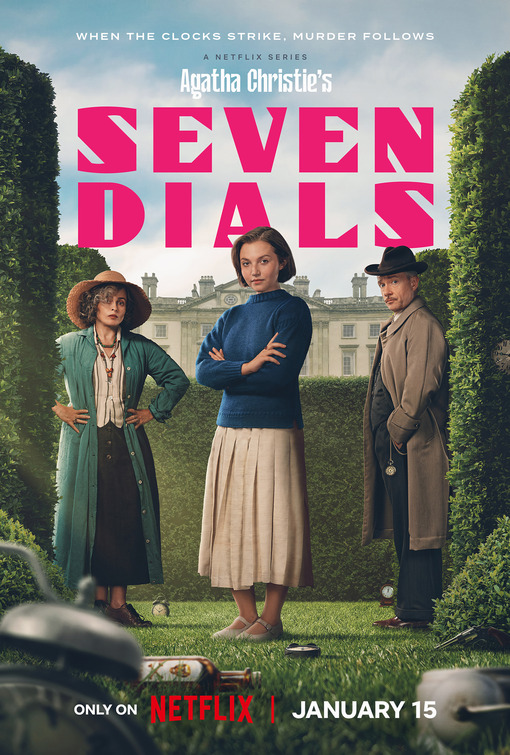
Agatha Christie's Seven Dials is a Netflix period mystery adapted by Chris Chibnall, the creator of Broadchurch and a former Doctor Who showrunner, from Christie's 1929 novel The Seven Dials Mystery. Directed by Chris Sweeney and released in January 2026 as a three-part miniseries, it revives one of the author's lighter, thriller-tinged whodunits with a starry British cast.
Set in 1925, the story follows the spirited Lady Eileen 'Bundle' Brent, played by Mia McKenna-Bruce, who investigates the suspicious death of a Foreign Office colleague and uncovers a shadowy secret society known as the Seven Dials, along with a conspiracy tangled up in her own father's death years earlier. Martin Freeman plays Superintendent Battle, with Helena Bonham Carter as Lady Caterham, Iain Glen as Lord Caterham and Edward Bluemel among the ensemble.
The debut production of the newly formed Orchid Pictures, the series filmed across Bristol, Bath and Ronda in Spain, using the stately Badminton House to stand in for the country estate known as 'The Chimneys.' Reviews were solid, praising the cast and the handsome period trappings. It is streaming on Netflix.

A stylistic and narrative departure from the other titles in the "CSI" franchise, the CSI: Miami edition strives to recreate the neon-drenched allure of South Beach. Veteran television viewers may recognize the show's natural affinity with the eighties hit "Miami Vice"; apparently, in Miami, the light always shines through colored filters and everyday events always have awesome soundtracks. As in all the "CSI" shows, a dedicated squad of forensics experts solves otherwise unsolvable crimes with the benefit of their daunting intellects and their dazzling technology. Plots follow Jerry Bruckheimer's tried-and-proven formula for "following the evidence" wherever it leads. The "pretty" one among the CSI brands, "CSI: Miami TV Show" features at least as much scientific could-be as it depends on forensic facts. Naturally, the characters are as pretty as their surroundings. David Caruso stars as Horatio Cane, the unit leader with a special gift for slowly and deliberately taking off his sunglasses and delivering pithy one-liners as if they were lines from Shakespeare. Emily Procter charms as ballistics expert Calleigh Duquesne, and the juxtaposition of petite southern belle with major firearms is not wasted on the show's primarily male audience. Adam Rodriguez plays the sometimes tormented "Delko," and Rodriguez tops fan polls as the show's most personable actor. Jonathan Togo and Eva LaRue round-out the show's collection of pretty people.

When "The Good Wife" premiered in the fall of 2009, insiders whispered that Alicia Florrick, the good wife, was modeled after Silda Spitzer, the remarkably resilient former spouse of Elliott Spitzer, former New York prosecutor who ended-up himself prosecuted on charges of using public funds to support his prostitute habit. In the first few episodes, Alicia stood mute and shell-shocked as her politician husband admitted to "indiscretions," was tried and sent to jail. With only mild irony, the good wife emerges as the amazing woman as soon as hubby gets fitted for his orange jumpsuit. Played with tremendous grace, style, and power by Julianna Marguiles, Alicia Florrick, a la Silda Spitzer, returns to her old law practice. A little out of practice after thirteen years as wife and mother, she wobbles before she restores her professional standing. As "The Good Wife" evolved, it outgrew its need for "ripped from the headlines" comparisons. Episode by episode, Marguiles quickened, toughened, and deepend Alicia's character. Her imprisoned spouse becomes simply a footnote or sidebar as Alicia struggles to keep her family intact and build her career in a law firm riddled with scheming, scandal, and intrigue.

Think of "The Mentalist" as USA Network's "Psych" with prettier people, more money, slightly more upscale locations, and shorter sentences. Working as a consultant to the California Bureau of Investigation, Patrick Jane"”expertly played with appropriate style and savoir faire by Simon Baker"”uses his exceptionally well-honed powers of observation to solve big-time homicides. As the "The Mentalist" series unfolds, we learn more about Jane's con-man past: he once made a spectacular living as a television psychic, who used his command of "tells" or nuances of expression, body language, and intonation to put willing patsies in touch with dead relatives and future lovers. Of course, a life-changing tragedy inspired him to use his (almost) super-powers for good. Summing-up his new-found crime-fighter philosophy, Jane flatly declares, "There's no such thing as real psychics. Anyone who claims to have a sixth sense is either deluded or dishonest." Like all of television's elite criminalists, "The Mentalist" shows that refined powers of observation are at least as rare and valuable as ESP. Best of all, "The Mentalist" always looks wonderfully fashionable as he nabs the bad guy.

The Biggest Loser TV show is the reality contest series in which couples of overweight people have to overcome various obstacles on the way to reducing its weight and gain good physical shape. Typically, these obstacles are not physical in nature, but psychological only. Laziness and lack of willpower, lack of confidence in themselves, the desire to cheat are the main barriers to a healthy lifestyle for anyone. But at NBC's The Biggest Loser TV show is something else that makes contestants going to do anything to achieve the goal - it's Prize. The couple who reach the best results for weight loss wins the Prize. And perhaps nothing motivates so well as $ 250,000 prize for the fact that you yourself will improve your health. As it as a problem of overweight is spreading around the world - just the same way grows audience of The Biggest Loser. TV show began in 2004 in the U.S. and already has his many fans in 26 countries, where it appears on television screens under different names, but with the same idea: Your goal is to lose weight - becoming healthy and wealthy. And a big cash prize stimulates contestants equally well the in the U.S. as anywhere in the world from South Africa to Ukraine.

"CSI" TV shows reveals the side of Las Vegas tourists seldom see... Gil Grissom, team leader of the Las Vegas Crime Scene Investigation unit, pioneered the intensity that has become the signature quality in all of Jerry Bruckheimer's heroes; but his flaws were closer to the surface and more genuinely tragic than Horatio Kane's or Mac Taylor's. William Peterson put a handsome face on dorkitude, but he seldom could conceal his passion for insects and his perverse fascination with the world of bondage and discipline. When Grissom bid adios to "CSI," Catherine Willows naturally stepped-up to take his place, dragging her single-mom issues and checkered past along with her. Blasting from relative obscurity to television uber-stardom, Marg Helgenberger has so thoroughly imprinted her own style on her character that fans expect her to sign "Catherine Willows" as her autograph. More old-fashioned gumshoe than techie whiz-kid, Willows nevertheless guides her hyper-dedicated team with skill, style, and love. No more sophisticated than any other television crime drama, "CSI" nevertheless has owned its time slot since its debut, because its characters combine street-savvy toughness with genuine likability. And who can resist all those cool shots of bullets blasting through brain matter? Trivia devotees will note that songstress Taylor Swift made her critically acclaimed acting debut on "CSI," playing the a dark, troubled, and ultimately dead "goth" girl in search of love and understanding"”in other words, the diametric opposite of her authentic self.

Like fine red wines, pate de foie gras, and escargot, Criminal Minds probably is an acquired taste: The crime drama psychoanalyzes the psychoanalysts, definitely building tense drama, but ironically downplaying the crimes. The New York Times has described Criminal Minds as "cerebral," a euphemism for "nerds with guns." Brilliant writing and compelling characters, however, make it work. The stories represent an elite team of specialists"”the FBI's "Behavioral Analysis Unit" "” who, in just forty-four minutes, can deconstruct a crime, profile a criminal, and bring everything to a profound resolution complete with quotation from literature. Naturally, the feds encounter resistance from local enforcers eager to protect their turf. Just as naturally, many of the stories spark viewers' recognition, because they are "ripped from the headlines." Two features sustain viewers' interest in this sometimes too-heady-for-primetime series: First, every audience loves a good hunt for a psychotic serial killer; and, second, in Criminal Minds, many of the good guys are almost as twisted as the bad guys.

Although the producers of "Family Guy" claim that it represents a "dysfunctional" family, millions of American viewers say it looks perfectly representative of most of the families in their neighborhood. Part of the "animation domination" line-up on Fox Network, "Family Guy" dramatizes the everyday dramas in the lives of Peter and Lois Griffin, their children Meg, Chris, and Stewie, and their dog Brian. Like all Seth MacFarlane productions, "Family Guy" depends on scathing satire of American popular culture for most of its humor, stretching the "plausible impossible" to make the baby and the dog by far the smartest and most perceptive among the members of the family. The Griffins have garnered three Emmys and three Annies for MacFarlane and company, and they have earned one Golden Reel Award. In 2009, "Family Guy" earned an Emmy nomination for Outstanding Comedy Series"”the first time since "The Flintstones" were nominated in 1962 that an animated series had numbered among the nominees.

At the time "Rules of Engagement" premiered on CBS, the network's average viewer was fifty-three years old and more devoted to "60 Minutes" than sexy badinage. Although committed to The Eye's Monday night youth movement, a few programming executives worried that David Spade's first-episode proclamation, "I do what I want. I date who I want. And I sleep with whoever will let me," would tank the new sit-com before it found its legs and voice. Instead, "Rules of Engagement" became a Monday night mainstay, a natural complement to "Two-and-a-Half Men" and "How I Met Your Mother." According to one pundit, "Rules of Engagement" shows "the three stages of sit-com love," comparing and contrasting a scoundrelly, scamming bachelor with both a love-struck, starry-eyed newly engaged couple and a jaded, open-eyed, realistic couple married to one another approximately forever. Although plots generally center on the fiancees, Jeff and Audrey, veterans of marriage, often save the show from life-threatening boredom. Patrick Warburton, poker-faced and intoning his lines in a deliciously monotone bass, makes the perfect foil to Russell, the bachelor's manic sex machine and Adam's ingenuousness.

According to the series' creator Marc Cherry, "Desperate Housewives TV show" recreates the suburban malaise of the hit movie American Beuaty, substituting irony for melancholy. Cherry reportedly conceived the show after watching news reports about Andrea Yates. When he first pitched the show, Cherry called it a "parody" of soap operas; when ABC picked-up the show, executives told Cherry to focus on the soap opera and the parody would take care of itself. They were right. Up and down Wisteria Lane, four women wage love and sustain family life, cleverly concealing all kinds of insidious plots, illicit affairs, and the occasional felony. Teri Hatcher, Felicity Huffman, Marcia Cross, and Eva Longoria Parker have imprinted their styles on their characters, collecting armloads of Emmys, Golden Globe Awards, and Screen Actors' Guild Awards along the way. In April, 2007, ratings experts reported "Desperate Housewives" was the most popular tv show in its global demographic, boasting more 120 million worldwide viewers. Behind the scenes, a little bit of the show's history reveals how Disney executives can overdose on their own sugary snacks. Shortly after programmers Lloyd Braun and Susan Lyne gave the go-ahead for "Desperate Housewives," the suits fired them, because they simultaneously had approved an extremely "risky" TV show called "Lost."

Television snobs maintain the American version of "The Office" TV series pales by comparison with its British forerunner. Their sneers, however, have done nothing to diminish "The Office's" standing as America's premier sitcom. Audiences and critics wholeheartedly agree the Dunder Mufflin office follies restored NBC as network television's pre-eminent purveyor of great half-hour comedies. Filmed as a "mockumentary," the American "Office" TV show remains faithful to the British example of perfectly deadpan delivery, and the producers wisely add neither laugh-tracks nor musical cues. Of course, brilliant one-liners punctuate the show, but they are subtle and ironic rather than snappy. For example, in characteristically clueless style, Scranton office manager Michael Scott tells his staff, "As Abe Lincoln once said: If you are a racist, we will attack you from the North." Steve Carrell leads a well-chosen ensemble cast who portray a sales force the New York Times aptly characterized as "uniformly unattractive, wan and dull" characteristics which, of course, make them deliciously funny.