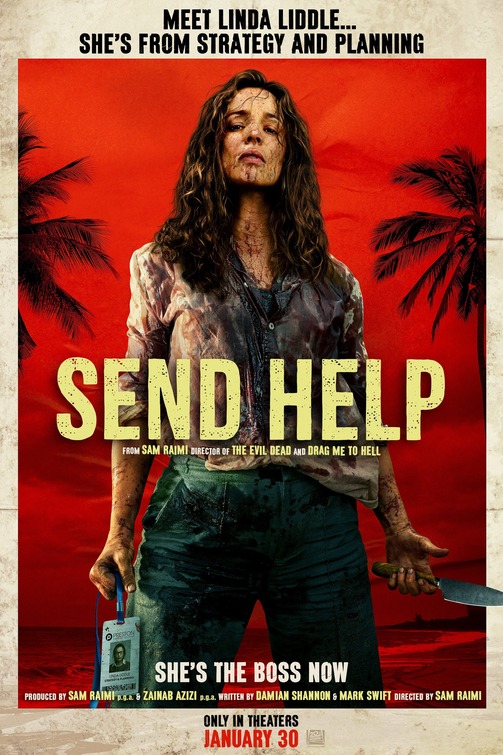
Send Help is a 2026 survival-horror thriller directed by Sam Raimi from a screenplay by Damian Shannon and Mark Swift, released by 20th Century Studios. It marks a return to the horror-comedy register that made Raimi's name, trading haunted cabins for a corporate power struggle stranded far from civilization.
Rachel McAdams stars as Linda Liddle, an underappreciated corporate strategist, opposite Dylan O'Brien as Bradley Preston, the company's newly appointed and much younger CEO. When a plane crash leaves the pair marooned on a remote island, the office hierarchy that once kept Linda in her place is violently upended: as she proves the more capable survivor, the balance of power shifts and curdles into something far darker. Dennis Haysbert, Xavier Samuel, Chris Pang, and Edyll Ismail feature in supporting roles.
Released in late January 2026, Send Help became a critical and commercial success, earning strong reviews for its tension, tone, and McAdams's against-type turn as a morally slippery anti-hero, and grossing well beyond its modest budget worldwide. It sparked plenty of debate over how far an audience's sympathy could stretch. It is now streaming on Disney+.

Miss Congeniality is a 2000 action-comedy film directed by Donald Petrie. The movie follows the story of Gracie Hart, a tomboyish FBI agent who goes undercover as a contestant in the Miss United States beauty pageant in order to stop a terrorist threat. As Gracie navigates the pageant world, she begins to develop a newfound appreciation for femininity and the women she is competing against.
The film features Sandra Bullock as Gracie and a talented ensemble cast, including Michael Caine, Benjamin Bratt, and Candice Bergen. It is known for its blend of action and comedy, as well as its exploration of gender roles and societal expectations. Miss Congeniality also touches on themes of self-discovery and personal growth.
Miss Congeniality was a commercial success upon its release, and has since become a beloved classic. The movie spawned a sequel and has been referenced and parodied in popular culture. It is praised for its heartwarming story, witty humor, and memorable characters. The film is also credited with helping to subvert the traditional beauty pageant narrative and presenting a strong, empowered female lead.

Crocodile Dundee is a 1986 Australian comedy film directed by Peter Faiman. The movie follows the story of Michael "Crocodile" Dundee, a charismatic Australian bushman who is brought to New York City by a journalist named Sue to be interviewed. While in New York, Dundee experiences culture shock and must navigate the unfamiliar city while also showing off his unique skills.
The film features Paul Hogan as the titular character and Linda Kozlowski as Sue. It is known for its light-hearted humor, charming performances, and stunning Australian landscapes. Crocodile Dundee also explores themes of cultural differences and the clash between city and country lifestyles.
Crocodile Dundee was a critical and commercial success upon its release, and has since become a beloved classic. The movie spawned two sequels and has been referenced and parodied in popular culture. It is praised for its heartwarming story and memorable characters, and is considered a landmark moment in Australian cinema.

Smokin' Aces is a 2006 action-comedy film directed by Joe Carnahan. The movie follows the story of Buddy "Aces" Israel, a Las Vegas performer who becomes a target of various hitmen after agreeing to testify against the mafia. The FBI must race against time to protect Buddy and bring him to safety.
The film features an ensemble cast, including Jeremy Piven as Buddy and Ryan Reynolds as an FBI agent. It is known for its fast-paced action sequences, dark humor, and intricate plot twists. Smokin' Aces also explores themes of loyalty, betrayal, and the corrupting influence of power.
Smokin' Aces received mixed reviews upon its release, but has since become a cult classic. The movie is praised for its originality and willingness to take risks. It has been compared to other films in the genre, such as Tarantino's Kill Bill and Guy Ritchie's Snatch, but is celebrated for its unique blend of comedy and action. The movie's twist ending has also become a topic of discussion among fans and critics alike.

American Ultra is a 2015 action-comedy film directed by Nima Nourizadeh. The movie follows the story of Mike, a stoner and convenience store clerk who discovers that he is actually a highly trained government agent with deadly skills. When he becomes the target of a government operation, Mike must fight to survive while also protecting his girlfriend, Phoebe.
The film features a talented cast, including Jesse Eisenberg as Mike and Kristen Stewart as Phoebe. It is known for its fast-paced action sequences, dark humor, and unexpected plot twists. American Ultra also explores themes of government control and personal identity.
American Ultra received mixed reviews upon its release, but has since gained a dedicated fan base. The movie is praised for its originality and subversion of typical action movie tropes. It has been compared to other films in the genre, such as the Bourne series and John Wick, but is celebrated for its unique blend of comedy and action.

"Cold Pursuit" is a 2019 action thriller film directed by Hans Petter Moland. The movie is a remake of Moland's 2014 Norwegian film "In Order of Disappearance". The story follows Nels Coxman, played by Liam Neeson, who seeks revenge against a drug cartel that killed his son. The film also stars Tom Bateman, Tom Jackson, Emmy Rossum, and Laura Dern.
Nels Coxman, a snowplow driver, lives a quiet life in the Colorado ski resort town of Kehoe with his wife and son. But after his son is killed by a drug cartel, Nels becomes a vigilante and sets out to avenge his son's death. Nels quickly finds himself in the middle of a drug war, as he takes on the cartel's powerful leader, Viking, and his henchmen.
The film was generally well-received by critics, who praised Neeson's performance and the movie's dark humor. However, some critics criticized the film for its violence and lack of originality, as it follows a similar revenge plotline as Neeson's previous movies. Despite the mixed reviews, "Cold Pursuit" was a box office success, grossing over $76 million worldwide.

Chungking Express is a 1994 Hong Kong romantic-comedy-drama film directed by Wong Kar-wai. The movie is made up of two stories that take place in the bustling city of Hong Kong. The first story follows a police officer who falls in love with a woman he meets in a fast-food restaurant. The second story follows another police officer who becomes infatuated with a mysterious woman who is constantly on the move.
The film explores themes of loneliness, love, and the fast-paced nature of city life. It is known for its stylish visuals and non-linear narrative structure. The movie's soundtrack, which features music by various artists, is also a standout element of the film.
Chungking Express was a critical and commercial success upon its release, and has since become a cult classic. The movie is praised for its innovative storytelling, memorable characters, and the way it captures the energy and spirit of Hong Kong. It has also been credited with influencing a new generation of filmmakers, both in Hong Kong and internationally.

The Great Race is a 1965 American comedy film directed by Blake Edwards. The movie is set in the early 1900s and follows the adventures of two rival daredevil racers, Leslie and the Great Leslie, who compete in a race from New York to Paris. Along the way, they encounter a variety of obstacles and challenges, including treacherous weather and sabotage from their competitors.
The film features a star-studded cast, including Tony Curtis, Jack Lemmon, and Natalie Wood, and is known for its extravagant production design and elaborate stunts. It also features memorable musical numbers, including the popular song "The Sweetheart Tree."
The Great Race was a box office success upon its release and has since become a beloved classic of the comedy genre. It is celebrated for its playful humor, impressive visuals, and the chemistry between its lead actors. The film has been praised for its ability to entertain audiences of all ages and remains a popular choice for family movie nights.

Ghost Dog: The Way of the Samurai is a 1999 crime film directed by Jim Jarmusch. The movie tells the story of a hitman named Ghost Dog, who follows the ancient code of the samurai and is bound to his mafia boss, Louie. After a job goes wrong, Ghost Dog becomes a target and must fight for survival while staying true to his samurai principles.
The film explores themes of loyalty, honor, and identity, as Ghost Dog struggles to reconcile his role as a killer with his personal values. As he navigates the dangerous world of organized crime, he forms an unlikely friendship with a young girl who shares his love for books and pigeons.
Ghost Dog: The Way of the Samurai is known for its unconventional narrative structure and use of intertextual references to samurai culture and philosophy. It has received critical acclaim for its unique style and thought-provoking themes, cementing its place as a cult classic in the crime film genre.

Stardust is a 2007 romantic fantasy adventure film based on the 1999 novel of the same name by Neil Gaiman. The story is about a young man named Tristan who lives in a village near a magical wall that separates the human world from the mystical realm of Stormhold. One day, he promises to bring a falling star to his beloved, Victoria, in exchange for her hand in marriage. He crosses the wall and finds that the star is a woman named Yvaine. They embark on a journey together to bring Yvaine back to the village, but they encounter many obstacles along the way, including witches, pirates, and princes who are all after the star's magical powers.
The film was directed by Matthew Vaughn and stars Charlie Cox as Tristan, Claire Danes as Yvaine, Michelle Pfeiffer as the evil witch Lamia, and Robert De Niro as a sky pirate named Captain Shakespeare. The film received generally positive reviews and was praised for its performances, visual effects, and imaginative storytelling. The film was a modest box office success, grossing over $135 million worldwide on a budget of $70 million.
Stardust has become a cult classic and has gained a loyal fanbase over the years. The film has been praised for its faithful adaptation of the source material, which was considered unfilmable by some. The film's themes of love, adventure, and the power of magic have resonated with audiences, and its whimsical tone and colorful characters have made it a beloved film for many. The film has also been credited with helping to revive the fantasy genre in Hollywood and inspiring a new wave of fairy tale adaptations in film and television.

"Godzilla, King of the Monsters!" is a 1956 Japanese-American science fiction film, directed by Ishiro Honda and Terry O. Morse. The film was created by re-editing footage from the 1954 Japanese film "Godzilla", which was combined with new footage of American actors, including Raymond Burr, to create a new storyline. In the film, a series of devastating attacks by the giant monster Godzilla leaves the city of Tokyo in ruins, and it's up to a group of scientists and military personnel to find a way to stop the creature before it destroys all of humanity.
The film was initially released in Japan under the title "Kaijū no Ō Godzilla", which means "King of the Monsters Godzilla". However, for the American release, the filmmakers decided to add new footage featuring Raymond Burr as American reporter Steve Martin, who serves as the audience's guide to the story. The new footage was shot to provide a western perspective on the events of the original film, which had been heavily influenced by Japan's post-war anxieties.
"Godzilla, King of the Monsters!" was a box office success and helped to launch the Godzilla franchise in the United States. The film has since become a cult classic, beloved by fans of both the original "Godzilla" and American science fiction films of the 1950s. While the re-editing and new footage have been criticized for diluting the original film's message and tone, "Godzilla, King of the Monsters!" remains a significant cultural artifact of the era in which it was made.