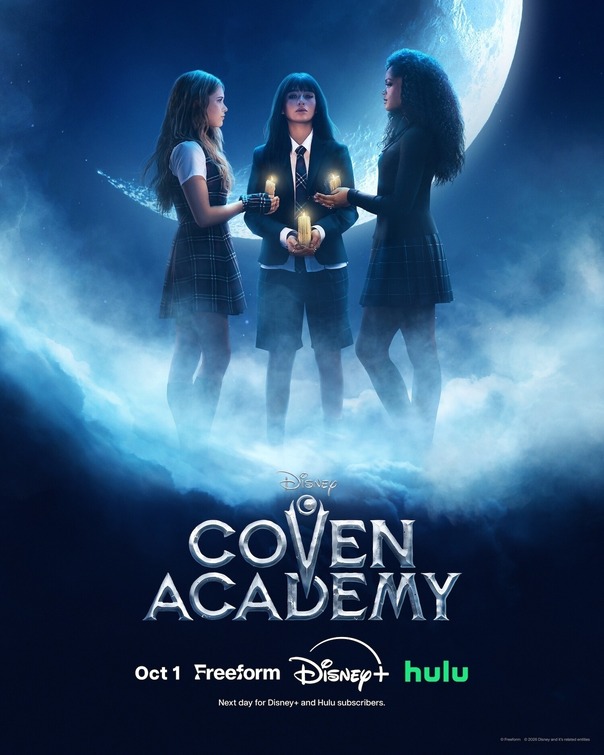
Coven Academy is a 2026 supernatural teen series created by Tim Federle, the writer-director behind High School Musical: The Musical: The Series, who also wrote and directed the pilot. A Freeform original that streams the next day on Disney+ and Hulu, it blends witchy coming-of-age drama with the glossy romance and humor of a classic young-adult ensemble.
Set in a richly atmospheric New Orleans, the series follows a group of teenage witches-in-training who must learn to master their powers while protecting the city from dangerous, ancient forces. Malina Pauli Weissman stars as Briar, with Tiffani Thiessen as the enigmatic Miss Graves and Malachi Barton among the young coven, as school rivalries, a simmering love triangle and genuine supernatural threats collide inside the walls of the academy.
Premiering on Freeform on October 1, 2026, with the full season landing on Disney+ and Hulu the following day, Coven Academy was moved over from an originally planned Disney Channel run to a slightly older-skewing home. It arrived aimed squarely at fans of supernatural teen soaps, mixing spellcraft, friendship and first love against a vividly gothic backdrop. It is streaming on Hulu and Disney+.
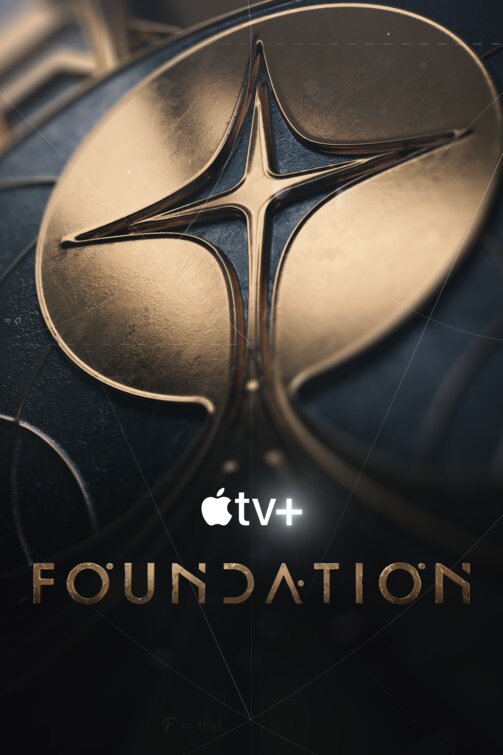
Foundation is Apple TV+'s epic adaptation of Isaac Asimov's landmark science fiction saga, one of the most ambitious productions in the history of streaming television. Based on the novels Asimov wrote between 1942 and 1993, the show follows mathematician and psychohistorian Hari Seldon (Jared Harris), who uses the science of statistical prediction to foresee the inevitable collapse of the Galactic Empire — a civilization spanning millions of worlds — and sets in motion a centuries-long plan to preserve human knowledge through the dark ages to come. The series spans thousands of years of galactic history, following multiple generations of characters connected by Seldon's grand design.
What distinguishes Foundation from previous Asimov adaptations is its willingness to translate the books' ideas into genuine dramatic spectacle. Showrunner David S. Goyer and his team have constructed a visual world of staggering scale — the planet Trantor with its gleaming metallic sky, the desert world of Terminus where the Foundation takes root — while also finding the human stakes within Asimov's vast and often abstract narrative architecture. The casting is extraordinary throughout, with Jared Harris bringing enormous intellectual gravity to Hari Seldon and Lee Pace achieving something genuinely menacing and complex as the Cleon dynasty of clone emperors.
Foundation rewards patient viewers with one of the grandest narratives in science fiction television, a story about civilization, entropy, knowledge, and the long arc of history that feels urgently relevant to the present moment. By its second season, it had developed into one of the most visually and narratively confident science fiction series on any platform, and stands as a testament to what prestige television production can achieve when paired with source material of genuine intellectual ambition.
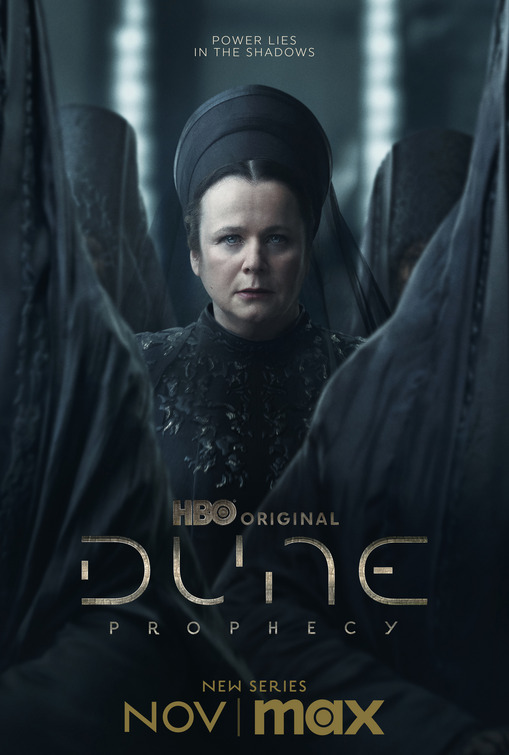
Dune: Prophecy is a sweeping science fiction prequel series set approximately 10,000 years before the events of Frank Herbert's Dune novels and Denis Villeneuve's acclaimed film adaptations. Developed for Max, the series traces the origins of the Bene Gesserit — the mysterious and powerful sisterhood who have guided humanity's genetic and political destiny across millennia — focusing on the Harkonnen sisters Valya and Tula as they lay the foundations of an order that will eventually produce characters like Lady Jessica and the Reverend Mother Mohiam. Emily Watson and Travis Fimmel lead an exceptional cast.
The series is based on the novel Sisterhood of Dune (2012) by Brian Herbert and Kevin J. Anderson, itself drawing on notes Frank Herbert left for a proposed prequel series. Dune: Prophecy expands the universe in ways that will delight dedicated fans while also functioning as an accessible entry point for viewers who want to understand the deeper mythology underlying the films. The production design is extraordinary, depicting a universe that is recognizably the world of Dune — feudal politics, the spice, religious fanaticism — but in an earlier, rawer state.
Dune: Prophecy is a thoughtful and ambitious series that takes seriously both the philosophical richness of Herbert's original vision and the demands of prestige television storytelling. It explores questions of power, prophecy, and the ethics of manipulating human destiny across generations — questions that feel acutely resonant today. For fans of epic, ideas-driven science fiction, it represents one of the most ambitious world-building exercises in recent television history.
Agatha All Along picks up after the events of WandaVision, finding the witch Agatha Harkness stripped of her powers and trapped in a false memory by Wanda Maximoff. When a mysterious teen known only as Teen frees her from the illusion, Agatha finds herself leading a coven of desperate witches through the legendary Witches' Road — a dangerous enchanted path said to restore lost powers to those who survive its trials. Each step of the Road presents a different supernatural challenge, testing the witches' resolve and forcing Agatha to reckon with her own complicated history.
Kathryn Hahn delivers a career-defining performance as Agatha, fully inhabiting a character who is simultaneously monstrous, brilliant, and unexpectedly moving. The series leans into her comedic timing while never allowing the audience to forget the genuine menace that makes Agatha such a compelling antihero. Joe Locke is a revelation as Teen, bringing quiet intensity and emotional complexity to a character whose true identity slowly becomes one of the season's most compelling mysteries, while Patti LuPone, Joe Morton, and Debra Jo Rupp round out the coven with memorable supporting turns.
Showrunner Jac Schaeffer, who also created WandaVision, crafts a season that works both as standalone horror-tinged fantasy and as a meaningful continuation of the MCU's magical mythology. The production design is visually arresting, with each trial on the Witches' Road offering a distinct aesthetic world ranging from 1970s suburbia to gothic medieval architecture. Agatha All Along is proof that the MCU can tell smaller, stranger stories with genuine artistic ambition, and it remains one of Disney+'s most acclaimed Marvel offerings.
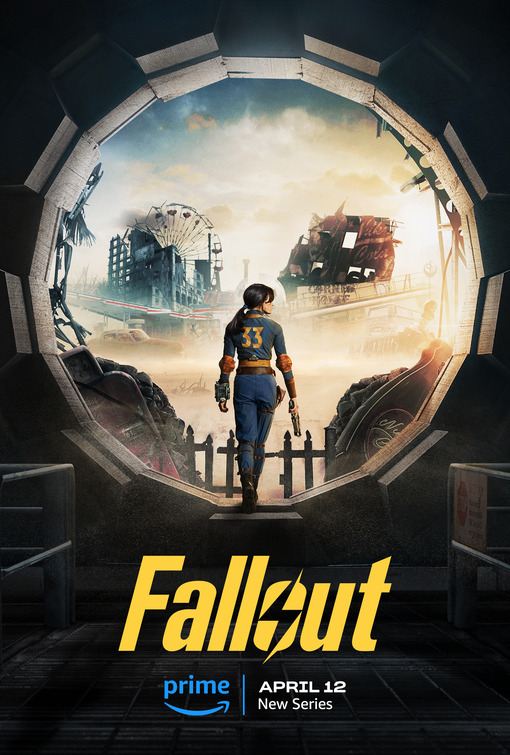
Fallout is a 2024 Amazon Prime Video science fiction series created by Geneva Robertson-Dworet and Graham Wagner, executive produced by Jonathan Nolan and Lisa Joy (Westworld), and adapted from Bethesda Game Studios' long-running video game franchise of the same name. Set in an alternate history in which 1950s American Atomic Age aesthetics and technology advanced to extremes before nuclear war rendered much of civilization to ash in 2077, the series takes place 219 years later in the ravaged Los Angeles area. The story follows three protagonists whose paths collide: Lucy MacLean (Ella Purnell), a sheltered vault dweller venturing into the deadly Wasteland for the first time; Maximus (Aaron Moten), a young Brotherhood of Steel squire seeking purpose within its rigid militaristic order; and The Ghoul (Walton Goggins), a disfigured and near-immortal former cowboy actor from before the war, pursuing something — or someone — across two centuries of apocalyptic survival.
The show captures with remarkable fidelity the games' distinctive blend of retro-futuristic production design, dark comedy, and brutal violence. Walton Goggins delivers one of the finest performances of his career as The Ghoul, toggling between haunted pre-war flashbacks as the human Cooper Howard — a genial 1950s TV cowboy — and the ruthlessly pragmatic, darkly funny Ghoul of the post-apocalypse. Ella Purnell's Lucy is an idealist's journey through disillusionment played with intelligence and warmth, while Aaron Moten's Maximus provides a working-class perspective on institutional mythology. Kyle MacLachlan brings his characteristic unsettling calm to Overseer Hank MacLean, Lucy's father, whose optimism conceals deeply held secrets.
Fallout premiered on April 10, 2024, to immediate and overwhelming critical and audience success, becoming one of Prime Video's most-watched original series of all time within its first two weeks. The show was renewed for a second season before Season 1 had finished its premiere weekend. Critics praised it as one of the most successful video game adaptations ever produced, alongside The Last of Us, for its ability to translate the tone and themes of the source material while telling an original story fully accessible to viewers with no familiarity with the games. The series won multiple awards including Saturn Awards for Best Science Fiction Television Series.
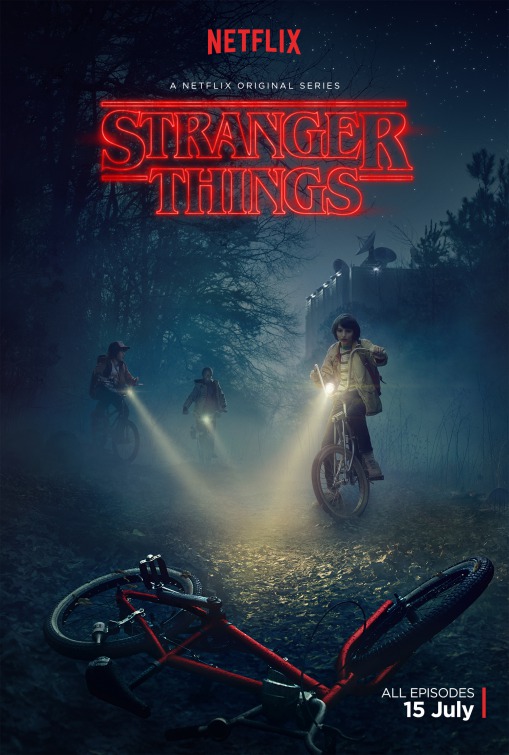
Stranger Things is an American science fiction horror drama series created by the Duffer Brothers (Matt and Ross Duffer) that premiered on Netflix on July 15, 2016. Set in the fictional town of Hawkins, Indiana, in the early 1980s, the series follows a group of young friends, their families, and local authorities as they confront supernatural events linked to a terrifying alternate dimension known as the Upside Down. The show's premise draws heavily from the science fiction and horror films of the era, particularly the work of Steven Spielberg, John Carpenter, and Stephen King.
The ensemble cast includes Millie Bobby Brown as Eleven, a girl with telekinetic abilities who escapes from a secretive government laboratory, alongside Winona Ryder as Joyce Byers, David Harbour as Chief Jim Hopper, and young leads Finn Wolfhard, Gaten Matarazzo, Caleb McLaughlin, Noah Schnapp, Sadie Sink, and Natalia Dyer. The series was shot in and around Atlanta, Georgia, with production design crafted to authentically replicate the visual look of the 1980s, and its synthesizer-driven soundtrack has become one of its most celebrated elements.
Stranger Things became a cultural phenomenon almost immediately upon release, earning Netflix its first Emmy Award nominations for a drama series. Over its run of five seasons the show consistently broke streaming records and revived classic 1980s music for younger audiences. Season 4's use of Kate Bush's 1985 song "Running Up That Hill" caused it to re-enter the global charts at number one nearly four decades after its original release — one of the most remarkable music revivals in pop history.
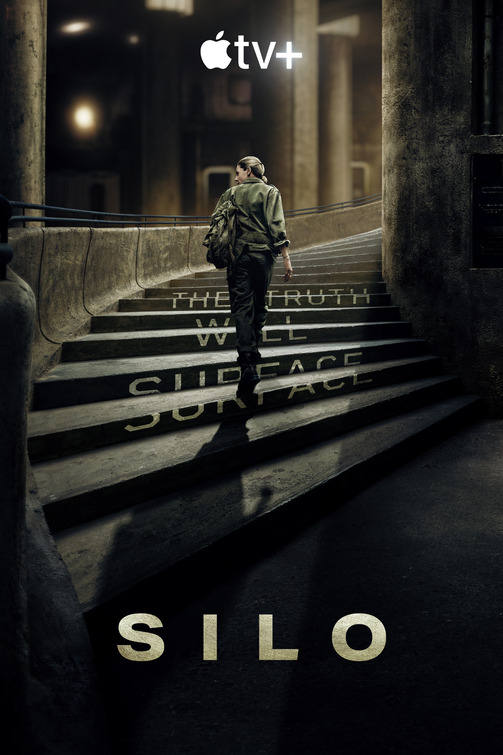
Silo is Apple TV+'s immersive, methodically crafted science fiction series based on Hugh Howey's bestselling Wool trilogy. Set entirely within a massive underground silo that houses the last remnants of humanity after an unspecified catastrophe rendered the outside world fatally toxic, the show follows engineer Juliette Nichols (Rebecca Ferguson) as she investigates a murder that leads her to question everything the silo's residents have been told about their world. The production design is extraordinary — the silo is a fully realized civilization of 10,000 people spread across 144 levels, with its own class structures, professions, laws, and mythology about the outside.
Rebecca Ferguson anchors the series with a grounded, fiercely intelligent performance that makes Juliette one of the most compelling protagonists in recent science fiction television. The show resists the temptation to over-explain its premise, instead letting viewers discover the silo's secrets at the same pace as Juliette — which makes each revelation land with genuine impact. The supporting cast is exceptional, with particular standouts in Common as the silo's calculating Sheriff and Tim Robbins as the enigmatic head of IT, a department that holds far more power than its mundane name suggests.
What separates Silo from lesser dystopian fiction is its commitment to the texture of daily life inside the silo. The show is interested in how civilization maintains itself, how power is exercised and rationalized, and how ordinary people navigate systems built on deceptions they cannot fully perceive. It is science fiction that earns its big ideas by grounding them in human-scale drama — a tense, confident, and deeply satisfying thriller that rewards patient viewing. Both seasons are now available on Apple TV+.
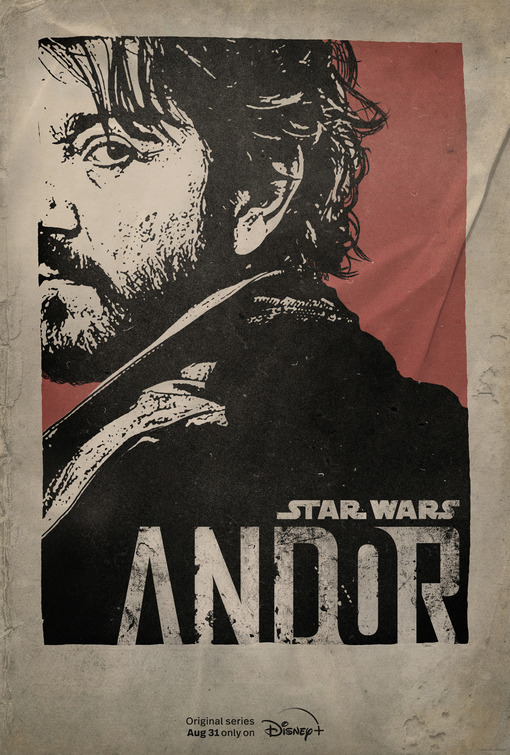
Andor is a Star Wars television series created by Tony Gilroy for Disney+, serving as a prequel to the 2016 film Rogue One: A Star Wars Story. The show follows Cassian Andor (Diego Luna) during the years leading up to the formation of the Rebel Alliance. Unlike typical Star Wars fare, Andor takes a gritty, grounded approach to the galaxy far, far away, exploring the political, social, and moral dimensions of life under the tyranny of the Galactic Empire.
The first season received universal acclaim for its mature storytelling, complex characters, and cinematic production values. A multi-episode arc set in the Imperial prison colony of Narkina 5 became particularly celebrated as some of the finest television of 2022. The series introduced compelling new characters including the revolutionary Luthen Rael (Stellan Skarsgård) and the determined intelligence officer Dedra Meero (Denise Gough), painting a richly layered portrait of a galaxy on the brink of rebellion.
The second and final season arrived in April 2025, structured as three distinct four-episode arcs set a year apart, and carried Cassian's story right up to the opening moments of Rogue One. Critics called it the most sophisticated writing the franchise has ever produced, comparing it to prestige dramas like The Americans rather than to other Star Wars titles. Tony Gilroy wrote or co-wrote every episode of both seasons, and the result is a rare prequel that genuinely enhances everything that follows it.