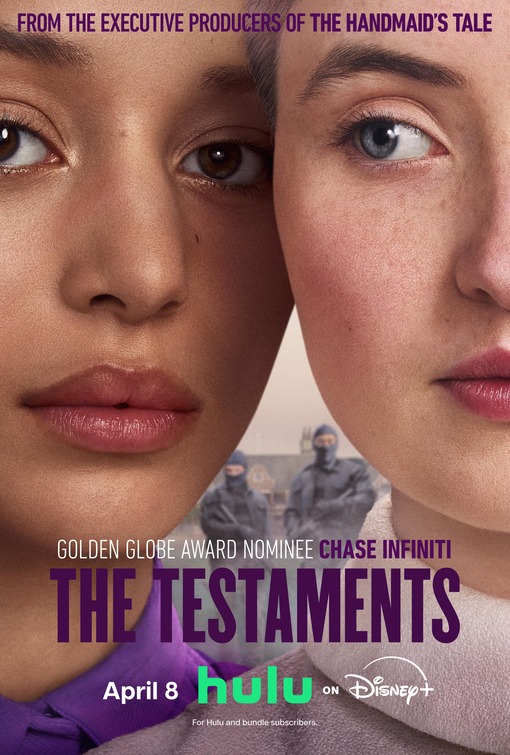
The Testaments is a Hulu dystopian drama and the sequel to The Handmaid's Tale, adapted from Margaret Atwood's 2019 Booker Prize-winning novel. Created by Bruce Miller, who stepped away from running the original series specifically to develop it, the show returns to the theocratic nation of Gilead more than a decade after Offred's story.
Ann Dowd returns as the fearsome Aunt Lydia, narrating the machinery of Gilead from the inside. The story follows two young women on opposite sides of the border: Agnes (Chase Infiniti), raised entirely within Gilead's rigid order, and Daisy (Lucy Halliday), a defiant teenager in Canada. Their converging fates drive a coming-of-age tale about resistance and complicity, with Elisabeth Moss returning as June Osborne.
Premiering in April 2026, The Testaments earned generally favorable reviews, with an 88% score on Rotten Tomatoes, for extending the franchise through a younger lens, and Hulu renewed it for a second season after it crossed 45 million hours streamed. It is streaming on Hulu.

Admittedly indebted to Jack Kerouac and the cinematic stylings of Harrison Ford in the Indiana Jones series, "Supernatural TV show" wobbled as it took its first tentative steps into the paranormal, but it has grown stronger and smarter with age and experience. Fans of "The Gilmore Girls" immediately will recognize Jared Padalecki who plays Sam, a Stanford undergrad who wants nothing more than to escape his family's ghost-busting business and go to law school. Of course, that's not gonna happen. Instead, Sam gets stuck riding shotgun on a road trip with his profligate brother Dean, played well by Jensen Ackless recently of "Smallville fame. As the boys travel from San Francisco to LA, normally a boring ten-hour trip, they encounter ghoulish and ghostly creatures brought to life from American folklore and legends. Describing steady improvement in the show's writing and acting, one critic said it went from being "a pretty good show to being a pretty great show." Just before the show launched its fifth season, Rolling Stone was more effusive in its praise as it numbered "Supernatural" among its "Fifty Best Reasons to Watch TV".

Sometimes "Bravo" serves-up high-quality instruction at least as powerfully as "The Learning Channel" and "National Geographic." Case in point: "Kell on Earth" reveals the ecology of New York's fashion industry, vividly illustrating the perilous lives of smaller fish on the couture food chain, and charting the symbiosis between design houses and the fashion press. The "Kell" in "Kell on Earth" refers to hyper-manic high-powered fashion publicist Kelly Cutrone, diva-dominatrix of public relations firm "People's Revolution." Although eponymous Kell gets the most air-time, "Kell on Earth" is not automatically all about her; instead, it shows the harried lives of second-tier stylists, public relations interns, and personal trainers who dwell near the bottom of New York's tumultuous, tempest-tossed fashion fishbowl. Observant viewers will note striking similarity between People's Revolution and Lauren Conrad's workplace on "The Hills" and "The City," which brought Cutrone into the public eye. Those same insightful viewers will see, however, that real-reality show "Kell on Earth" proves Cutrone's "little people" frequently sweat, swear, and stress, really working for their paychecks.

One critic characterized "Breaking Bad's" dark humor as "Thelma and Louise as seen by Dostoyevsky" and that was one of the perkier, more optimistic descriptions. A seven-part AMC series, "Breaking Bad" TV show tells the story of Walt White, high school chemistry teacher turned methamphetamine cooker and dealer. Of course, as Glenn Frye crooned, "The lure of easy money has a very strong appeal," but "Breaking Bad" does not allow for even a split-second of sunshine through the abysmal darkness. In this corner of the universe, crime never-ever pays. Walt, expertly portrayed by Bryan Cranston of "Malcolm in the Middle" fame, is neck-deep in problems, complications, and flat-out ugliness from the minute he lights the Bunsen burner. Although the writers have woven-in some amazingly ironic lines, known in the trade as "comic relief," the characters deliberately deliver their quips in such a super-slow, slack-jawed drawl they seem more tragic than funny. Of course, "Breaking Bad" TV series make some pretense toward allegory of the American middle class struggling through the throes of deep recession, and it scores some hard hits. Most of all, though, "Breaking Bad" shows that even when fine writers, directors, and actors can find humor and pathos in displaced white-collar workers' undignified struggle for dignity, it still looks awfully damned dreary and ugly.

Intensely cerebral, narrated more or less in the style of a Latin American magic-realist novel which shows the conclusion before the story begins, "Damages" TV show strangely fulfills the immanent promise in cable television programming, appealing very strongly to what the poet Milton called "fit audience though few." "Damages" series'unmistakable style, sophistication, and subtle sizzle are spellbinding, and the writers have crafted heroes you love to love and villains you love to hate with a team of attorneys working both sides of the continental divide between good and evil. Unabashedly stealing its premise from the Bernie Madoff case, "Damages" asks and answers, "What if you were Madoff's antagonist?" Glenn Close plays Patty Hewes, the high-powered and equally high-priced attorney determined to bring down ponzi-schemer Louis Tobin, portrayed by Len Cariou. The word "perfect" appears in most critics' discussions of their performances. A New York Times reviewer aptly summarized, "It's impossible to overestimate how delicious Ms. Close is as this fiercely driven, mercurial and manipulative woman. " In a stroke of casting genius, the producers chose Lily Tomlin to quicken the character of Mrs. Tobin, long-suffering wife of the arch-villain; the audience remains in suspense about her true colors and motives, suspecting she may be "Damages'" answer to Lady Macbeth. Martin Short also stars as Tobin's family attorney.

Lisa Jane Smith, author of a whole library-shelf full of Vampire Diaries for literate tweens, has every right to feel like a Shakespearean monarch whose throne is usurped in a tragedy's first act. She pioneered the genre, took a little sabbatical, and came back to find her world dominated by Harry Potter and all those "Twilight People." In 2008, The Vampire Diaries were reprinted in cool new covers and fonts, and L.J. Smith returned to writing full time. In the fall of 2009, "The Vampire Diaries TV Show" came to the CW, developed and produced by Kevin Williamson of "Dawson's Creek" fame. To his everlasting credit, Williamson expertly preserves the goodness and sweetness of Smith's characters and situations. Although the vampires naturally want to seduce the sensitive young heroines into their dark world, the pretty little women always bring the flesh-hungry bad boys back into the light. Of course, the show's production values allow lots of room for good music and teen-aged angst"”there is no shortage of fog, but it also has plenty of attitude. In addition to foretelling evil events, the show's prophet can predict fashion trends. The story turns on a tween's eternal dilemma: wistful good girl falls in love with the good vampire brother but is constantly tempted by bad-boy vampire other-brother. What is a girl to do?

"There are eight million stories in the city that never sleeps," Gary Sinise's unmistakable tenor voices-over the opening skyline shots for "CSI: New York." Apparently, New York's dedicated crime scene investigators also suffer sleep-deprivation, working tirelessly"”some would say obsessively"”to demystify eight million different ways to die in the Big Apple. Sinise plays Detective Mac Taylor, suitably intense CSI:NY unit leader, complemented well by workaholic assistant Stella Bonasera, expertly portrayed by Melina Kankaredes. Together, the lead detectives manage an appropriately colorful team of streetwise geeks and nerds determined always to make their cases well beyond reasonable doubts. Like the others in Jerry Bruckheimer's crime-drama franchise, "CSI: New York" devotes more attention to sophisticated computer work and uber-cool lab procedures than to the old-fashioned business of talking to people. Mac Taylor quickly reminds, though, "We follow the evidence, because the evidence never lies."

Imagine! Once upon a time, Dr. McDreamy, star of "Grey's Anatomy" and a million women's fantasies, was uncomfortably married to Dr. Addison Montgomery (Kate Walsh). Then, Dr. Montgomery proved complicated, compelling, and cute enough to warrant her own TV show"”"Private Practice." For a very little while, "Private Practice" TV series depended on viewers' basic understanding of "Grey's Anatomy," because it showed Dr. Montgomery, probably much better known simply as Addison, leaving Seattle Grace Hospital and joining the staff at Oceanside Wellness, a practice owned and operated by all of her old medical school buddies. A few of the early episodes depended on the good doctor's broken heart and separation anxiety for their drama and poignancy; after all, withdrawal from McDreamy takes its toll on a girl. But as "Private Practice" gained momentum and popularity, plots focused more and more on cases that challenge the doctors' ethics and skills. Despite her genius and surgical prowess, Dr. Montgomery suffers fierce bouts of self-doubt, making her accessible and an object of empathy for the show's predominantly female audience.