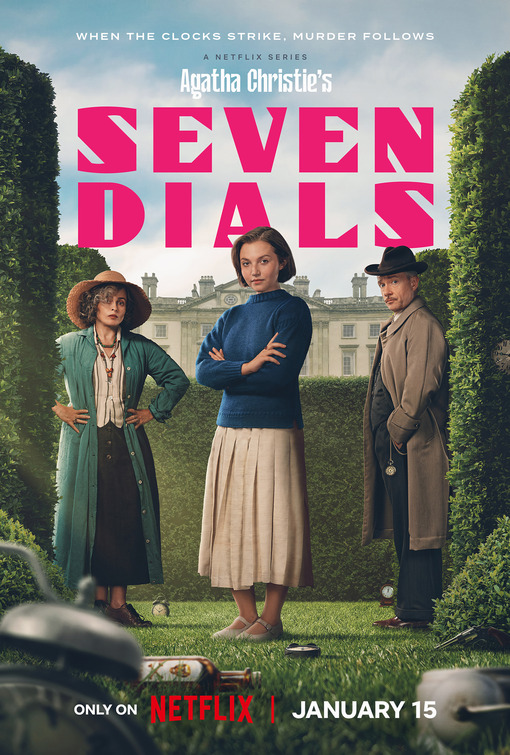
Agatha Christie's Seven Dials is a Netflix period mystery adapted by Chris Chibnall, the creator of Broadchurch and a former Doctor Who showrunner, from Christie's 1929 novel The Seven Dials Mystery. Directed by Chris Sweeney and released in January 2026 as a three-part miniseries, it revives one of the author's lighter, thriller-tinged whodunits with a starry British cast.
Set in 1925, the story follows the spirited Lady Eileen 'Bundle' Brent, played by Mia McKenna-Bruce, who investigates the suspicious death of a Foreign Office colleague and uncovers a shadowy secret society known as the Seven Dials, along with a conspiracy tangled up in her own father's death years earlier. Martin Freeman plays Superintendent Battle, with Helena Bonham Carter as Lady Caterham, Iain Glen as Lord Caterham and Edward Bluemel among the ensemble.
The debut production of the newly formed Orchid Pictures, the series filmed across Bristol, Bath and Ronda in Spain, using the stately Badminton House to stand in for the country estate known as 'The Chimneys.' Reviews were solid, praising the cast and the handsome period trappings. It is streaming on Netflix.

Designed and built according to Bravo's standard blueprint for reality programming, "Shear Genius" TV show pits hairstylists against one another in cut-throat competition for reputation and glamorous prizes. In its first season, "Shear Genius" series steadily gained loyal viewers by word-of-mouth, and the original coterie of just over one million fans has made the program just popular and just profitable enough that Bravo programmers have stayed with it. For the first two seasons, "Charlie's Angels" mega-star Jacklyn Smith came out of retirement to host "Shear Genius"; in the third season Brazilian super-model Camila Alves took over hosting and refereeing the competitions. Like the top chefs and the aspiring fashion designers, the hair stylists on "Shear Genius" compete against the clock, arbitrary constraints, and one another, submitting their work for celebrity judges' approval. In some of the most intense challenges, the shear wizards work on mannequins' hair; in some of the eliminations, they work on aspiring models' locks. Winning styles are displayed on the Wall of Fame at Allure magazine, and the best stylist is celebrated with the signature expression, "Your work is shear genius!"

If your family drama cannot be "Modern Family" or "Brothers and Sisters," then what can it be? It almost inevitably will be NBC's "Parenthood," a mid-season, post-Olympic experiment boldly launched in February, 2010. The "Parenthood" experiment tests the hypothesis that good writers and actors can find the middle ground between "Modern Family's" understated but outrageous satire and "Brothers and Sisters'" intensity. Producers Ron Howard and Brian Grazer are re-working the basic premise of Parenthood, the 1989 movie starring Steve Martin as a frazzled father trying with all his might to do the right thing for everyone he loves. The New York Times accurately observes, "'Parenthood,' with its polished scripts and beautifully shot exteriors, seems like a last gasp of television past," big-big production values and a cast of small-screen all-stars including Craig T. Nelson, Bonnie Bedelia, and Lauren Graham. "Parenthood's" plots and dialogue exploit the irony in everyday family life, winning empathetic laughs and wry smiles where other teams might push too hard for punchlines. Some of the dialogue has the same brilliant serrated edge that distinguished "Gilmore Girls," but, as Lauren Graham points out, "I do not have to talk so fast." Like all good comedy, the teasing and quirkiness are fundamentally good-natured, and every episode features at least one weep-worthy segment. Because "Parenthood" is not "Modern Family" or "Brothers and Sisters," it has become the rarest of rare productions at NBC"”a hit.

When Bravo began promoting "The Real Housewives of Orange County" TV series in 2006, the producers and the network hyped the series as a "documentary" hybrid of ABC's monster hit "Desperate Housewives" and Fox's equally popular "The OC." The emphasis on "real" did not suggest "average and ordinary"; instead, it suggested "real" as opposed to the housewives on Wisteria Lane and all the pretty people in the rest of the prime real estate south of Los Angeles and north of Camp Pendleton. In its first several seasons, "The Real Housewives of Orange County" TV show beguiled and enraged viewers with its emphasis on five frighteningly wealthy women ensconced inside an exclusive gated community and addicted to shopping, tanning, and their own petty dramas: for example, should a smart-mouthed, disrespectful daughter get a new BMW or a new Mercedes for her sixteenth birthday? In subsequent seasons, reality has caught-up with the housewives, who have been forced to down-size and down-scale in the wake of job losses, foreclosures, marital problems, and other genuine crises in the lives of "real" housewives.

Handsomely animated in the style of old-school newspaper comic serials, "Archer" TV series illustrates the life, times, adventures, and quandaries of super-sleuth Lew Archer, would-be international man of mystery. Critics aptly characterize Sterling Archer as "suave, vain, and overly confident," quickly adding that his exceptional expertise as a secret agent contrasts sharply with his bumbling ineptitude in every other area of his life. "Archer" TV show especially satirizes office intrigues and American corporate politics by extension, making global crises and dangerous espionage simply pre-texts for International Secret Intelligence Service agents to make one another look bad. "Archer" creator H. Jon Benjamin, who also does the voice of Sterling Archer, is not particularly kind to his stereotypically American hero: Archer's more-than-vaguely Oedipal relationship with his mother complicates all the plots; and, at work, Archer must team-up, awkwardly, with his former girlfriend Lana, who has moved-on to another relationship with an ISIS employee.

America cannot get enough "True Blood." Derived from Charlaine Harris's series of novels, The Southern Vampire Mysteries, and produced by the same characters and company who brought you're the macabre comedy hit "Six Feet Under," this rough, raw, foul-mouthed, sexed-up and blood-sucking series has become America's summertime Sunday night guilty pleasure supreme. Meet the "True Blood" TV show! Set in fictional but aptly named Bon Temps, Louisiana, "True Blood" TV series makes vampire life look a great deal like a serious but not thoroughly detestable drug addiction. Once bitten, new recruits discover all kinds of voracious appetites,of which blood-thirst in fact may be the least. Although a host of undead characters work their insidious plots and attempt world conquest just for fun, the plot centers on Sookie Stackhouse (Anna Paquin), not a vampire but showing beguiling signs of being a fairy, who falls in love with Bill Compton (Stephen Moyer), definitely a vampire but reluctant about it. To the writers' and producers' credit, the series shows minimal gore and serves-up maximal suspense and irony. "True Blood" has collected an armload of awards, including Golden Globes and Emmys.

From the same folks who brought you "Lost," "Fringe TV show" looks and feels a lot like "The X-Files" with way better lab equipment, except when it looks and feels a whole lot like "Altered States" as it goes to the furthest frontiers of human consciousness and imagination, except when its realism makes the show look and feel every bit as creepy as "The Twilight Zone." Not surprisingly, "Fringe" is a major science fantasy hit. The stories show a team of FBI agents who use "fringe" technology to demystify a terrifying series of events that suggest the mysterious workings of a parallel universe. Stories focus on Special Agent Olivia Dunham, whose boyfriend suffered hideous wounds from an unidentifiable chemical compound. Agent Dunham joins forces with mad scientist Dr Walter Bishop and his estranged son, racing against the clock to save Olivia's lover and humankind. The New York Times aptly describes "Fringe" as a "sensational, "artful, suspenseful mix of horror, science fiction, layered conspiracies and extended car chases".

"White Collar" delivers the requisite Feds and felons, but you do it a serious dis-service if you describe it as a "crime drama." No one on "White Collar" would insist "just the facts, ma'am; just the facts," because complex characters and complicated motives drive the plots and magnetize viewers. As The New York Times wisely remarks, "White Collar" complies with USA Network's higher standards for cops and robbers; it "creates a fantasy version of law enforcement in which bureaucracies don't scuttle justice, reason prevails, and brilliance ensures the best possible outcome. At one point Burke asks his office how many went to Harvard, more than half raise their hands." Matt Bomer plays Neil Caffrey, "White Collar's" resident lovable bad-guy-turned-good-guy. Caffrey, whose style and savoir faire give him legitimate claim to membership in the Rat Pack, has struck a deal with his long-time nemesis, FBI agent Peter Burke, played to perfection by Tim DeKay. Burke will release Caffrey from Federal prison long before the end of his sentence if Caffrey agrees to lend his criminal genius to the Bureau's efforts to seek-out and imprison sophisticated evil-doers. Who could resist a deal like that?

Describing "South Park" TV show as "an American animated sitcom" compares with characterizing baseball as "an American form of exercise" such flagrant under-statement it is just insulting and unlawful in thirty-seven states. Over the course of its more than two-hundred episodes, "South Park" has achieved the exalted status of cultural icon and ratings bonanza. "South Park" consistently tops the basic cable charts, and it has earned distinction as Comedy Central's highest rated and longest running show. From their South Park, Colorado, vantage, four foul-mouthed but frighteningly precocious elementary schoolers willingly satirize everything from politics to the prophet Mohammed. Everything is grist for Stan Marsh's, Kyle Broflovski's, Eric Cartman's, and Kenny McCormick's mills. "South Park's" distinctive cut-out animation, originally done by hand but now computer-generated, adds to its often surreal and always dark humor. Generally heralded as the internet's first "viral" video, since 1997, "South Park" has garnered four primetime Emmy Awards and a Peabody Award for Comedy Central.

A 1983 mini-series gets a 2011 make-over, more sinister and creepy than ever. As "V" begins, hunormous space ships appear over twenty-nine major cities around the world, and Anna, leader of the technologically advanced alien species piloting the spacecraft, assures terrified earthlings she and her people come in peace. Of course, Anna is lying. Anna goes on to explain that she and her extra-terrestrial pals need just a few Earth resources, and they willingly will trade their medical and electronic wizardry for the few items on their shopping lists. FBI counter-terrorism ace Erica Evans quickly sees through the deception, gaining a very few powerful allies as the affable visitors curry favor among the locals. "V" writers, directors, and producers clearly understand the dynamics of terror and suspense, and they especially know how to plot a cliff-hanger. "V" attracted legions of loyal viewers during its premier season in spring, 2010, and it left thousands of beguiling plot possibilities for its 2011 season. Every "V" viewer anticipates the inevitable, imminent Anna-Erica smackdown, and Earth's future turns on the outcome"”"appointment television" for sure.

Using state-of-the-art technology and amazing skill with make-up and costuming, Chance, the main character, becomes literally a human target. In each episode of "Human Target," Chance assumes the identity and everyday life of a prominent person in danger. Describing himself as an "extreme bodyguard," Chance uses his wits, skills, and wise-cracking bravado to turn serious danger into a trap for the villains. The sinister evil-doers plot kidnapping, blackmail, extortion, and especially death; the "human target" plots capture. Not the kind of thing for which an ordinary guy usually would volunteer. "Human Target" TV show was praised by the critics and audiences for the quality of the acting"”especially the performances by Earl Haley, Jr., which make a somewhat implausible premise absolutely believable and compelling. Because "Human Target," a decidedly out-of-the-box crime drama, is loosely based on the DC comic series of the same name, the creators have no shortage of bad guys, nor do they struggle to find quirky characters for Chance to impersonate. Critics and audiences agree that the actors playing the three main characters go a long way toward redeeming the show's average, sometimes genuinely awkward writing. They wonder, though, will the actors be able to hold the viewers' attention and loyalty long enough for the writing to fulfill the promise in the premise?