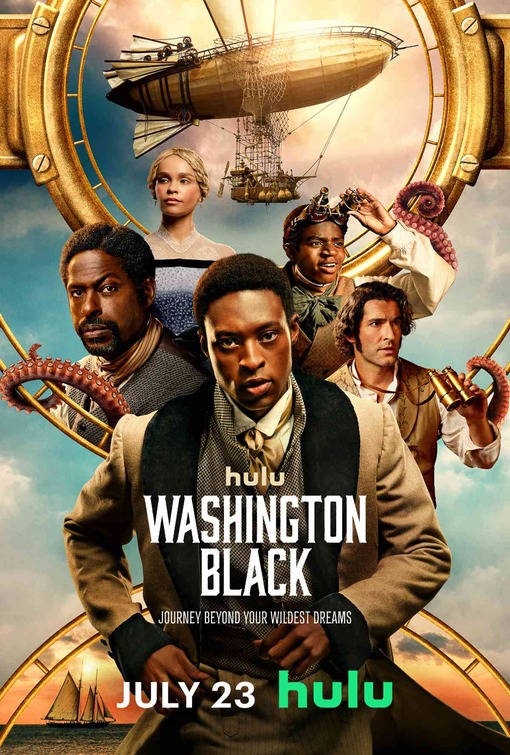
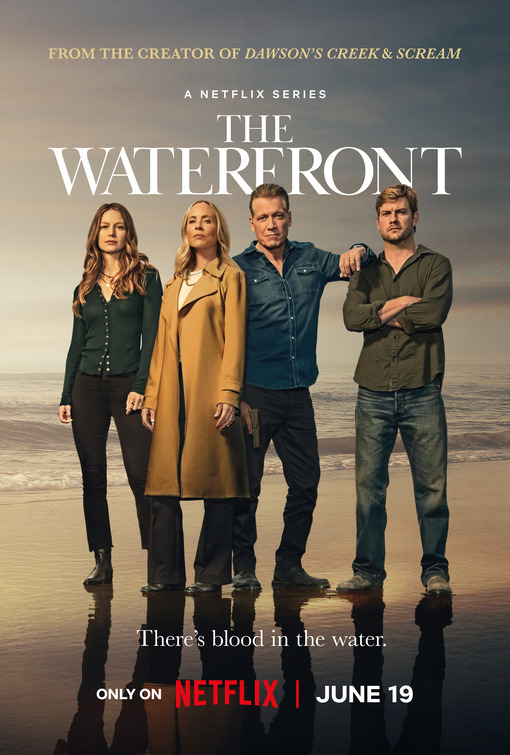
Washington Black is a sweeping Hulu limited series adapted from Esi Edugyan's acclaimed 2018 novel, a coming-of-age adventure that carries its hero from bondage to the far corners of the globe. Ernest Kingsley Jr. stars as the adult George Washington “Wash” Black, a boy born into slavery on a Barbados sugar plantation whose prodigious scientific gifts are recognized by an eccentric abolitionist inventor. When a death forces him to flee, Wash embarks on an odyssey across oceans and continents that transforms him from fugitive to scientist, artist, and explorer.
Sterling K. Brown, who also executive produces, plays Medwin Harris, a charismatic community leader in Halifax whose role is expanded from the novel, while Eddie Karanja plays the younger Wash and Tom Ellis, Iola Evans, and Sharon Duncan-Brewster fill out the cast. Told across dual timelines and multiple continents, the series pairs the propulsive momentum of a nineteenth-century adventure yarn with a thoughtful meditation on freedom, identity, and who gets to author their own story.
Adapting a novel that won Canada's Giller Prize and was shortlisted for the Booker, the series reaches for the grandeur of classic adventure storytelling while centering a Black hero's journey toward self-invention. Lavishly mounted and spanning locations from the Caribbean to the Arctic, Washington Black streams on Hulu.
.jpeg)
Dune: Prophecy is a sweeping science fiction prequel series set approximately 10,000 years before the events of Frank Herbert's Dune novels and Denis Villeneuve's acclaimed film adaptations. Developed for Max, the series traces the origins of the Bene Gesserit — the mysterious and powerful sisterhood who have guided humanity's genetic and political destiny across millennia — focusing on the Harkonnen sisters Valya and Tula as they lay the foundations of an order that will eventually produce characters like Lady Jessica and the Reverend Mother Mohiam. Emily Watson and Travis Fimmel lead an exceptional cast.
The series is based on the novel Sisterhood of Dune (2012) by Brian Herbert and Kevin J. Anderson, itself drawing on notes Frank Herbert left for a proposed prequel series. Dune: Prophecy expands the universe in ways that will delight dedicated fans while also functioning as an accessible entry point for viewers who want to understand the deeper mythology underlying the films. The production design is extraordinary, depicting a universe that is recognizably the world of Dune — feudal politics, the spice, religious fanaticism — but in an earlier, rawer state.
Dune: Prophecy is a thoughtful and ambitious series that takes seriously both the philosophical richness of Herbert's original vision and the demands of prestige television storytelling. It explores questions of power, prophecy, and the ethics of manipulating human destiny across generations — questions that feel acutely resonant today. For fans of epic, ideas-driven science fiction, it represents one of the most ambitious world-building exercises in recent television history.
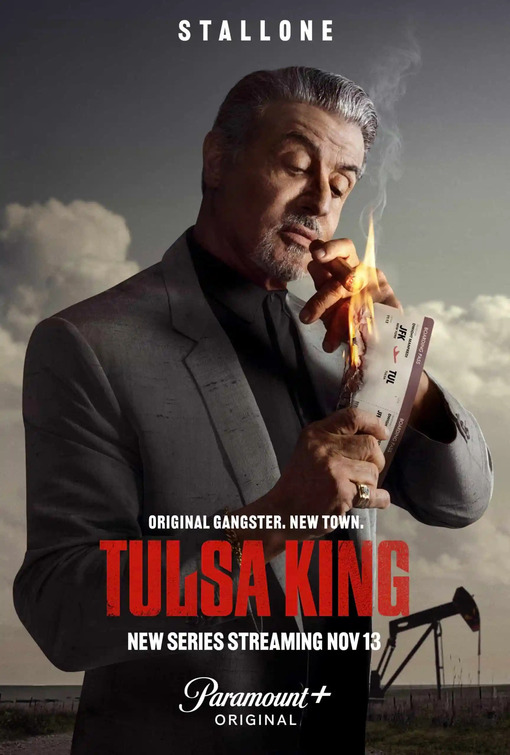
Tulsa King offers a deceptively simple premise — aging New York mafia boss exiled to Tulsa, Oklahoma — and spins it into something far richer than its elevator pitch suggests. Taylor Sheridan, the architect of Yellowstone's neo-Western empire, created the series as a vehicle for Sylvester Stallone, whose performance as Dwight "The General" Manfredi is the most charming, lived-in work of the actor's late career. After serving 25 years in prison without informing on his bosses, Dwight is rewarded with banishment to Tulsa to establish a new criminal enterprise in territory about as foreign to him as the moon.
What Tulsa King understands that many fish-out-of-water stories miss is that displacement is only interesting when the fish is genuinely interesting himself. Stallone's Dwight is a man who operated by codes that the world has moved on from, confronting a Midwest that runs on entirely different rules, speeds, and assumptions. His bewilderment is played with genuine vulnerability and extraordinary comic timing — Stallone has rarely been funnier, and his scenes with the local ensemble generate the kind of chemistry that makes network television feel quaint.
The show isn't shy about its genre pleasures — the slow accumulation of Dwight's Tulsa operation, the comedy of mafia protocols applied to a baffled heartland, the violence when it arrives — but it earns its most memorable moments from character. By the end of the first season, Tulsa has genuinely become Dwight's home, and the audience feels that transition as keenly as he does. Subsequent seasons deepen the mythology while keeping Stallone's magnetic presence firmly at the center of everything.

Interior Chinatown is a 2024 Hulu limited series created by Charles Yu, adapting his own National Book Award-winning 2020 novel of the same name. The show stars Jimmy O. Yang as Willis Wu, a struggling actor trapped in the recurring role of Generic Asian Man in a long-running procedural drama filmed inside his apartment complex in Chinatown. Willis dreams of graduating to the coveted role of Kung Fu Guy, but finds himself pulled deeper into a conspiracy that blurs the line between the TV show within the show and his real, precarious life in an immigrant community on the edge of erasure.
The series is a formally inventive and emotionally resonant exploration of Asian-American identity told through the lens of Hollywood's history of marginalizing and stereotyping Asian actors. Creator Charles Yu uses the conceit of a show-within-a-show to expose the mechanisms of typecasting and the psychic toll of performing a diminished version of yourself for the entertainment of others. The supporting cast is stellar, with Ronny Chieng and Chloe Bennet delivering sharp, funny, and deeply felt performances alongside Yang.
Interior Chinatown received strong critical acclaim for its originality, its performances, and the courage of its formal ambitions. The adaptation earned Jimmy O. Yang significant recognition as a dramatic actor capable of anchoring a prestige project, and it was widely praised as one of the most inventive and overdue pieces of Asian-American storytelling in the history of American television.
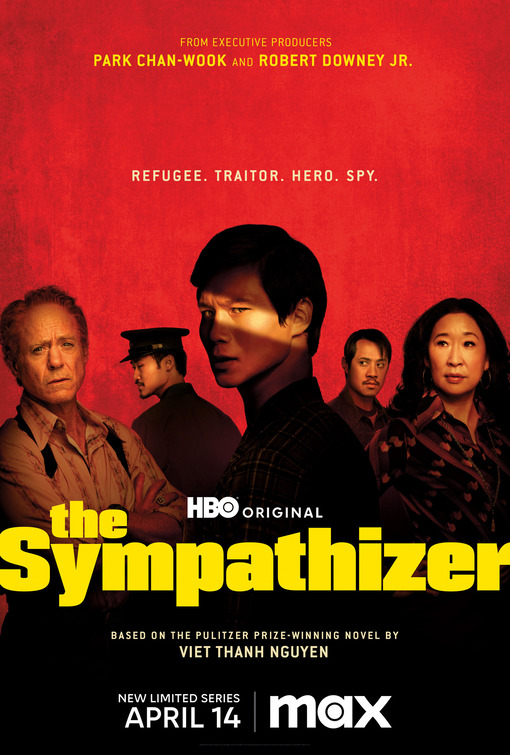
The Sympathizer is a 2024 HBO limited series directed by Park Chan-wook, the acclaimed South Korean filmmaker behind Oldboy and Decision to Leave. Based on Viet Thanh Nguyen's Pulitzer Prize-winning 2015 novel of the same name, the series follows a nameless narrator known only as the Captain, a communist spy of mixed French-Vietnamese heritage embedded within the South Vietnamese military during the final days of the Vietnam War. Played with extraordinary range by Hoa Xuande, the Captain is a man of two faces, two loyalties, and two worlds, perpetually caught between the country he serves and the ideology he secretly holds.
As Saigon falls in April 1975, the Captain is evacuated to the United States alongside the South Vietnamese general he serves, and the show pivots into a darkly comic and deeply subversive portrait of the Vietnamese refugee experience in Los Angeles. The production is visually opulent and tonally audacious, blending spy thriller mechanics with bitter satire of American imperialism and Hollywood's history of Asian representation. Robert Downey Jr. appears in a tour-de-force of character acting, playing multiple white American authority figures across the series to pointed, thematic effect.
The Sympathizer received wide critical acclaim for its ambition, its performances, and its willingness to tell the Vietnam War story from a perspective rarely granted by American film or television. The series earned numerous Emmy nominations and cemented Hoa Xuande as one of the most exciting new screen presences in years.

Poker Face is a 2023 Peacock original mystery series created by Rian Johnson, the filmmaker behind Knives Out and its sequels. The show stars Natasha Lyonne as Charlie Cale, a woman with an extraordinary gift: she can always tell when someone is lying. After a confrontation with a dangerous casino boss forces her to go on the run, Charlie drifts across America in a battered Plymouth Barracuda, stumbling into a different murder case every week and using her supernatural instincts to uncover the truth.
The series is a loving, expertly crafted homage to the classic American detective shows of the 1970s and 1980s, particularly Columbo. Each episode opens with the murder itself, showing the audience precisely what happened and who did it, before Charlie arrives and slowly, charmingly pieces it together. This inverted mystery format puts all the dramatic tension on how rather than who, and Lyonne's performance is so magnetic and lived-in that the show works even when it isn't trying to surprise anyone. The guest cast across the season is exceptional, featuring names like Adrien Brody, Joseph Gordon-Levitt, Chloë Sevigny, and Stephanie Hsu.
Poker Face became one of the most acclaimed television series of 2023, earning Natasha Lyonne a Golden Globe nomination and near-universal praise from critics who called it the most purely entertaining show of the year. Johnson's sharp direction across multiple episodes and Benjamin Millepied's retro-inflected score give the show a consistent identity that holds it together across its standalone episode structure. A second season is in production.
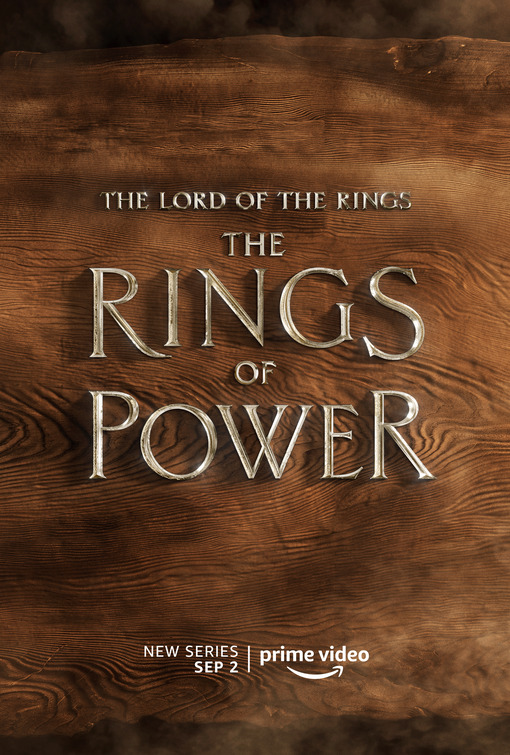
The Lord of the Rings: The Rings of Power is Amazon Studios' landmark fantasy epic — the most expensive television series ever produced — set thousands of years before the events of Tolkien's The Lord of the Rings in the mythical Second Age of Middle-earth. The show brings to life the forging of the rings of power, the rise of Sauron from obscurity, and the drowning of the island kingdom of Numenor, drawing on the appendices and notes that Tolkien left scattered across his legendarium. It follows a vast ensemble including the immortal Galadriel (Morfydd Clark), the half-elven Elrond (Robert Aramayo), and the human Isildur (Maxim Baldry), along with Harfoots — ancient ancestors of Hobbits — and a mysterious Stranger who fell from the sky.
The scale and craft of The Rings of Power are genuinely staggering. Filmed primarily in New Zealand, the series deploys production design of almost inconceivable ambition — from the gleaming halls of Lindon to the volcanic Southlands that will become Mordor — and is shot by cinematographer Alex Disenhof with the same grandeur and texture that defined Peter Jackson's original trilogy. The show wears its influence openly and honors it fully.
Season two deepened the mythology significantly, with Sauron's machinations growing in sophistication and the tragedy of Numenor developing its full weight. The Rings of Power has established itself as the definitive prestige fantasy of the streaming era — ambitious, visually extraordinary, and rooted in a love for Tolkien's world that radiates from every frame.

Pachinko is one of the most ambitious television dramas ever produced — a multigenerational epic based on Min Jin Lee's bestselling 2017 novel that spans nearly a century of Korean-Japanese history through the story of one family's survival, sacrifice, and resilience. The series opens in early twentieth-century Korea, where a young woman named Sunja makes a fateful decision that will reverberate through four generations of her family, eventually reaching a young Solomon (Jin Ha) navigating identity and belonging in 1980s Osaka and New York.
What makes Pachinko extraordinary is its ambition matched by its execution. Showrunner Soo Hugh and her team weave between three distinct time periods and three languages — Korean, Japanese, and English — with total command, finding the thread that connects the grandmother of 1915 to the grandson of 1989 not through plot mechanics but through a shared DNA of stubbornness and love. The performances throughout are exceptional, with Youn Yuh-jung (Oscar winner for Minari) delivering heartbreaking grace as the elder Sunja.
Pachinko is also a rare television drama that places the Korean-Japanese experience — one of the twentieth century's most overlooked stories of displacement and discrimination — at the absolute center of a major prestige production. It is sweeping in scale and intimate in feeling, and it stands as one of the defining works of international television storytelling.
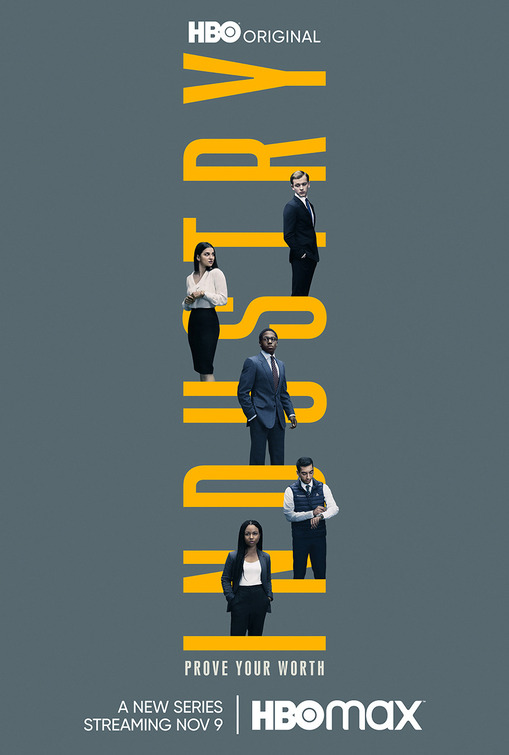
Industry is the most bracingly alive drama on television — a series set inside the brutal meritocracy of a London investment bank that follows a cohort of ambitious young graduates competing for permanent positions in a world that rewards performance, ruthlessness, and the willingness to sacrifice everything. Created by Mickey Down and Konrad Kay, the show follows characters including Harper Stern (Myha'la), an American recruit hiding a secret from her resume; Yasmin Kara-Hanani (Marisa Abela), a well-connected Oxford graduate navigating her own privilege; and Robert Spearing (Harry Lawtey), an emotionally volatile trader from a working-class background.
What elevates Industry above other workplace dramas is its unsparing honesty about power — who holds it, how it is extracted, and what it costs to climb toward it. The show is deeply uncomfortable in the best way: it refuses to make any character purely sympathetic or purely villainous, tracing instead the ways that an institution shapes and deforms the people inside it. The bank becomes a pressure cooker for class, race, gender, and ambition, with the trading floor as the arena where all these forces collide.
By its third season, Industry had evolved from a promising debut into one of the sharpest dramas of its era — tight, stylish, and willing to make choices that major network television would never attempt. It is essential viewing for anyone interested in the contemporary intersection of capitalism and identity.
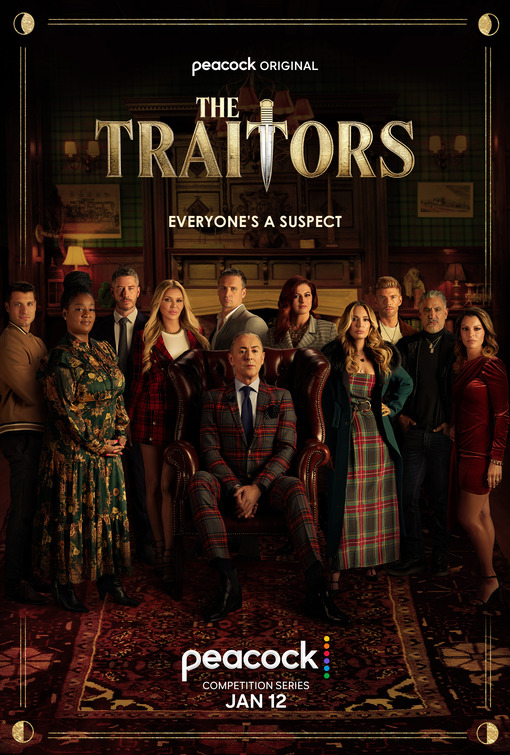
The Traitors US is a riveting social strategy competition series that pits strangers against each other in a game of trust, deception, and psychological warfare. Set in a dramatic Scottish castle, a cast of celebrities and civilians are divided into two secret factions: Faithfuls, who must work together to identify the hidden Traitors among them, and Traitors, who scheme to eliminate the Faithfuls one by one. Each episode ends in a dramatic Roundtable where players vote out whoever they believe to be a Traitor, making for some of the most intense interpersonal drama on television.
Hosted by the irresistible Alan Cumming, who presides over each elimination ceremony with delicious theatrical flair, The Traitors US became an instant cultural phenomenon. The series features a mix of Real Housewives alumni, Survivor veterans, Big Brother champions, and other reality TV icons who bring formidable game-playing skills to the castle. What makes the show compulsive viewing is not just the strategy but the genuine emotional bonds that form — and spectacularly shatter — over the course of the competition.
By its second and third seasons, The Traitors US had evolved into one of the most talked-about reality series in America, inspiring watch-along communities and a devoted fandom that dissects every episode for hidden clues. It is proof that reality television at its best can be as psychologically rich and dramatically gripping as any scripted drama.
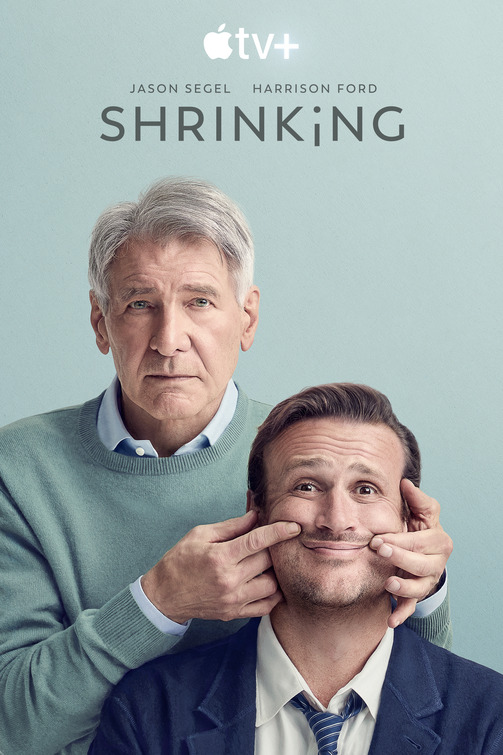
Shrinking is a heartfelt comedy-drama that dares to imagine what therapy might look like if a grieving therapist decided to throw out his professional rulebook. Jason Segel plays Jimmy, a psychologist still reeling from the death of his wife a year earlier, who begins sharing blunt and unfiltered opinions with his patients instead of offering careful, measured guidance. What follows is a chain of unexpectedly positive outcomes that force Jimmy to question everything he thought he knew about healing, connection, and the right way to help people.
Created by Brett Goldstein and Bill Lawrence, the creative forces behind Ted Lasso, Shrinking carries that show's signature warmth but leans further into authentic emotional complexity. Harrison Ford delivers a career-rejuvenating performance as Dr. Paul Rhodes, Jimmy's curmudgeonly mentor who is himself quietly grappling with a Parkinson's diagnosis. Jessica Williams rounds out the central trio as Gaby, a fellow therapist whose comedic timing and emotional intelligence provide the perfect counterweight to Jimmy's chaos.
Set in a sun-drenched Pasadena neighborhood, Shrinking is ultimately about how deeply we need each other to survive loss and grow. It treats grief and mental health with unusual tenderness while remaining genuinely funny, earning devoted audiences and critical acclaim across its first two seasons on Apple TV+.