
Verified streaming availability
Editorial verification
Reviewed by the OnlineTVcast Editorial Team against official provider catalogs and authoritative release sources. Material availability changes are recorded by market.
What this status means
Availability is specific to the named country and check date. Prices, plans and catalogs can change.
OnlineTVcast may earn a commission from some provider links. This does not affect which services we list or their order.
1. Kip Thorne's equations led to published scientific papers. Theoretical physicist Kip Thorne served as executive producer and scientific consultant, and the visual effects team's rendering of the black hole Gargantua was so physically accurate it generated two peer-reviewed papers — published in the American Journal of Physics and Classical and Quantum Gravity — on the optics of gravitational lensing around black holes.
2. Nolan planted 500 acres of corn in Alberta specifically for the film. Rather than use existing farmland or digital sets, the production planted a 500-acre cornfield in Alberta, Canada as the backdrop for Cooper's farm. After filming wrapped, the production harvested and sold the crop, which reportedly turned a modest profit.
3. Hans Zimmer composed the score without knowing the film's story. Nolan gave Zimmer a handwritten letter describing only the emotional relationship between a father and his child — withholding any mention of space, science fiction, or plot — to ensure the score emerged from purely human emotion. The result, centered on a vintage pipe organ recorded at Temple Church in London, became one of Zimmer's most celebrated works.
4. McConaughey genuinely cried during the video-message scene and Nolan used the first take. The sequence in which Cooper watches years of accumulated video messages from his children — realizing his daughter Murph is now older than he is — prompted unscripted tears. Nolan chose this raw first take for the finished film with no additional direction given, preserving its spontaneous authenticity.
5. The data generated by Gargantua's visual effects totaled approximately 800 terabytes. The visual effects company Double Negative wrote entirely new rendering software to simulate light bending around the black hole at physically accurate angles. Single IMAX frames required up to 100 hours each to render, with the final data footprint across the project reaching approximately 800 terabytes.
6. The IMAX version reveals additional picture not visible in the standard release. Nolan shot substantial sequences using large-format 70mm IMAX cameras, meaning the theatrical IMAX version expands to fill more of the screen during key sequences rather than remaining letterboxed — a choice that makes the IMAX viewing experience qualitatively different from any other format.
7. The film won the Academy Award for Best Visual Effects and received five nominations in total. Additional nominations included Best Original Score for Zimmer, Best Film Editing, Best Production Design, and Best Sound Mixing — reflecting the film's extraordinary technical ambition across nearly every craft discipline involved in its creation.
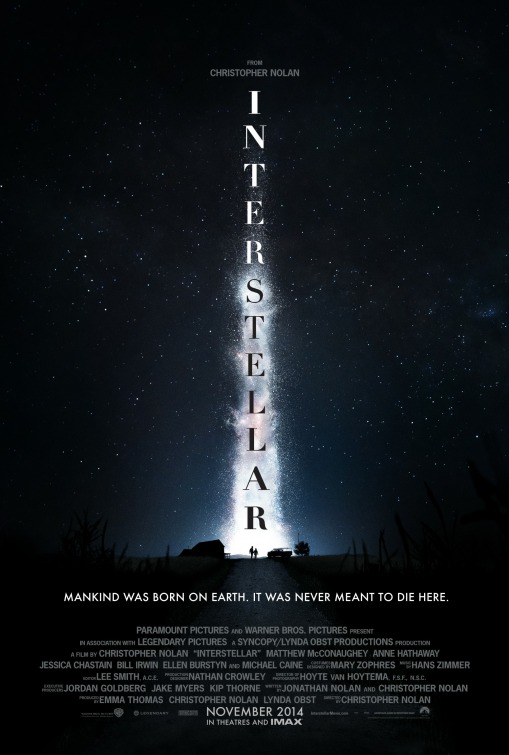
Interstellar is a 2014 epic science fiction film written and directed by Christopher Nolan, produced by Paramount Pictures and Warner Bros. The film stars Matthew McConaughey as Cooper, a former NASA pilot turned farmer living in a near-future Earth where crop blight and dust storms are steadily rendering the planet uninhabitable. When a mysterious gravitational anomaly leads him to a secret NASA facility, Cooper is recruited to pilot a spacecraft through a newly discovered wormhole near Saturn — humanity's last hope of finding a new home among the stars.
The ensemble cast includes Anne Hathaway as Dr. Amelia Brand, Jessica Chastain and Mackenzie Foy as Cooper's daughter Murph at different life stages, and Michael Caine as Professor Brand. Theoretical physicist Kip Thorne served as executive producer and scientific consultant, ensuring the film's depictions of black holes, wormholes, and relativity were grounded in real science — a collaboration that resulted in two peer-reviewed scientific papers. Tom Hardy originally had a supporting role that was recast; Matt Damon, Casey Affleck, and John Lithgow round out a formidable supporting cast.
Released on November 7, 2014, Interstellar received strong critical acclaim for its ambitious scope, emotional depth, and groundbreaking visual effects, grossing over $773 million worldwide. At the 87th Academy Awards it won Best Visual Effects, and Hans Zimmer's organ-driven score became one of the most celebrated film soundtracks of the decade. Interstellar is now widely regarded as one of the defining science fiction films of the twenty-first century, a film equally concerned with the physics of spacetime and the human experience of love and loss across impossible distances.
Got a "Not available in your region" message?
No worries. Learn about streaming access by region and explore available titles where the service is available.

Streaming availability and access rules vary by provider and region. Review each service’s terms before subscribing.
View service details and availabilityStreaming access guide →


