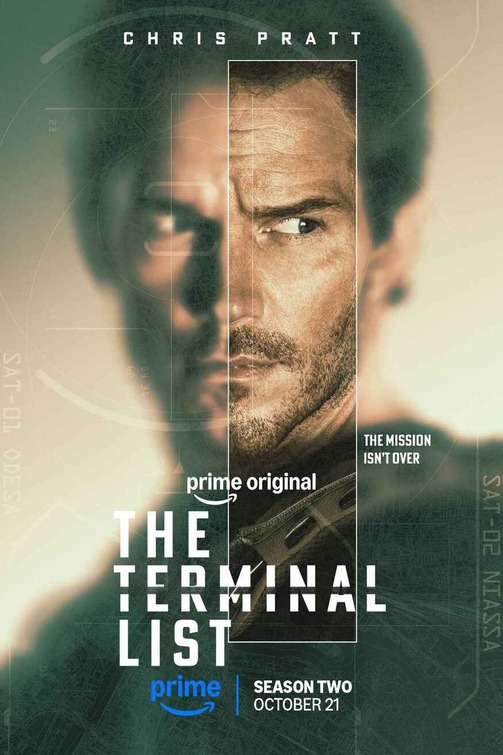
The Terminal List Season 2 brings Chris Pratt back as former Navy SEAL James Reece and adapts Jack Carr’s novel True Believer. Reece is searching for purpose when the CIA corners him into another mission, exposing a conspiracy that connects Moscow, Langley and his own family.
As of October 11, 2026, the season is not yet streaming. Prime Video has confirmed that all eight episodes will premiere on October 21, 2026, exclusively on the service. The answer block therefore links to the official title page without implying that Season 2 can already be watched.

Starring stand up comedian Denis Leary, Rescue Me deals with real life trauma and the life of a fire fighter in the great city of New York. In a fictional fire house we follow along with the daily activities of the FDNY finest and bravest. Often their private lives call for more bravery than the job. Tommy Gavin (Denis Leary) has a dysfunctional family and after losing a close cousin on September 11, 2001 he has problems dealing with the fact that cousin keeps showing up in his dreams or visions. Tommy deals with his alcoholism, unsettling visions, and the stress that goes with being a fire fighter each week. We ride along on the fire trucks as he and his group of firemen go about the business of putting out fires, help injured civilians, and deal with some domestic issues. The recurring guest list is impressive including Gina Gershon, Susan Sarandon, Artie Lange, Maura Tierney, Jennifer Esposito, and Michael J. Fox. As you would expect, the firemen in New York City are kept quite busy and danger is a constant possibility. Denis Leary and Peter Tolan are co-creators of Rescue Me.

With well over one million views on its very first day Mortal Kombat: Legacy could be called a phenomenal hit! Machinima began the ten episode run on YouTube and it is proving that if you launch (online) it they will come. Michael Jai White along with Jeri Ryan are seriously busting chops and taking names this time around even though White (as Jax) still has human arms and Sonya Blade (Jeri Ryan) appears to be tied up an incapacitated throughout half the first episode. We notice that Kano (Darren Shahlavi) also still has both his eyes so this may get interesting if the story line is changed very much. Well presented and with great visuals the series has a PG rating but look for plenty of violence and strong language in spite of that, seemingly because they've tried to set the show with a dark style as seen in movies like Se7en or even Saw with less emphasis on the mystical aspect and more on fast action and bloody scenes to keep all ages begging for more episodes.

When you appear on "Jeopardy," choosing "Epic Fail" as your category, expect the big money question to read, "What is "˜The Cape'?" Score hundreds of dollars on your tote board. "The Cape" enjoyed a very brief and frighteningly unspectacular run on NBC, a 2010-2011 mid-season replacement for some equally forgettable je ne sais qua. The show didn't even struggle across the finish line; the season finale aired only on the NBC website. So surprising in light of "The Cape's" genius premise"”framed for murder, a police officer goes undercover as a masked hero, striving to restore his good name and win the privilege of once again seeing his estranged son. What son would not be thrilled to see his father in action as a masked-man; tights optional? Developed for the 9p.m. time-slot, very deliberately family-friendly, "The Cape's" few fiercely loyal viewers characterized it as "good clean fun," scathing NBC and alleging the programming execs had axed Superhero and Son because it was not sleazy and salacious enough. More tights? A handsome codpiece? A representative Yahoo review suggested, "The cape needs time to develop a fan base"¦. How can you develop characters in a short time? I think that NBC should cancel their people who make the decisions."

Any officer involved shooting results in plenty of paperwork and some serious investigation before they may decide it was a Justified event. US Marshal Raylan Givens character is based on an intriguing and somewhat old fashioned lawman appearing in some Elmore Leonard stories. The writing is especially good as is the acting and each character in this show is someone to explored further. Timothy Olyphant (Deadwood) is a soft spoken southerner who happens to carry a Marshal's badge and has his own special style of law enforcement. Harlan Kentucky is the setting (although mostly filmed in California) and redneck style justice prevails in this back woods community. Raylan Givens must contend with relatives, ex-wife (Winona played by Natalie Zea from HBO series Hung), and crooked politicians in order to keep the streets of Harlan clean and safe. Even his own father is part of the criminal element found in this small Kentucky town. Seems like Raylan can trust no one but himself. A love interest and some multi-dimensional "bad guy" characters make this program always entertaining and intriguing.

Stephen Spielberg and Tom Hanks already had saved Private Ryan and had shown the relatively tame exploits of a brotherly band in the Pacific Theater when they bravely took-on the challenge of recreating the bitter, brutal battles that made Pacific Islands household names in the darkest hours of World War II. Most Americans can trace the broad outlines of the Allies' liberation of Europe, but few can recall the highlights of American Marines' fierce struggles over "tiny specks of earth that we have never heard of." HBO's ten-part mini-series, "The Pacific," retrieves the war against Japan from the threshold of obscurity. Based on survivors' accounts of the battles, and rendered as vividly as the small screen will allow, "The Pacific" tracks three Marines' odysseys from Guadalcanal through Cape Gloucester to Peleliu and ultimately to the epic battle for Iwo Jima. Testifying to "The Pacific's" intense realism, the mini-series collected Emmy Awards for Art Direction, visual and sound effects. More amply testifying to "The Pacific's" overwhelming genius and power, however, the Television Academy awarded it the 2010 Emmy for Outstanding Mini-Series.

Since its debut night back on September 21, 2010, Tuesday night viewing hasn't been quite the same. Detroit 187 brings a gritty realism to television that shows the heroic and positive side of the city that cars built. The program is a crime drama and with its ensemble cast of great actors, explores various 187's (police code for homicides) that occur with frequent regularity in the writer's minds in the Motor City. We, the viewing audience, ride along and explore the people and reasons why murders happen and why they are part of the culture of every big city. Detective Louis Fitch, played by Michael Imperioli, is rather rough around the edges yet as a ten year veteran of the DPD was first a cop with the NYPD, bringing that tough mentality to the Motor City and almost fitting in. Sergeant Jesse Longford (James McDaniel) is a lifelong resident of Detroit whose father was also a police officer. He's tough yet understanding and about to retire. Aisha Hinds is yet another alumni of NYPD Blue and represents a tough as nails black woman who heads up the DPD homicide unit. The entire cast is superb and with good writing Detroit 187 should be around for a good long while.

Because "No Ordinary Family" has far more in common with "Swiss Family Robinson" than NBC's Chuck or its flash-in-the-pan "Heroes," it comes as little surprise that this family drama with superpowers comes to life on Disney-property ABC. Culled, of course, from the world of graphic novels, "No Ordinary Family" introduces us to Dad, Mom, and two teenagers beset with the normal collection of post-modern developmental and relational complaints, the youngest boasting the added difficulty of a learning disability. After surviving a light-plane crash in the Amazon, the family returns home to discover their ordeal has invested them with super-powers which seem to compensate precisely for their previous inadequacies. Still in its infancy, "No Ordinary Family" faces an unusual challenge: Can it continue developing the lives and times of a typical Southern California family even as it sets the fearsome foursome in hot pursuit of villains culled from the most frightening pages of graphic novels? If it succeeds, "No Ordinary Family" will have added a twenty-first century dimension to Walt Disney's concept of "the plausible impossible."