
Verified streaming availability
Editorial verification
Reviewed by the OnlineTVcast Editorial Team against official provider catalogs and authoritative release sources. Material availability changes are recorded by market.
What this status means
Availability is specific to the named country and check date. Prices, plans and catalogs can change.
OnlineTVcast may earn a commission from some provider links. This does not affect which services we list or their order.
1. Demi Moore won the Golden Globe for Best Actress in a Motion Picture Drama for her performance as Elisabeth Sparkle. Having entered Hollywood fame in the 1980s and built a career of commercial roles that were often underestimated critically, Moore's work in The Substance prompted widespread reevaluation of her as a performer of genuine dramatic depth and physical courage.
2. The film's climactic practical effects sequence reportedly took several weeks to complete. Production used hand-built prosthetics and practical physical effects on a substantial scale to achieve the film's most extreme visual passages — a deliberate creative choice Fargeat made to ensure that the horror of Elisabeth's dissolution felt real and weighted rather than digitally clean.
3. Coralie Fargeat developed the screenplay over several years before the film was made. The script went through many drafts as Fargeat worked to balance the film's competing registers — its feminist critique of the male gaze, its horror mechanics, its satirical intelligence — into a single coherent and formally rigorous vision that could sustain feature length.
4. Margaret Qualley trained intensively for months to inhabit the physically demanding demands of the role. Qualley's character exists in a state of near-constant physical performance — her body is simultaneously the film's object of desire and the vehicle for its horror — requiring a discipline of physical preparation that the actress has described as among the most challenging of her career.
5. Fargeat and her production designers drew on Douglas Sirk and Hollywood melodrama of the 1950s for the film's visual world. Elisabeth's television studio, apartment, and professional environment were deliberately built to resemble the hyper-stylized, color-saturated sets of postwar Hollywood — a nostalgic visual language that made the film's horror elements more dissonant and its satire more pointed.
6. The Substance received a standing ovation at Cannes that lasted several minutes alongside a polarized audience response. Some audience members booed the film's more extreme passages while others applauded at length — a response Fargeat publicly welcomed as entirely consistent with the film's provocations, and which generated substantial press attention that amplified the theatrical release.
7. The film uses almost no digital effects in its most extreme sequences, relying instead on practical prosthetics built by a team of specialists. This commitment to physical filmmaking gave The Substance's horror a tactile weight that digital alternatives could not replicate, and the Makeup and Hairstyling team's work was recognized with the Academy Award — a rare instance of genre horror craft achieving mainstream awards recognition.
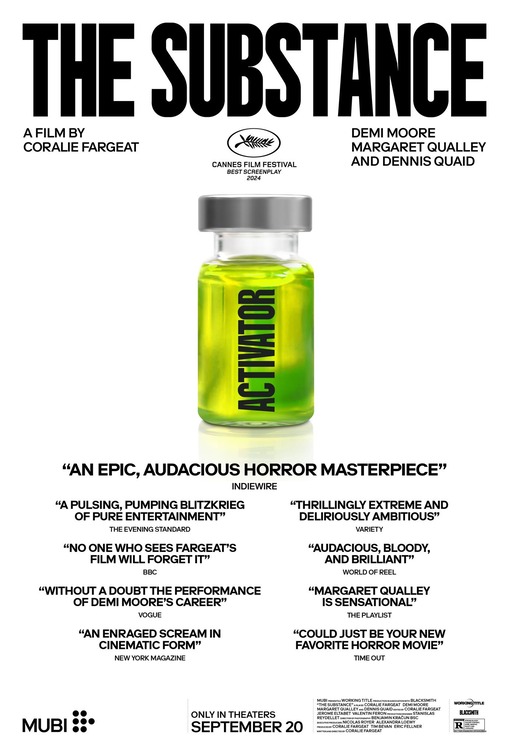
The Substance is a 2024 body horror film written and directed by Coralie Fargeat, the French filmmaker whose debut feature Revenge established her as one of the most formally radical voices in contemporary genre cinema. The film is a visceral, unflinching provocation about the entertainment industry's treatment of aging women, told through the vehicle of science fiction body horror and delivered with the maximalist visual confidence of a filmmaker who treats disgust and beauty as equally legitimate artistic instruments.
The film stars Demi Moore as Elisabeth Sparkle, an aging Hollywood celebrity and aerobics television host who, upon learning she is being replaced by a younger talent, injects a mysterious medical substance that generates a second, younger version of herself — played by Margaret Qualley. The two versions must share their single body on a strict alternating schedule, but as Elisabeth's envy and the younger self's ambitions escalate past the boundaries of the agreement, their shared existence begins to deteriorate in increasingly grotesque and operatic ways. The film uses its horror mechanics as a relentless formal metaphor for the way women are conditioned to consume themselves in the pursuit of an impossible standard of desirability.
The Substance premiered at the 2024 Cannes Film Festival, where Fargeat won the Prix du Scénario for Best Screenplay. The film subsequently won the Academy Award for Best Makeup and Hairstyling at the 2025 Oscars, and Demi Moore won the Golden Globe for Best Actress in a Motion Picture Drama — her first major acting award after a career spanning decades. The film divided critics and audiences with its commitment to escalating excess, but united them in acknowledging it as an uncompromising vision that demanded to be reckoned with.
Got a "Not available in your region" message?
No worries. Learn about streaming access by region and explore available titles where the service is available.

Streaming availability and access rules vary by provider and region. Review each service’s terms before subscribing.
View service details and availabilityStreaming access guide →