
Verified streaming availability
Editorial verification
Reviewed by the OnlineTVcast Editorial Team against official provider catalogs and authoritative release sources. Material availability changes are recorded by market.
What this status means
Availability is specific to the named country and check date. Prices, plans and catalogs can change.
OnlineTVcast may earn a commission from some provider links. This does not affect which services we list or their order.
1. Leonardo DiCaprio ate a real raw bison liver despite being a vegetarian. For a scene requiring Glass to consume raw meat for survival, DiCaprio — a committed vegetarian — chose to eat an actual raw bison liver rather than a prop substitute, citing his commitment to the character's physical reality. He has described it as one of the most challenging demands any role has made of him.
2. The film was shot entirely using natural light. Iñárritu and Lubezki decreed no artificial lighting on set. This meant shooting only during specific hours of the day when natural light was sufficient, with the schedule built entirely around the available daylight window — typically a few hours near golden hour. The constraint contributed directly to the film's extraordinary visual atmosphere.
3. Climate change forced production to relocate from Canada to Argentina. Filming began in Calgary expecting snow-covered wilderness; unusually warm weather left the landscape bare and green. The production relocated to the southern tip of Tierra del Fuego in Argentina — one of the most remote filming locations ever used for a major Hollywood production — adding months and significant cost to the schedule.
4. This was DiCaprio's first Academy Award win after five previous nominations. DiCaprio had been nominated for What's Eating Gilbert Grape, The Aviator, Blood Diamond, The Wolf of Wall Street, and The Revenant before winning — spanning twenty-two years and four acting losses. His win became one of the most celebrated moments in recent Oscar history and the culmination of a long cultural narrative about recognition overdue.
5. Iñárritu became the first director to win consecutive Best Director Oscars since Joseph L. Mankiewicz in 1949–1950. His wins for Birdman (2015) and The Revenant (2016) in consecutive years matched a feat not achieved in sixty-six years, cementing his status as one of the defining directors of contemporary cinema.
6. The grizzly bear attack sequence required over three weeks of planning and six days to shoot. The sequence — widely considered one of the most harrowing and convincing in modern film — was achieved through a combination of animatronic bear elements, wire work, and post-production visual effects. DiCaprio performed the physical elements of the sequence himself, wearing a specially rigged harness that required precise choreography with the VFX team.
7. Tom Hardy lost a bet to DiCaprio about receiving an Oscar nomination and had to get a tattoo. Hardy bet DiCaprio that he would not receive a nomination for Best Supporting Actor for The Revenant. When Hardy was indeed nominated, he honored the bet and received a tattoo reading "Leo knows all" — an episode that became one of the more memorable anecdotes from the film's awards season.
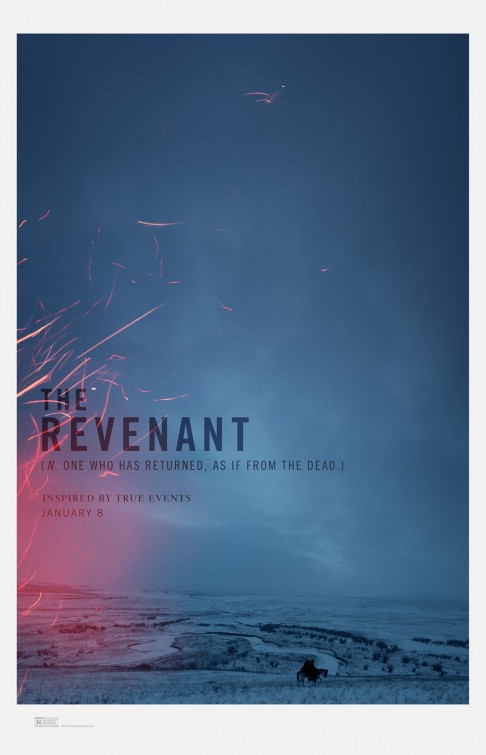
The Revenant is a 2015 survival epic directed by Alejandro González Iñárritu, based on Michael Punke's 2002 novel inspired by the historical figure Hugh Glass. Set in the American frontier of 1823, the film follows Hugh Glass (Leonardo DiCaprio), a skilled frontiersman guiding a fur-trapping expedition through the Louisiana Territory wilderness. After Glass is mauled nearly to death by a grizzly bear and left for dead by the treacherous John Fitzgerald (Tom Hardy) — who murders Glass's half-Pawnee son Hawk before his eyes — Glass must survive the brutal winter landscape on sheer willpower and the driving need to find Fitzgerald and exact revenge.
The film is a grueling, visually transcendent meditation on survival, grief, and vengeance. Cinematographer Emmanuel Lubezki shot the entire film using only natural light — no artificial lighting was permitted on set — giving the image a frigid, painterly quality that evokes the wilderness landscapes of Bruegel and Caspar David Friedrich. Production was notoriously difficult: filming began in Calgary, Canada, but an unusual lack of snow forced the production to move to the southern tip of Argentina in Tierra del Fuego, one of the most remote and demanding filming locations in cinema history. The extreme cold, the requirement for natural light, and Iñárritu's insistence on long takes meant the production schedule stretched far beyond its original plan.
The Revenant was released on December 25, 2015, and grossed over $533 million worldwide against its $135 million budget. At the 88th Academy Awards it received twelve nominations, winning three: Best Director for Iñárritu (his second consecutive win, following Birdman), Best Actor for DiCaprio (his first Oscar win after five previous nominations), and Best Cinematography for Lubezki (his third consecutive win, following Gravity and Birdman). DiCaprio's long-awaited Oscar victory became a cultural event, celebrated across social media and in years of preceding memes about his then-elusive recognition.
Got a "Not available in your region" message?
No worries. Learn about streaming access by region and explore available titles where the service is available.

Streaming availability and access rules vary by provider and region. Review each service’s terms before subscribing.
View service details and availabilityStreaming access guide →