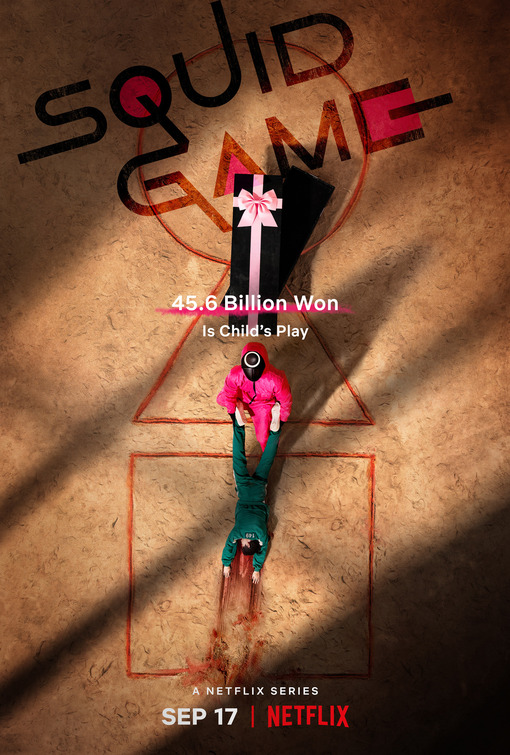
Squid Game Season 3 is the final chapter of Hwang Dong-hyuk's record-shattering South Korean survival drama, the series that became a global phenomenon on Netflix. Picking up immediately after the events of Season 2, it brings Lee Jung-jae's Seong Gi-hun back into the deadly arena for a concluding run of episodes that Hwang originally conceived as part of one larger story.
Reeling from the failed rebellion that closed the previous season, a hardened and grief-stricken Gi-hun re-enters the games determined to bring them down from the inside, while the masked Front Man (Lee Byung-hun) tightens his grip and welcomes the shadowy VIPs. Outside the island, detective Hwang Jun-ho (Wi Ha-joon) presses on with his desperate search as the surviving players are funneled through a final gauntlet of childhood games turned lethal. The season sharpens the show's central question: what people will sacrifice, and whether any decency can survive, inside a machine built on human desperation.
Season 3 launched to staggering numbers, drawing more than 60 million views in its first three days to become Netflix's biggest television premiere ever and topping the charts in dozens of countries. Critics praised its bleak ambition and emotional payoff even as its ending divided some fans. Streaming on Netflix.

It was good while it lasted. Launched with much fanfare and intense audience interest, "FlashForward" brilliantly recreated the mysterious, fascinating, are-they-prophetic? two minutes and seventeen seconds on October 6, 2009, when almost everyone on Earth lost consciousness of their ordinary surroundings and caught glimpses of their lives on April 29, 2010. An ambitious attempt at transposing Robert J. Sawyer's "high-concept" novel from the printed page to the small screen, "FlashForward" focused on the team of FBI investigators charged with determining what had happened. One of the FBI agents enjoyed the special privilege of seeing his team crack the case in his vision of the future; all he has to do is recreate the six months of investigative work that yield the break-through. Meanwhile, the principal characters attempt to cope with the consequences of their visions for their lives in the present, because they have seen broken marriages, lives lost, and great portrayals on their horizons. Most viewers and critics sadly agreed "FlashForward" unfortunately juxtaposed a brilliant high-tech crime drama on some pathetically ordinary people and lives.

In its first review of "Dexter TV show", the New York Times summarized, "[Dexter Morgan] kills people and cuts them up. But they deserve it. Besides, he's neat." When a serial killer leaves a trail of tidy corpses in service of justice, audiences cannot get enough; he liberates everybody's inner vigilante. Dexter, played pitch-perfect and spot-on by television veteran Michael C. Hall (late of "Six Feet Under"), is a smart and smart-mouthed, self-aware crime scene investigator who moonlights as a blood-thirsty avenger. Dexter is your average psychopath-next-door, comparable with Macbeth or Hannibal Lecter, but with charm and good jokes. As critics and viewers have stressed since the show's very first episode, Dexter kills only people who deserve to die"”depraved pedophiles, drunk drivers with neither conscience nor remorse, and other reprehensible characters who slip through the cracks in the justice system. The show's producers John Goldwyn and Sara Colleton assert, "Dexter becomes a metaphor for people closeted by their secrets." They exaggerate their character's allegorical powers"¦but only a little.

One of two intense medical dramas NBC introduced in the fall of 2009, "Mercy" had all the advantages its one-named rival "Trauma" did not. First, it had talent behind the scenes. Liz Heldens from "Friday Night Lights" created the show and led the writers, proving once again that the best way to dramatize the real world is to show it realistically"”ugliness and all. Second, it had attitude and guts to stay true to its revolutionary premise, the well-informed notion "that nurses remain [not only] more generous caregivers, but that they are more intuitively apt, smarter, more committed and as technically able as their [physician] superiors, with none of the accompanying arrogance." In a winner-take-all ER smackdown, you always would go all-in with the Mercy Hospital nurses. The main character, nurse Veronica Flanagan Callahan, has just returned from a tour in Iraq, where she clearly learned more in each day than the pompous, presumptuous doctors learned in all five years of medical school. Of course, Veronica gets neither the respect nor the reward she deserves, but "Mercy" dangles the possibility of true love as just recompense for Veronica's skill and compassion. Taylor Schilling plays Veronica with exactly the right balance of toughness and vulnerability, skillfully juxtaposing her consummate skill as a nurse with her intrepid ingenuousness in matters of the heart. If only "Mercy" had survived into a second season, all the tangled threads in the story might have come to their proper denouement. If only.

"Mad Men TV show" delivers its drama in the same slick and glossy packaging the Madison Avenue ad-men serve-up to their clients, making it just as stylized, trendy, and gotta-have-it cool as anything as a two-page spread for Chryslers and Chesterfields in the centerfold Life. Central character Don Draper, a pitch-man with a secret and sordid past, ruthlessly and relentlessly courts clients and seduces women, attempting to feed his insatiable ego. In other words, he personifies the archetype of the ad-man. Draper races full speed to stay one step ahead of changing times, cut-throat competitors, and revelation of his secrets: Born the son of a prostitute who died in childbirth, he stole a Korean war buddy's identity to put on a patina of respectability. Propriety and respectability figure prominently in the drama, which accurately represents steamy seductions and corner-office conniving hiding behind the Norman Rockwell wholesomeness of 1960s family values. Brilliantly written, beautifully photographed, and consummately well acted, "Mad Men TV show" has collected a boatload of awards, including three Golden Globes and back-to-back Emmys.

Call it one of television's most credible attempts at realistic fiction: Ryan Murphy, "Nip/Tuck's" producer, insists the medical conditions and procedures on which the episodes center "are 100% based on fact." Ironically, though, "Nip/Tuck's" representation of the surgeon's private lives may impress ordinary viewers as the program's most faithful representation of real life people and events. "Nip/Tuck" centers on Sean McNamara and Christian Troy, successful plastic surgeons, originally practicing their science and art in Miami, but conveniently relocated to Los Angeles at the end of "Nip/Tuck's" fourth season. Dr. McNamara, "the nice one," struggles to keep his family together as they weather trials and tribulations that come as the complications of success. Dr. Troy, "the naughty one," loves money and sex, and sometimes commits serious scalpel screw-ups. Never shy about taking-on controversial subjects, "Nip/Tuck" won critical acclaim, Golden Globe and Emmy awards for its treatment of domestic violence, promiscuity, recreational drug use, and the risk of addiction to cosmetic surgery. On March 3, 2010, "Nip/Tuck's" one hundredth episode, last in the series, became the most-watched scripted program in the history of the FX network.

America cannot get enough "True Blood." Derived from Charlaine Harris's series of novels, The Southern Vampire Mysteries, and produced by the same characters and company who brought you're the macabre comedy hit "Six Feet Under," this rough, raw, foul-mouthed, sexed-up and blood-sucking series has become America's summertime Sunday night guilty pleasure supreme. Meet the "True Blood" TV show! Set in fictional but aptly named Bon Temps, Louisiana, "True Blood" TV series makes vampire life look a great deal like a serious but not thoroughly detestable drug addiction. Once bitten, new recruits discover all kinds of voracious appetites,of which blood-thirst in fact may be the least. Although a host of undead characters work their insidious plots and attempt world conquest just for fun, the plot centers on Sookie Stackhouse (Anna Paquin), not a vampire but showing beguiling signs of being a fairy, who falls in love with Bill Compton (Stephen Moyer), definitely a vampire but reluctant about it. To the writers' and producers' credit, the series shows minimal gore and serves-up maximal suspense and irony. "True Blood" has collected an armload of awards, including Golden Globes and Emmys.

Using state-of-the-art technology and amazing skill with make-up and costuming, Chance, the main character, becomes literally a human target. In each episode of "Human Target," Chance assumes the identity and everyday life of a prominent person in danger. Describing himself as an "extreme bodyguard," Chance uses his wits, skills, and wise-cracking bravado to turn serious danger into a trap for the villains. The sinister evil-doers plot kidnapping, blackmail, extortion, and especially death; the "human target" plots capture. Not the kind of thing for which an ordinary guy usually would volunteer. "Human Target" TV show was praised by the critics and audiences for the quality of the acting"”especially the performances by Earl Haley, Jr., which make a somewhat implausible premise absolutely believable and compelling. Because "Human Target," a decidedly out-of-the-box crime drama, is loosely based on the DC comic series of the same name, the creators have no shortage of bad guys, nor do they struggle to find quirky characters for Chance to impersonate. Critics and audiences agree that the actors playing the three main characters go a long way toward redeeming the show's average, sometimes genuinely awkward writing. They wonder, though, will the actors be able to hold the viewers' attention and loyalty long enough for the writing to fulfill the promise in the premise?