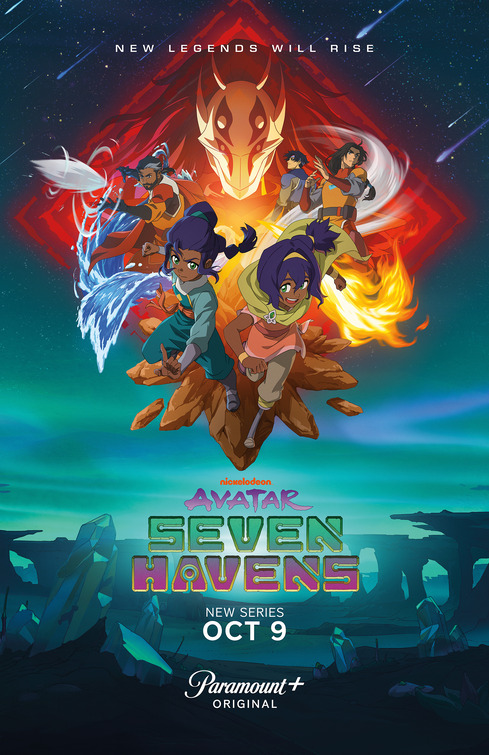
Avatar: Seven Havens is streaming globally on Paramount+. Episodes 1–3 premiered on October 9, 2026; episodes 4–6 follow October 16, episodes 7–9 on October 23, and episodes 10–13 on October 30. As of the October 11 check, the first three episodes are the released installments.
The animated series comes from Avatar: The Last Airbender creators Michael Dante DiMartino and Bryan Konietzko. In a world shattered by a cataclysm, a young Earthbender discovers that she is the Avatar after Korra, but people fear her as a possible destroyer rather than a savior. Hunted by human and spirit enemies, she joins her long-lost twin to uncover their origins and keep civilization's remaining Seven Havens from collapsing.

Either the CIA is just not that cool and relevant anymore, or Seth Macfarlane and associates are still mining the mother lode of 1970s humour as they develop episodes of "American Dad!" for Sunday nights on Fox. Television historians claim animated series have replaced sit-coms as television's principal source of informed social commentary; and "The Simpsons" have replaced "All in the Family" as the nation's premier satire, the weekly litmus test of American values and expectations. "American Dad!" shows little sign of aspiring to that lofty standing. Most episodes set the standard simply at "amusing." CIA agent and uber-patriot Stan Smith, the "American Dad!" anchors a predictably diverse, dysfunctional just-beyond-the-beltway family. Francine, his wife, appears to atone for her wild youth by remaining vacant, mostly boring in contemporary life. Hayley, Stan's college-aged radical daughter, naturally acts-out all the standard forms of late adolescent rebellion and family insurgency. And Steve, not surprisingly, enters puberty eager to live-up to Dad's expectations but congenitally incapable of coming even close. Holding its own in Fox's Sunday night animated line-up, "American Dad!" has improved in its several seasons on the air. Translation: "American Dad!" has evolved from "mediocre" to "not bad" as it has outgrown its abject dependence on cliches and stereotypes, freshened its subject matter and treatment, and drawn sharper edges on its characters. Still, the premises for "American Dad!" showed promise in 1973; in the new millennium, they seem a little tired.

The world knows and loves Matt Groening for his unprecedented and unparalleled work on "The Simpsons." During the Fox Network's ambitious "Animation Domination" initiative, Groening teamed with David Cohen, creating a second hit animated series, "Futurama." Groening and Cohen described their wonderwork as "retrofuturistic," an amazingly apt oxymoron for a working class sitcom set in the thirty-first century. Apparently, blue collar labor will not evolve over the next thousand years: In "Futurama," a late 20th century pizza delivery guy is accidentally cryogenically frozen for a millennium; when he thaws and returns to consciousness, he finds a job at Planet Express, an inter-planetary delivery company. Not especially concerned with science, the writers focus the stories on the workplace trials and tribulations of the three central characters"”Fry, Leela, and Bender. Their future dramas strangely resemble every working person's today dramas. Although "Futurama" has moved up and down the dial, exiting Fox for Cartoon Network, and bidding farewell to Cartoon Network for a new home on "Comedy Central," it has held onto a fiercely loyal audience, and it especially has garnered unprecedented critical acclaim. In 2010, "Futurama" set a Guiness World Record for "Current Most Critically-Acclaimed Animated Series", adding to its eight Emmys and thirteen Annies.

Drawn in retro-sixties comic book style, rendered irreverent and ironic by exceptionally good writing from "Simpsons" renegade Devin Clark, "Ugly Americans" TV show made its debut on Comedy Central during March, 2010. Matt Oberg lends his vocal stylings to the main character, Mark Lilly, harried social worker at the "Department of Integration," the all-purpose welfare agency for the citizens of a parallel-universe New York liberally populated with demons, zombies, wizards, monsters, and other chimerical creatures. Up-and-coming comedienne Natasha Leggero, one of Chelsea Handler's coterie, gives voice and life to Callie Maggotbone, Mark's immediate supervisor and sometimes lover. Callie claims distinction as the succubus daughter of the Devil and a human mother; not surprisingly, she is prone to extreme mood swings. Newcomer to the big-bad city, Mark, an intrepid optimist and wanna-be do-gooder, remains barbarously untutored in the ways of his city's multi-species immigrants, and his mistakes naturally multiply into comic misadventures. Hardly Saturday-morning kiddie fare, "Ugly Americans" deals as directly and explicitly with characters' bizarre sexual proclivities as with their sociopathy.

RIN: Daughters of Mnemosyne TV Show is a Japanese anime television series produced by Xebec and Genco, featuring grotesque and erotic visuals. The plot of RIN: Daughters of Mnemosyne TV Show is rich of the mix of murder and action, it is set in modern and near-future Tokyo, and revolves around Rin Asogi, an immortal female private investigator. In a series of lurid vignettes, Rin, an immortal private detective, struggles to unravel the secrets of her endless agony at the hands of Apos. He lurks in the shadows, eager to tear into Rin's lush body and devour the memories of her countless lives. Rin's no stranger to the realm of the dead, but her next visit could last forever.

SpongeBob SquarePants is Nickelodeon’s animated comedy about a relentlessly optimistic sea sponge who lives in a pineapple in Bikini Bottom. SpongeBob works as a fry cook at the Krusty Krab, practices for a boating license he never seems to earn, and turns ordinary errands into surreal adventures with his best friend Patrick Star. His enthusiasm regularly tests the patience of neighbor and co-worker Squidward Tentacles, while Sandy Cheeks, Mr. Krabs, Plankton and pet snail Gary give the undersea town its recurring comic relationships. Episodes are usually self-contained and mix slapstick, wordplay, music and visual absurdity, allowing viewers to begin almost anywhere. Creator Stephen Hillenburg drew on his background in marine science and animation to build a world that can entertain children while leaving room for jokes aimed at adults. Tom Kenny voices SpongeBob. This page covers the original television series, not its films, Kamp Koral or The Patrick Star Show.
Where to watch (checked October 7, 2026): Paramount+ lists seasons 1–15 with an explicit regional-availability notice, while Nickelodeon remains the home of new episodes. Streaming catalogs can receive later seasons on a different timetable from their broadcast, so check the local Paramount+ and Nickelodeon listings.
Official sources: Paramount+ series page; Paramount Global production record.

A spin-off from Fox's monster hit "Family Guy," "The Cleveland Show" easily could inspire serious questions about whether or not three middle-aged white men ought to attempt writing comedy about African-Americans. Somehow, though, Seth MacFarlane, Mike Henry, and Richard Appel have attracted a devoted multi-racial, multi-cultural audience for Cleveland and his family by making their points gently and with genuine humor. Consistent with his approach to "Family Guy," MacFarlane reserves most of his animus for middle-aged white suburban guys a lot like himself. Cleveland and his family have moved back to his home town, Stoolbend, Virginia, where he lives with Junior, his high school crush, and her two children. The majority of Cleveland's funniest lines derive more from his cluelessness than his color, and the majority of the ethnic humor derives from the creators' brilliant satire of racial attitudes among unenlightened southern white people. Among MacFarlane's only-slightly-exaggerated redneck characters, Lester does the majority of the comic work, languishing on his Confederate flag folding chair and cleaning his beloved guns. In general, the racial humor remains tame if not always politically correct, and "The Cleveland Show" gets the vast majority of its big laughs from allusions to pop culture.

The Simpsons is an American animated comedy created by Matt Groening and developed with James L. Brooks and Sam Simon. Since its half-hour premiere in 1989, the series has followed Homer and Marge Simpson and their children Bart, Lisa and Maggie in the deliberately flexible town of Springfield. Family arguments, school trouble, workplace mishaps and civic scandals become vehicles for satire about television, politics, consumer culture and everyday American life. Episodes generally stand alone, making the show easy to enter at almost any season, while recurring neighbors, teachers, co-workers and local institutions give Springfield a dense shared history. The tone moves from broad slapstick to character-driven stories and anthology installments such as Treehouse of Horror.
Where to watch (checked October 7, 2026): Disney+ lists seasons 1–36 and exclusive episodes in supported regions, while current FOX episodes and Hulu access vary by country and subscription. Because the series remains in production, check local listings for the newest season and catalog depth.
Official source: Disney+.