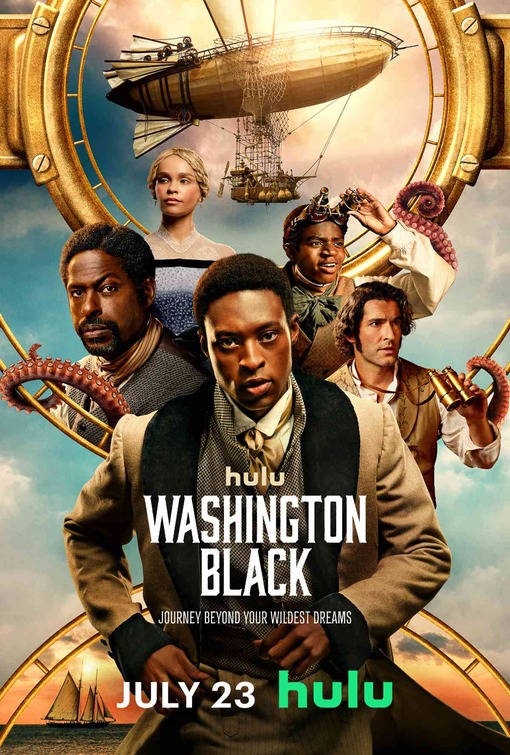
Washington Black is a sweeping Hulu limited series adapted from Esi Edugyan's acclaimed 2018 novel, a coming-of-age adventure that carries its hero from bondage to the far corners of the globe. Ernest Kingsley Jr. stars as the adult George Washington “Wash” Black, a boy born into slavery on a Barbados sugar plantation whose prodigious scientific gifts are recognized by an eccentric abolitionist inventor. When a death forces him to flee, Wash embarks on an odyssey across oceans and continents that transforms him from fugitive to scientist, artist, and explorer.
Sterling K. Brown, who also executive produces, plays Medwin Harris, a charismatic community leader in Halifax whose role is expanded from the novel, while Eddie Karanja plays the younger Wash and Tom Ellis, Iola Evans, and Sharon Duncan-Brewster fill out the cast. Told across dual timelines and multiple continents, the series pairs the propulsive momentum of a nineteenth-century adventure yarn with a thoughtful meditation on freedom, identity, and who gets to author their own story.
Adapting a novel that won Canada's Giller Prize and was shortlisted for the Booker, the series reaches for the grandeur of classic adventure storytelling while centering a Black hero's journey toward self-invention. Lavishly mounted and spanning locations from the Caribbean to the Arctic, Washington Black streams on Hulu.
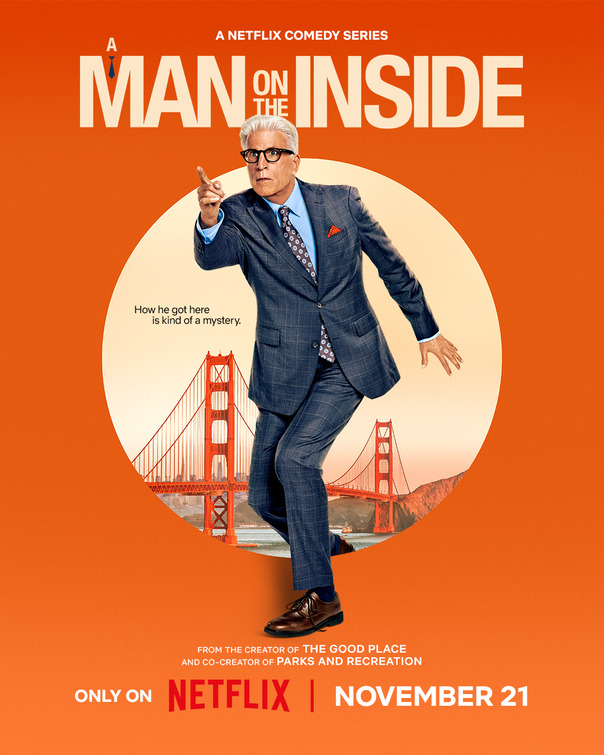
When a recently widowed retired professor named Charles is struggling to find purpose after his wife’s death, his daughter hires him to go undercover at a San Francisco retirement home to investigate a theft from another resident. What begins as a reluctant mission gradually becomes a genuine awakening as Charles discovers unexpected friendships, buried community, and a reason to keep living.
Created by Mike Schur and starring Ted Danson, A Man on the Inside is one of the warmest and most quietly radical comedies of recent years. It treats its senior characters with rare specificity and dignity — they are not punchlines, not props for younger characters’ growth, but complete people with complicated histories, genuine ambitions, and the same capacity for connection and reinvention as anyone else.
The show arrives as a comedy of remarkable gentleness: funny without cruelty, moving without sentimentality, and anchored by Ted Danson’s finest television performance since Cheers — a man discovering that it is never too late to become part of something again.
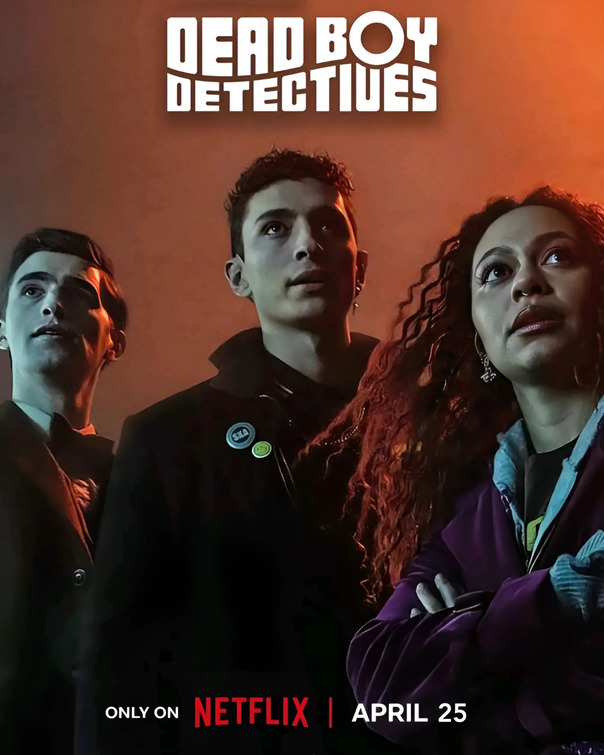
Two teenage boys who died decades apart — Edwin Payne in 1916 and Charles Rowland in 1989 — have refused to cross over to the afterlife and instead set up a supernatural detective agency. Together with a psychic girl named Crystal Palace who can see the dead, they investigate strange cases involving witches, demons, and other creatures lurking in the hidden corners of the world.
Spun off from Neil Gaiman’s Sandman universe and developed for Netflix by Steve Yockey, Dead Boy Detectives is a series of enormous warmth and wit that wears its gothic influences lightly. Where many supernatural shows default to dread, this one chooses joy — finding genuine delight in its premise and investing deeply in the friendship at its core.
The show earned passionate fan attention for its production design, its sharp comic writing, and above all the chemistry between George Rexstrew and Jayden Revri as Edwin and Charles — a duo whose bickering, loyal relationship became the emotional engine of every episode.
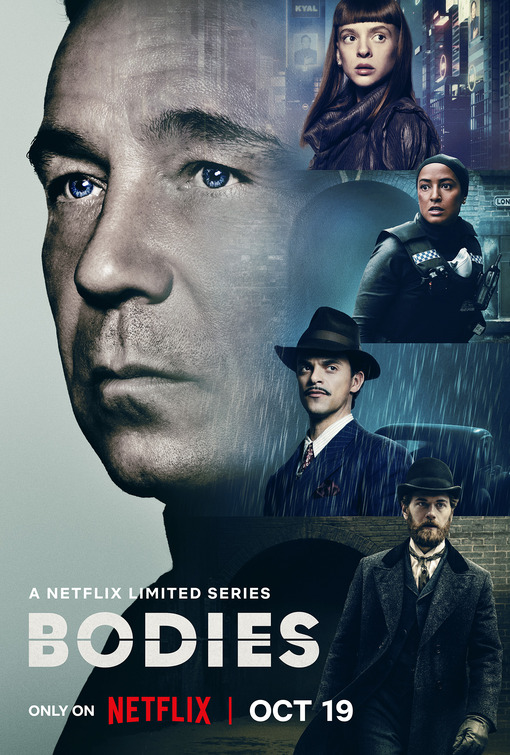
When the same unidentified corpse is discovered in the same alley in London across four different time periods — 1890, 1941, 2023, and 2053 — four detectives living a century apart find themselves drawn into a single, impossible mystery. As each investigator peels back the layers of their individual cases, the terrifying truth of what connects the four eras begins to emerge.
Based on Si Spencer’s acclaimed graphic novel and adapted by Paul Tomalin, Bodies is a fiercely inventive genre puzzle that trusts its audience to hold four timelines simultaneously in mind. Each era has its own visual language and social texture — gas-lit Victorian London, Blitz-era wartime, contemporary multiculturalism, authoritarian near-future — yet the central mystery pulls all four threads toward a single devastating knot.
The show became a quiet Netflix sensation on its arrival in late 2023, celebrated for its exceptional production design, its refusal to condescend to viewers, and a quartet of lead performances — Jacob Fortune-Lloyd, Kyle Soller, Shira Haas, and Amaka Okafor — that anchor the complexity with genuine human urgency.
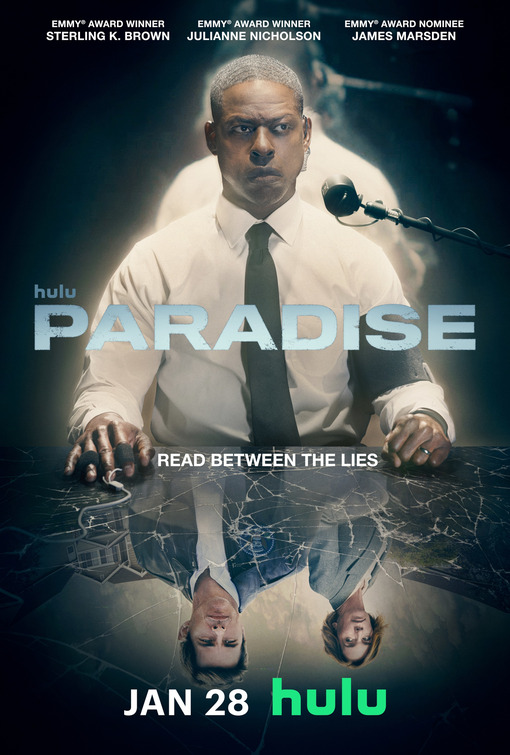
Paradise is Hulu's gripping mystery thriller from Dan Fogelman, the creator of This Is Us, starring Sterling K. Brown as Xavier Collins — the head of security for a former United States president living in a meticulously constructed underground community called Paradise, a hidden refuge built to protect the country's most powerful people in the event of catastrophe. When the former president is found dead in what appears to be a suicide, Xavier refuses to accept the official conclusion and begins an investigation that will force him to question everything he thought he knew about Paradise, its residents, and his own past.
Fogelman applies the emotional architecture of This Is Us to a tightly wound genre thriller, using fractured timeline storytelling and carefully withheld information to keep the audience perpetually off-balance. What distinguishes Paradise from conventional conspiracy thriller fare is its investment in character and grief: Xavier's investigation is inseparable from his mourning, and the secrets of the underground world he's been protecting turn out to be inseparable from the secrets he's been keeping from himself. Sterling K. Brown carries the show with the same combination of magnetic intensity and open vulnerability he brought to This Is Us, and James Marsden delivers a career-best performance as the former president whose death sets everything in motion.
Paradise arrived on Hulu as one of the most talked-about new series of early 2025, praised for the confidence of its direction, the quality of its ensemble — which also includes Julianne Nicholson, Jon Beavers, and Sarah Shahi — and for Fogelman's ability to make audiences feel the emotional weight of plot mechanics that in lesser hands would feel purely mechanical. Available to stream on Hulu.
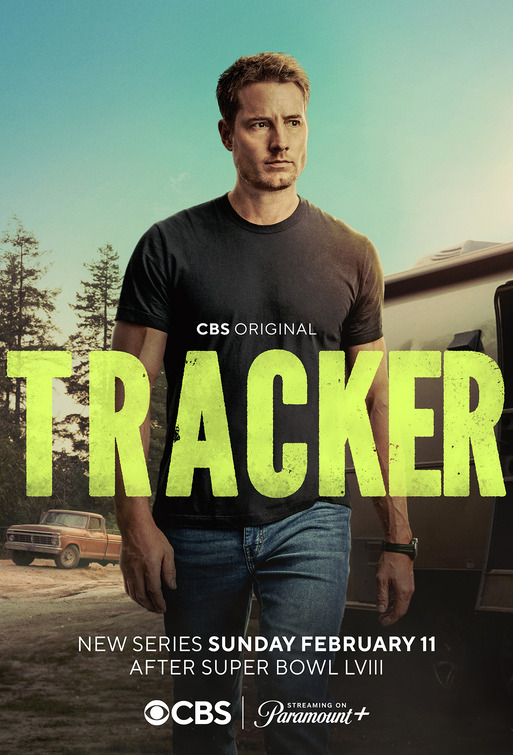
Tracker is CBS's hit procedural drama starring Justin Hartley as Colter Shaw, a lone-wolf survivalist and expert tracker who travels the country in his Airstream trailer taking rewards for finding missing persons and solving cases that local law enforcement has been unable to crack. Based on Jeffery Deaver's novel The Never Game, the show blends the classic American road narrative with a character-driven procedural format, using each episode's new location and new case to reveal something about Colter's complicated past — a family shaped by a brilliant, paranoid father and a childhood spent learning to survive in the wilderness, skills that have made him extraordinarily capable and deeply reluctant to form lasting attachments.
Justin Hartley, best known to audiences from This Is Us, brings a relaxed physical confidence to Colter that makes the character's near-superhuman competence feel earned rather than fantastical. Hartley's charm is crucial — Tracker asks its lead to carry most episodes almost alone through its first half, navigating new communities and new crises with limited backup — and he delivers consistently, finding the humor and the sadness in a man who has built a life out of movement precisely because stillness frightens him.
Tracker became one of the highest-rated new dramas of the 2023-24 television season, proving that CBS audiences still respond enthusiastically to well-executed standalone procedural storytelling built around a compelling central character. The show's success reflects a genuine craft in its writing and production: each episode is a complete story, but the serialized backstory of Colter's family accumulates across the season to deliver something more emotionally substantial than the format typically promises. Available on Paramount+ with live TV or as catch-up streaming.
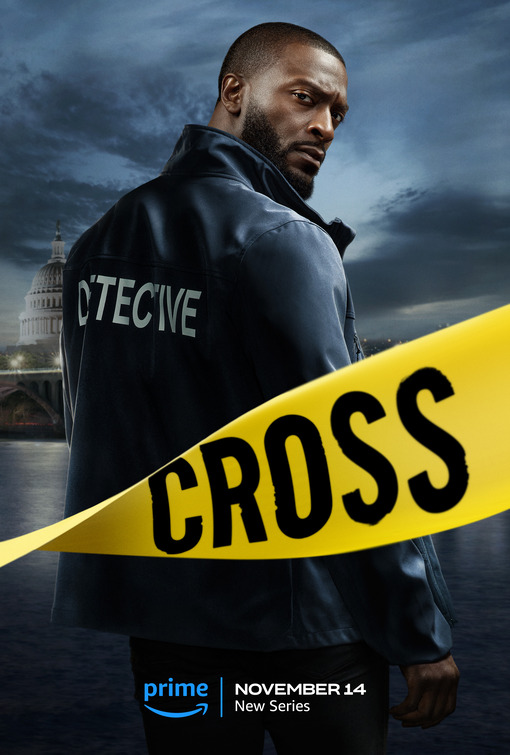
Cross is Amazon Prime Video's long-awaited live-action adaptation of James Patterson's beloved detective franchise, starring Aldis Hodge as Dr. Alex Cross — the Washington D.C. forensic psychologist and former FBI agent whose ability to get inside criminal minds has made him one of the most enduring figures in American crime fiction. The series adaptation follows Cross as he is pulled back into active investigation after a series of murders appear connected to a case that cost him something deeply personal, working alongside his grandmother Nana Mama (Juanita Jennings) and his partner John Sampson (Isaiah Mustafa) while navigating the political pressures of D.C. law enforcement and his own complicated relationship with violence and justice.
Aldis Hodge brings an intelligence and physicality to Cross that previous film adaptations — most memorably Morgan Freeman's three-film run in the role — captured differently but less urgently. Hodge's Cross is younger, angrier, more physically dangerous, and more emotionally raw, a man whose professional gifts are inseparable from the trauma that produced them. The show's D.C. setting is rendered with atmospheric density — the neighborhoods, the political machinery, the layered hierarchies of race and class and institutional power that shape every investigation — giving the procedural elements a grounded social texture.
Cross arrives as one of Prime Video's most commercially ambitious genre series, drawing on Patterson's most famous character and an established readership of millions. The first season establishes the show's tonal range — from intimate psychological thriller to large-scale action set pieces — and positions Hodge as a leading man capable of carrying a franchise. Available exclusively on Prime Video.
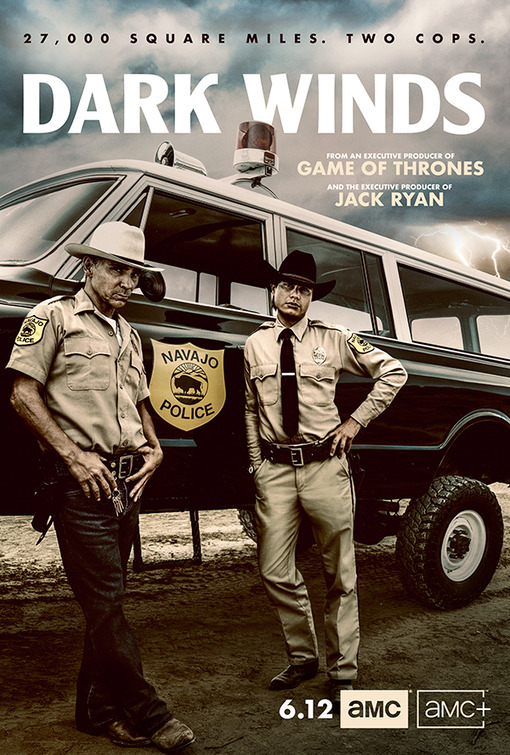
Dark Winds is one of the finest crime dramas of the streaming era — an AMC production that takes the form of a classic procedural and transforms it through the specificity of its setting, the depth of its character work, and the seriousness with which it engages with Navajo history, culture, and sovereignty. Based on Tony Hillerman's beloved Leaphorn and Chee mystery novels, the show is set in the early 1970s on the Navajo Nation reservation in New Mexico and Arizona, and follows Tribal Police Lieutenant Joe Leaphorn (Zahn McClarnon) and his new deputy Jim Chee (Kiowa Gordon) as they investigate a series of crimes that draw them into a web of violence, buried secrets, and confrontations with forces that see the reservation and its people as obstacles rather than sovereign citizens.
What distinguishes Dark Winds from a conventional procedural is its relationship to place and community. The Navajo Nation is not a backdrop — it is the protagonist in its own right, and the show is shaped by the perspectives, protocols, and values of the community it depicts. The writing room included Native American writers throughout, and the production sought extensive consultation with Navajo cultural authorities. Zahn McClarnon's Leaphorn is one of the finest characters in contemporary television drama: a man shaped by profound loss, driven by a fierce sense of justice, and navigating the impossible space between the sovereign Navajo legal system and the encroaching power of the federal government.
Dark Winds has built an intensely loyal audience precisely because it trusts its viewers to be interested in something genuinely different — a Native American-centered story that refuses to simplify its world for outside consumption. It has been renewed for multiple seasons, each adding complexity and ambition to what has become one of the most distinctive crime series on American television, available on AMC and AMC+.
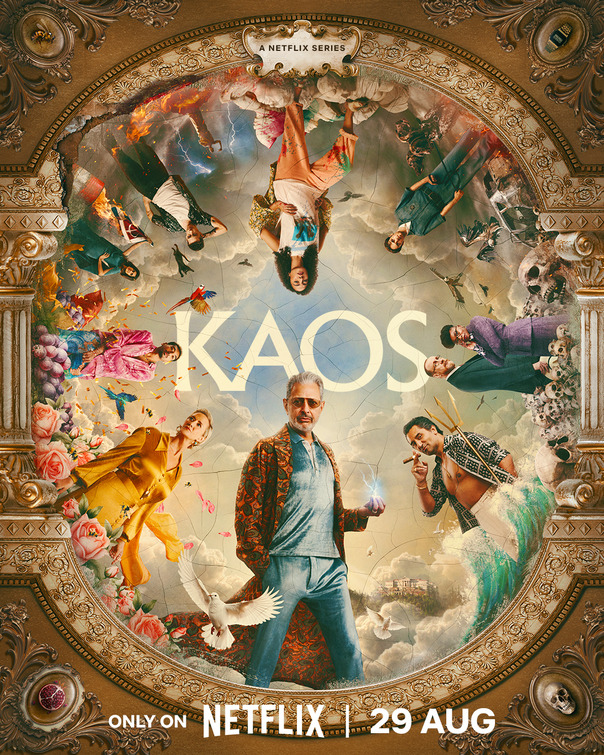
Kaos is Netflix's wildly inventive British fantasy series that reimagines Greek mythology as a contemporary dark comedy, set in a world where the Olympian gods are real, neurotic, and deeply invested in maintaining their dominance over a modern Mediterranean society that closely resembles our own. At the center of it all is Zeus (Jeff Goldblum), an aging, narcissistic god increasingly consumed by a paranoid obsession with a wrinkle on his forehead — which, according to prophecy, signals the beginning of his end. The show cuts between three storylines — Olympus, the mortal world, and the Underworld — weaving together a rich ensemble of characters, both divine and human, who are all entangled in the approaching crisis.
Created by Charlie Covell, Kaos is formally daring in the way it treats its mythological source material as a living, mutable text rather than a fixed canon. Characters from different myths coexist and interact in ways that generate both comedy and tragedy; the show refuses to foreground the gods as its moral center and instead roots its sympathies firmly with the mortals — particularly a young woman named Riddy (Aurora Perrineau) and her entanglement with the Prometheus storyline — who are suffering the consequences of divine whim and institutional neglect.
Jeff Goldblum's performance as Zeus is a tour de force of comic vanity and menace, perfectly calibrated to the tone Covell is after: funny enough to make the satire land, but genuinely threatening enough that the stakes feel real. The show is lush, strange, and strikingly original, one of the more adventurous pieces of genre television produced in recent years, and it suggests a new direction for mythology on screen — not as epic adventure but as a vehicle for political and social satire of the first order.
Foundation is Apple TV+'s epic adaptation of Isaac Asimov's landmark science fiction saga, one of the most ambitious productions in the history of streaming television. Based on the novels Asimov wrote between 1942 and 1993, the show follows mathematician and psychohistorian Hari Seldon (Jared Harris), who uses the science of statistical prediction to foresee the inevitable collapse of the Galactic Empire — a civilization spanning millions of worlds — and sets in motion a centuries-long plan to preserve human knowledge through the dark ages to come. The series spans thousands of years of galactic history, following multiple generations of characters connected by Seldon's grand design.
What distinguishes Foundation from previous Asimov adaptations is its willingness to translate the books' ideas into genuine dramatic spectacle. Showrunner David S. Goyer and his team have constructed a visual world of staggering scale — the planet Trantor with its gleaming metallic sky, the desert world of Terminus where the Foundation takes root — while also finding the human stakes within Asimov's vast and often abstract narrative architecture. The casting is extraordinary throughout, with Jared Harris bringing enormous intellectual gravity to Hari Seldon and Lee Pace achieving something genuinely menacing and complex as the Cleon dynasty of clone emperors.
Foundation rewards patient viewers with one of the grandest narratives in science fiction television, a story about civilization, entropy, knowledge, and the long arc of history that feels urgently relevant to the present moment. By its second season, it had developed into one of the most visually and narratively confident science fiction series on any platform, and stands as a testament to what prestige television production can achieve when paired with source material of genuine intellectual ambition.
.jpeg)
Eric is a gripping and emotionally devastating six-part limited series from Netflix, starring Benedict Cumberbatch as Vincent Anderson, a volatile and brilliant puppeteer whose nine-year-old son Edgar goes missing in 1980s New York City. As the police investigation unfolds — led by the detective played by McKinley Belcher III — Vincent's already-fragile grip on reality begins to disintegrate, and he becomes convinced that his salvation lies in bringing to life a giant, shaggy monster puppet he calls Eric, a character Edgar had sketched as a friend he desperately wanted to see on television.
Created by Abi Morgan, the series weaves together several distinct narrative strands: the immediate thriller of the missing child; the portrait of a marriage under extreme strain; an exploration of the policing of New York's underground communities of homeless people and gay men during the AIDS crisis; and a surrealist interior drama as Vincent's psyche begins to fragment and Eric himself becomes an on-screen presence visible only to Vincent. Cumberbatch's performance is extraordinary — physically committed, emotionally raw, and willing to be profoundly unsympathetic without ever losing the audience's complicated investment.
Eric is a series that trusts its audience to hold complexity — to see how one person's unraveling connects to larger social failures, how grief and guilt can warp a mind beyond recognition, and how a city's most vulnerable people are too often erased by the systems meant to protect them. It is haunting, beautifully shot, and driven by performances of the highest order. For viewers willing to embrace its demanding emotional register, it stands as one of the finest limited series of 2024.