The Eternaut is Netflix's first Argentine original series and one of the most ambitious science-fiction productions ever mounted in Latin America. Directed by Bruno Stagnaro, it adapts El Eternauta, the legendary 1957 graphic novel by writer Hector German Oesterheld and artist Francisco Solano Lopez that holds near-mythic status in Argentina.
Ricardo Darin, the country's most celebrated actor, stars as Juan Salvo, an ordinary man thrust into an extraordinary nightmare when a silent, deadly snow begins falling over Buenos Aires, killing instantly anyone it touches and knocking out power across the city. As Salvo and a small band of survivors improvise makeshift protection and venture into the frozen streets, they realize the snow is only the opening move of a vast and terrifying alien invasion.
Released in 2025, the series became a global phenomenon and one of Netflix's most-watched non-English titles, praised for its craft, its scale, and the way it grounds cosmic horror in ordinary human solidarity. Its resonance is deepened by the history of its source material and its author, and a second season has been confirmed. It is streaming on Netflix.
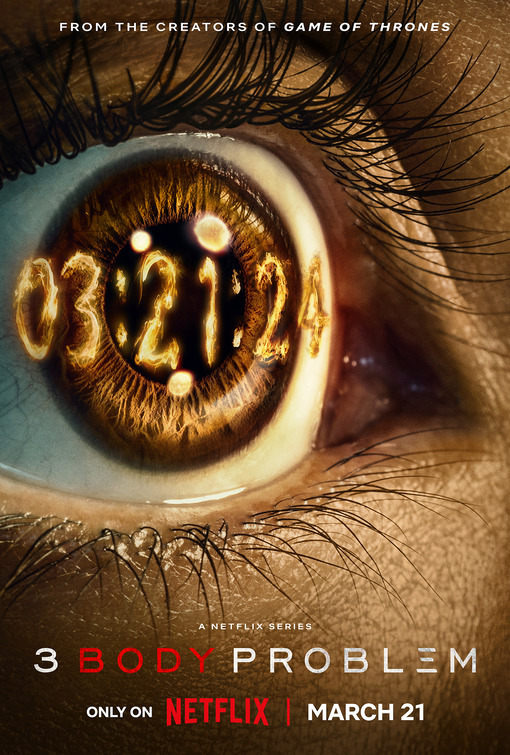
3 Body Problem is a 2024 science fiction drama series created by David Benioff, D.B. Weiss, and Alexander Woo for Netflix, adapting the first novel in Liu Cixin's celebrated Remembrance of Earth's Past trilogy — one of the most acclaimed works in contemporary science fiction. The series makes a significant structural departure from the source material, expanding the story's scope beyond its original Beijing setting to follow a group of scientists in Oxford and London while retaining the novel's central premise: that humanity has unknowingly made contact with an alien civilization, and the consequences will determine the species' fate.
The ensemble cast includes Jess Hong as Jin Cheng, John Bradley as Jack Rooney, Liam Cunningham as Thomas Wade, Eiza González as Auggie Salazar, and Benedict Wong in a central investigative role. The series opens in Cultural Revolution-era China with Ye Wenjie (Zine Tseng), whose traumatic experience of political violence leads her to make a decision with civilization-altering consequences. The interweaving of personal grief and scientific discovery with cosmic-scale stakes gives the series its emotional texture, grounding an otherwise vast narrative in recognizable human experience.
3 Body Problem was Netflix's most ambitious international genre series of 2024, praised for the scope of its production design and the ambition of its storytelling — particularly its willingness to engage with the novel's most challenging conceptual puzzles about physics, probability, and civilization. The VR sequences depicting the three-body simulation became some of the most discussed visual sequences on streaming that year. The series has been renewed for a second season. It streams exclusively on Netflix.
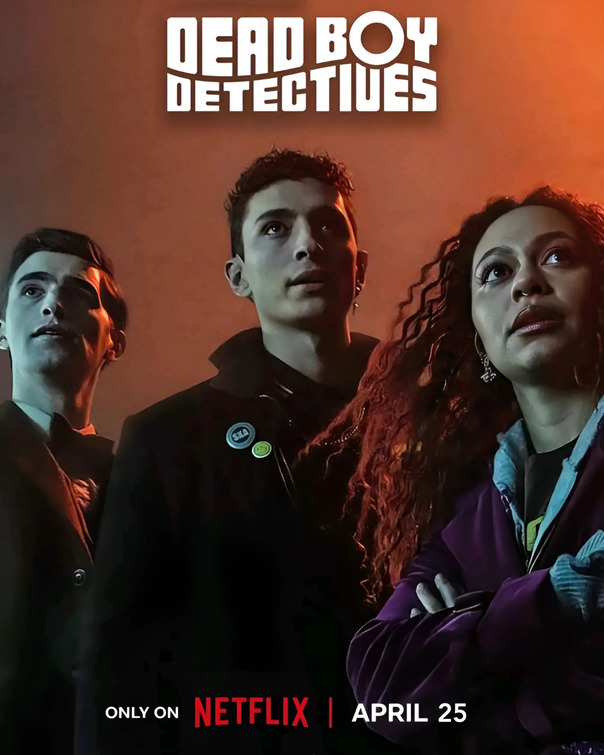
Two teenage boys who died decades apart — Edwin Payne in 1916 and Charles Rowland in 1989 — have refused to cross over to the afterlife and instead set up a supernatural detective agency. Together with a psychic girl named Crystal Palace who can see the dead, they investigate strange cases involving witches, demons, and other creatures lurking in the hidden corners of the world.
Spun off from Neil Gaiman’s Sandman universe and developed for Netflix by Steve Yockey, Dead Boy Detectives is a series of enormous warmth and wit that wears its gothic influences lightly. Where many supernatural shows default to dread, this one chooses joy — finding genuine delight in its premise and investing deeply in the friendship at its core.
The show earned passionate fan attention for its production design, its sharp comic writing, and above all the chemistry between George Rexstrew and Jayden Revri as Edwin and Charles — a duo whose bickering, loyal relationship became the emotional engine of every episode.
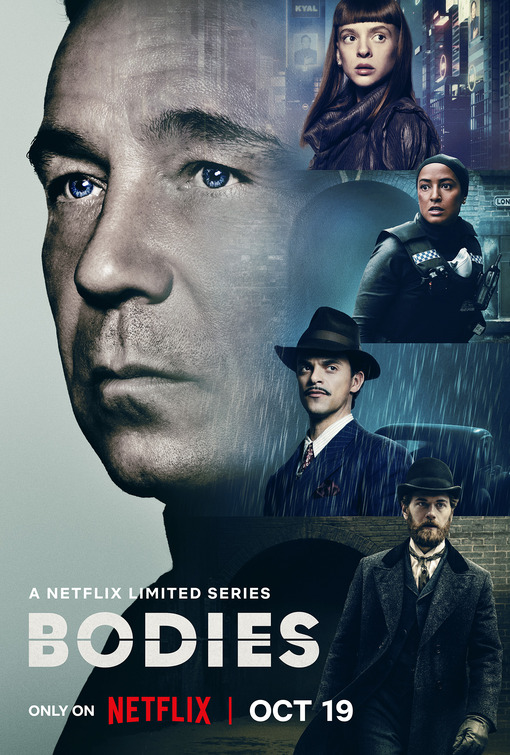
When the same unidentified corpse is discovered in the same alley in London across four different time periods — 1890, 1941, 2023, and 2053 — four detectives living a century apart find themselves drawn into a single, impossible mystery. As each investigator peels back the layers of their individual cases, the terrifying truth of what connects the four eras begins to emerge.
Based on Si Spencer’s acclaimed graphic novel and adapted by Paul Tomalin, Bodies is a fiercely inventive genre puzzle that trusts its audience to hold four timelines simultaneously in mind. Each era has its own visual language and social texture — gas-lit Victorian London, Blitz-era wartime, contemporary multiculturalism, authoritarian near-future — yet the central mystery pulls all four threads toward a single devastating knot.
The show became a quiet Netflix sensation on its arrival in late 2023, celebrated for its exceptional production design, its refusal to condescend to viewers, and a quartet of lead performances — Jacob Fortune-Lloyd, Kyle Soller, Shira Haas, and Amaka Okafor — that anchor the complexity with genuine human urgency.
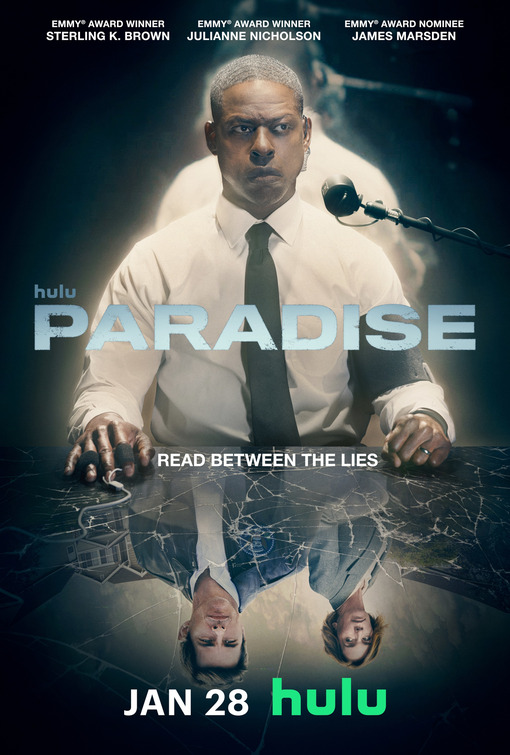
Paradise is Hulu's gripping mystery thriller from Dan Fogelman, the creator of This Is Us, starring Sterling K. Brown as Xavier Collins — the head of security for a former United States president living in a meticulously constructed underground community called Paradise, a hidden refuge built to protect the country's most powerful people in the event of catastrophe. When the former president is found dead in what appears to be a suicide, Xavier refuses to accept the official conclusion and begins an investigation that will force him to question everything he thought he knew about Paradise, its residents, and his own past.
Fogelman applies the emotional architecture of This Is Us to a tightly wound genre thriller, using fractured timeline storytelling and carefully withheld information to keep the audience perpetually off-balance. What distinguishes Paradise from conventional conspiracy thriller fare is its investment in character and grief: Xavier's investigation is inseparable from his mourning, and the secrets of the underground world he's been protecting turn out to be inseparable from the secrets he's been keeping from himself. Sterling K. Brown carries the show with the same combination of magnetic intensity and open vulnerability he brought to This Is Us, and James Marsden delivers a career-best performance as the former president whose death sets everything in motion.
Paradise arrived on Hulu as one of the most talked-about new series of early 2025, praised for the confidence of its direction, the quality of its ensemble — which also includes Julianne Nicholson, Jon Beavers, and Sarah Shahi — and for Fogelman's ability to make audiences feel the emotional weight of plot mechanics that in lesser hands would feel purely mechanical. Available to stream on Hulu.
Foundation is Apple TV+'s epic adaptation of Isaac Asimov's landmark science fiction saga, one of the most ambitious productions in the history of streaming television. Based on the novels Asimov wrote between 1942 and 1993, the show follows mathematician and psychohistorian Hari Seldon (Jared Harris), who uses the science of statistical prediction to foresee the inevitable collapse of the Galactic Empire — a civilization spanning millions of worlds — and sets in motion a centuries-long plan to preserve human knowledge through the dark ages to come. The series spans thousands of years of galactic history, following multiple generations of characters connected by Seldon's grand design.
What distinguishes Foundation from previous Asimov adaptations is its willingness to translate the books' ideas into genuine dramatic spectacle. Showrunner David S. Goyer and his team have constructed a visual world of staggering scale — the planet Trantor with its gleaming metallic sky, the desert world of Terminus where the Foundation takes root — while also finding the human stakes within Asimov's vast and often abstract narrative architecture. The casting is extraordinary throughout, with Jared Harris bringing enormous intellectual gravity to Hari Seldon and Lee Pace achieving something genuinely menacing and complex as the Cleon dynasty of clone emperors.
Foundation rewards patient viewers with one of the grandest narratives in science fiction television, a story about civilization, entropy, knowledge, and the long arc of history that feels urgently relevant to the present moment. By its second season, it had developed into one of the most visually and narratively confident science fiction series on any platform, and stands as a testament to what prestige television production can achieve when paired with source material of genuine intellectual ambition.
.jpeg)
Dune: Prophecy is a sweeping science fiction prequel series set approximately 10,000 years before the events of Frank Herbert's Dune novels and Denis Villeneuve's acclaimed film adaptations. Developed for Max, the series traces the origins of the Bene Gesserit — the mysterious and powerful sisterhood who have guided humanity's genetic and political destiny across millennia — focusing on the Harkonnen sisters Valya and Tula as they lay the foundations of an order that will eventually produce characters like Lady Jessica and the Reverend Mother Mohiam. Emily Watson and Travis Fimmel lead an exceptional cast.
The series is based on the novel Sisterhood of Dune (2012) by Brian Herbert and Kevin J. Anderson, itself drawing on notes Frank Herbert left for a proposed prequel series. Dune: Prophecy expands the universe in ways that will delight dedicated fans while also functioning as an accessible entry point for viewers who want to understand the deeper mythology underlying the films. The production design is extraordinary, depicting a universe that is recognizably the world of Dune — feudal politics, the spice, religious fanaticism — but in an earlier, rawer state.
Dune: Prophecy is a thoughtful and ambitious series that takes seriously both the philosophical richness of Herbert's original vision and the demands of prestige television storytelling. It explores questions of power, prophecy, and the ethics of manipulating human destiny across generations — questions that feel acutely resonant today. For fans of epic, ideas-driven science fiction, it represents one of the most ambitious world-building exercises in recent television history.
Agatha All Along picks up after the events of WandaVision, finding the witch Agatha Harkness stripped of her powers and trapped in a false memory by Wanda Maximoff. When a mysterious teen known only as Teen frees her from the illusion, Agatha finds herself leading a coven of desperate witches through the legendary Witches' Road — a dangerous enchanted path said to restore lost powers to those who survive its trials. Each step of the Road presents a different supernatural challenge, testing the witches' resolve and forcing Agatha to reckon with her own complicated history.
Kathryn Hahn delivers a career-defining performance as Agatha, fully inhabiting a character who is simultaneously monstrous, brilliant, and unexpectedly moving. The series leans into her comedic timing while never allowing the audience to forget the genuine menace that makes Agatha such a compelling antihero. Joe Locke is a revelation as Teen, bringing quiet intensity and emotional complexity to a character whose true identity slowly becomes one of the season's most compelling mysteries, while Patti LuPone, Joe Morton, and Debra Jo Rupp round out the coven with memorable supporting turns.
Showrunner Jac Schaeffer, who also created WandaVision, crafts a season that works both as standalone horror-tinged fantasy and as a meaningful continuation of the MCU's magical mythology. The production design is visually arresting, with each trial on the Witches' Road offering a distinct aesthetic world ranging from 1970s suburbia to gothic medieval architecture. Agatha All Along is proof that the MCU can tell smaller, stranger stories with genuine artistic ambition, and it remains one of Disney+'s most acclaimed Marvel offerings.